EXCLUSIVE: How liturgical changes in the Charlotte diocese have affected my family
When we joined our current parish in 2010, there was no Extraordinary Form Mass. We were drawn to Our Lady of Grace in Greensboro for various reasons, notably the community and the church's personality, but I must say the architecture was one of the most compelling factors.
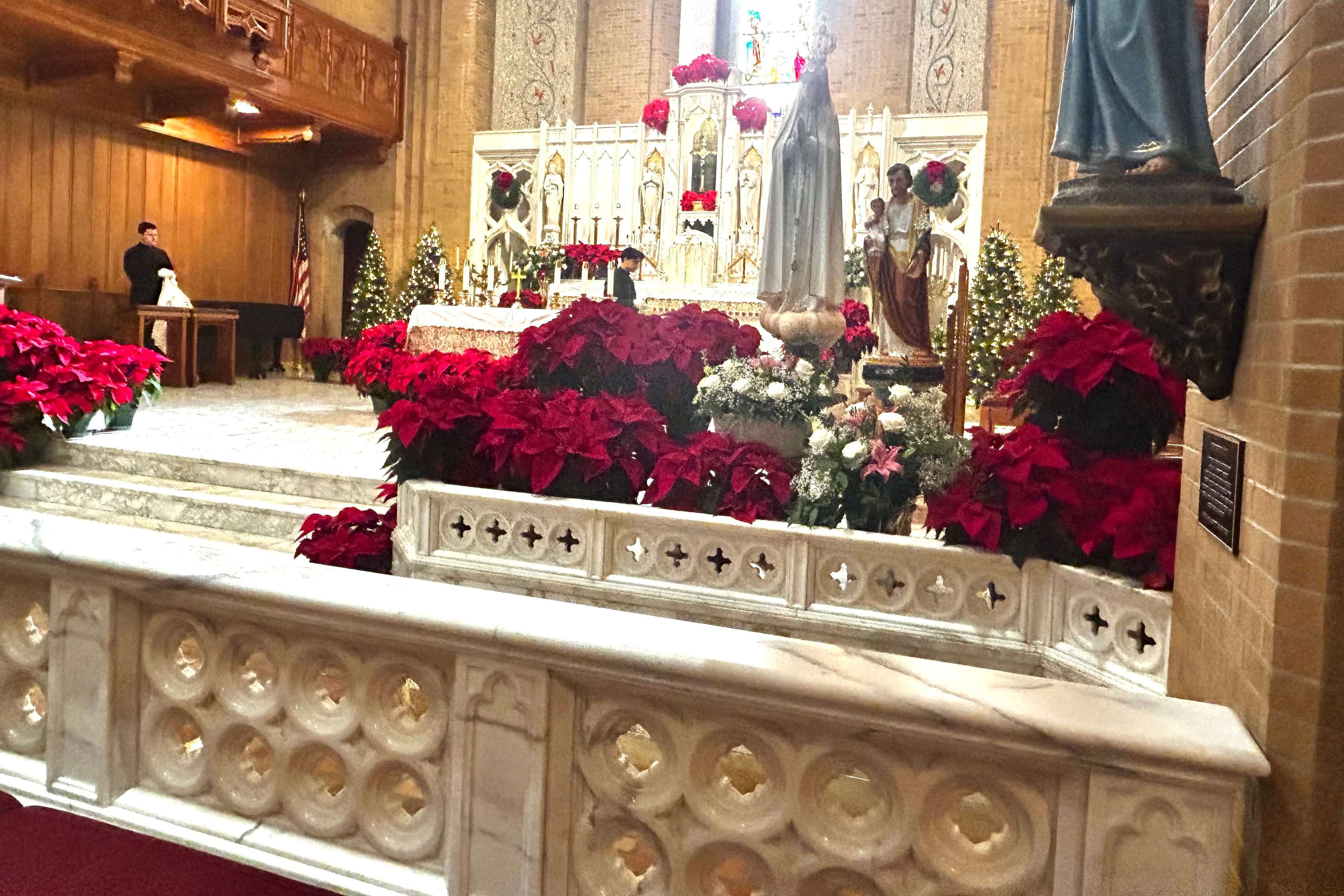
When we joined our current parish in 2010, there was no Traditional Latin Mass (TLM) in the Extraordinary Form. We were drawn to Our Lady of Grace in Greensboro for various reasons, notably the community and the church's personality, but I must say the architecture was one of the most compelling factors. The Mass is the heaven on earth I’d read about in The Lamb’s Supper by Scott Hahn, and this church, with its architecture, stained-glass windows, marble sanctuary, high altar, candles, statues of angels and saints, and altar rails (which were unused at the time) greatly enhanced my experience of the Mass. It’s one of those churches where visitors can easily get lost in the beauty of the stained-glass windows.
Then we discovered the Latin Mass as it was first introduced to our parish in 2012, and with it came an introduction to older holy days. I found a new sense of the sacred in all aspects of life. I began abstaining and fasting on Fridays, not because I believed myself better for it, but because I found a particular tradition attractive and beneficial and, quite honestly, because it was easier than forgetting we are still called to offer up something on Fridays and then trying to figure out what that something will be. But discovering these older traditions and incorporating them into our lives gives us the sense that God isn't simply relegated to Sundays. In the old calendar, they are still celebrating Christmas; in the new, we are in ordinary time.
There is an implied assumption behind the assertion that recent liturgical changes are intended to promote unity. This assumption suggests that, prior to Bishop Michael Martin’s leadership, our diocese was fragmented and that the TLM contributed to this division. However, the Charlotte diocese and seminary is a thriving community.
From my personal experience at Our Lady of Grace, I can attest that my children, both past and present students of OLG School, are actively engaged in church and parish life. They have formed strong friendships, frequently gathering with peers and participating in our youth group. We have built close relationships with numerous families from the parish, often camping together at least twice a year, and making an annual trip together to the Appaloosa Music Festival in Front Royal, Virginia. Additionally, a Frassati homeschool group, initiated by a friend who attends the TLM, meets weekly, illustrating the communal spirit among many families, who worship at a variety of parishes.
In Greensboro, we are fortunate to have four Catholic parishes, and our connections extend across all of them. The Triad Area Catholics w/Kids (TACKS), a social media group designed to connect Catholic families in the region, was established by those who regularly participate in the TLM, but includes many who do not.
Furthermore, the Greensboro Chesterton Society meets monthly to discuss selected readings by various authors, exploring their relevance to our lives. My wife is an active member of the Well Read Mom Book Club. Both groups comprise individuals from diverse parishes with differing liturgical practices. Our parish life coordinator, who attended both the Ordinary Form and TLM before the traditional liturgy was relegated to a single chapel in the diocese, spearheads parish-wide potlucks for feast days, such as the St. Patrick’s Day party, the Wine and Cheese Social promoting clubs and societies for new parishioners, and celebrations for All Saints Day, St. Nicholas, and the St. John the Baptist Pig Roast. These efforts are driven by a commitment to fostering community, rather than creating division.
Portrayals of traditional Catholics as divisive and suggestions that there is division between us are, in fact, misleading.
There are also aspects of the TLM that are misunderstood by people who do not regularly attend, including some Catholics who fail to see the big deal about losing the TLM or altar rails. I can name many reasons why I enjoy the TLM or what I will miss about it, but the following two reasons are what have been recently on my mind, both of which point to the participatory aspects of the TLM.
I remember a friend once asked why the priest’s chasuble is lifted by an altar server from behind at the moment of consecration. It seemed strange to this person. And I admit it’s odd until you realize that every element of the Mass has a distinct reason for being implemented. It was because the chasuble, heavily ornate, made it hard for the priest to lift it for the consecration.
Chasubles have become much lighter, but the practice has remained and taken on a symbolic meaning of how we are all there “helping” the priest in having something to offer, with Christ, by Christ, for Christ at the moment of consecration –just as Aaron and Hur stood on each side of Moses, helping hold up his staff in the midst of battle. And that symbolic meaning is simple. You don’t need a theologian to explain it to you. I say this because the TLM is often criticized for lacking the feel of participation, but I would argue that there is no greater example of simple, accessible symbolism.
Similarly, when my children go up to communion at the altar rail as I lead the family, kneeling with torchbearers at either end, who began the Mass with a procession that now highlights the Real Presence, the whole scene is greatly symbolic of the communal banquet. Oddly enough, that banquet is precisely what the bishop wishes to preserve or implement in his changes. Yet the changes diminish rather than enhance the impression of the communal meal. I am now expected to go through the communion line like I would in a cafeteria line. My eldest daughter living at home says she uses the quiet time before reception to contemplate the mystery of the Incarnation at the altar and sanctuary — something she can’t as effectively do while sitting afar in the pew. Doing away with the altar rails deprives her of this moment and deprives the family of the ability to receive communion together.
G.K. Chesterton made an argument in The Thing: Why I am a Catholic, that is uncannily applicable to the business of doing away with altar rails:
There exists in such a case a certain institution or law; let us say, for the sake of simplicity, a fence or gate erected across a road. The more modern type of reformer goes gaily up to it and says, “I don’t see the use of this; let us clear it away.” To which the more intelligent type of reformer will do well to answer: “If you don’t see the use of it, I certainly won’t let you clear it away.”
This paradox rests on the most elementary common sense. The gate or fence did not grow there… It is highly improbable that it was put there by escaped lunatics who were for some reason loose in the street. Some person had some reason for thinking it would be a good thing for somebody. Until we know what the reason was, we really cannot judge whether the reason was reasonable. It is extremely probable that we have overlooked some whole aspect of the question if something set up by human beings like ourselves seems to be entirely meaningless and mysterious. There are reformers who get over this difficulty by assuming that all their fathers were fools; but if that be so, we can only say that folly appears to be a hereditary disease. If he simply stares at the thing as a senseless monstrosity that has somehow sprung up in his path, it is he and not the traditionalist who is suffering from an illusion.
The altar rail hasn’t sprung up out of nowhere; it is not meaningless or mysterious. In fact, the General Instructions for the Roman Missal (GIRM) in article 295 favorably allows for altar rails.
Pope Leo has told us the importance of conserving the Eastern rites, heritage, and traditions without “attenuating” them. Yet somehow I am expected to find no value in my own heritage and tradition?
What’s left of our own culture and heritage to reduce when we do away entirely with the altar rails, altar candles, altar crucifix, ringing of bells, women who choose to veil as an expression of “personal piety,” vesting prayers, and ornate vestments (fiddleback chasubles, birettas, crossed stoles, server gloves, and the maniple)? Are we to return to old collage felt vestments (and banners) because it is believed that ornate vestments put more focus on the ministers than on the Eucharist?
Chesterton finds another paradox in debates over ornate vestments versus plain, dull vestments in his book Orthodoxy, stating:
The modern man thought [Thomas] Becket's robes too rich and his meals too poor. But then the modern man was really exceptional in history; no man before ever ate such elaborate dinners in such ugly clothes... The man who disliked vestments wore a pair of preposterous trousers. And surely if there was any insanity involved in the matter at all it was in the trousers, not in the simply falling robe… Becket wore a hair shirt under his gold and crimson, and there is much to be said for the combination; for Becket got the benefit of the hair shirt while the people in the street got the benefit of the crimson and gold.
Chesterton is saying that overly ornate vestments, in fact, diminish individuality and put less focus on the minister than one who dons ordinary unadorned trousers.
LT Terrell is a husband and father of nine and the president of the Greensboro chapter of the G.K. Chesterton Society.



.jpg&w=3840&q=75)
Comments