Governors cross aisle to denounce political violence at DC cathedral
Democratic Gov. Josh Shapiro of Pennsylvania and Republican Gov. Spencer Cox of Utah convened for a public conversation on the escalating threat of political violence in the U.S. during an event at the Washington National Cathedral in Washington, D.C., on Dec. 9.

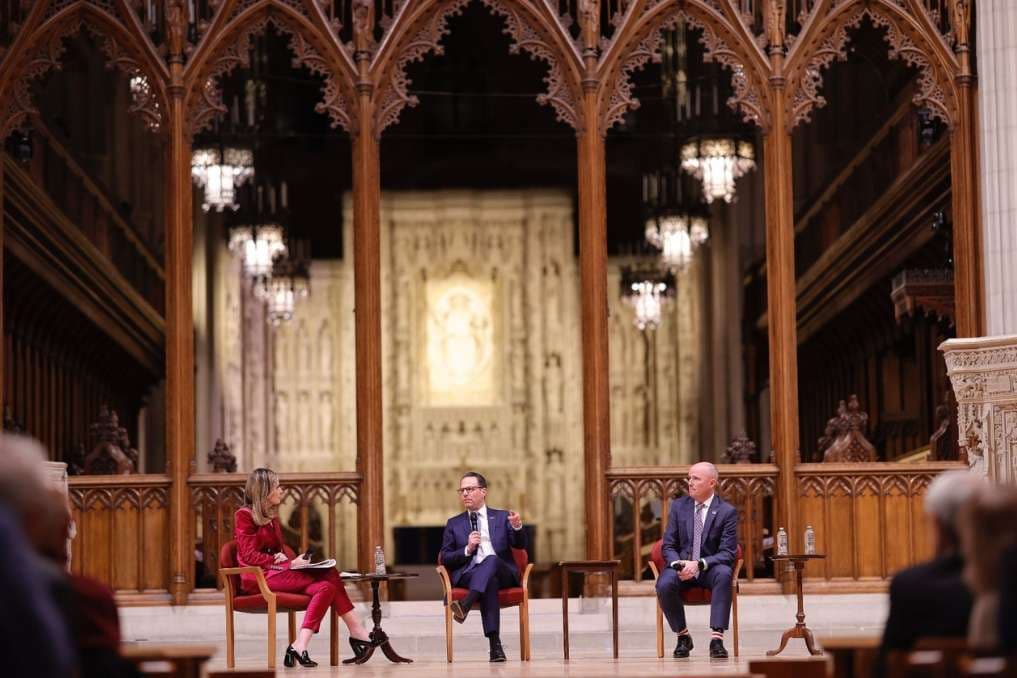
Democratic Gov. Josh Shapiro of Pennsylvania and Republican Gov. Spencer Cox of Utah convened for a public conversation on the escalating threat of political violence in the U.S. during an event at the Washington National Cathedral in Washington, D.C., on Dec. 9.
Moderated by NBC News anchor Savannah Guthrie, the discussion focused on personal experiences with violence, the role of faith in leadership, the dangers of social media, and the need for civil discourse amid deepening national divisions.
The forum, titled “Toward a Better Politics: An Evening with Governors Cox and Shapiro,” drew on recent incidents that have shaken both states, including the fatal shooting of conservative activist Charlie Kirk at a Utah Valley University event in September and an arson attack on Shapiro’s family residence in April.
Cox said Shapiro was one of the first people to call him after Kirk’s killing, offering the guidance to “speak with moral clarity and to speak from the heart” that shaped Cox’s public response to Kirk’s death.
Shapiro, who is widely expected to run for president in 2028, according to the Washington Post, reciprocated the praise. He said Cox handled the tragedy in a way that elevated the national conversation, modeled leadership amid crisis, and inspired him to engage in national dialogue about political violence.
Rising hostility threatens U.S. democracy
Both governors warned that rising political hostility threatens the stability of democratic institutions.
Cox, a member of The Church of Jesus Christ of Latter-day Saints, pointed to Christ’s command in the New Testament “to love our enemies” and contrasted it with the combative tone of modern politics.
“That’s not what politics teaches us today,” he said. “And too often, we think we can separate our Christianity or our religion from our politics.”
Shapiro emphasized the need for “moral clarity” from leaders and criticized those who selectively condemn violence, saying that silence or inconsistency fuels further extremism. He argued that President Donald Trump “fails that test” regularly.
“Here’s what we cannot allow: for leaders who don’t act with moral clarity, remain silent about certain violence, or give a pass to others, because that is insidious, that is gasoline on the fire, and that leads to greater violence,” Shapiro said.
Leaders say social media fueling national division
The governors also addressed the role of social media in amplifying divisions and harming children. Cox likened tech companies to “the opioid companies of the early 2000s,” accusing them of profiting from addictive products that harm children.
“[Social media companies] gave your daughter an eating disorder, and they gave your son a pornography addiction, and they give all of our kids and grandkids anxiety and depression, and some of them have taken their lives because they want to profit off of this,” he said. “This dopamine addiction that they're giving our kids.”
He urged states to enact laws restricting or banning social media use for minors.
Shapiro took a different approach, signaling that he would not support an outright ban and instead described Pennsylvania’s efforts to teach digital literacy in schools.
Governors call for renewed civic virtue
During the conversation, Cox warned that without a national “course correction,” the country risks fracturing into “failed states and civil wars.”
Both men pointed to ordinary citizens as a source of hope, with Shapiro stating, “The answers to so much of the darkness that we see in America today is the light that ordinary Americans bring each day, oftentimes grounded in faith and in our shared humanity. I think politicians would do well to take cues from the people we represent, to listen more to them, to see our shared humanity.”
The event, hosted in partnership with Disagree Better, the Wheatley Institute at Brigham Young University, and the National Institute for Civil Discourse, was interrupted four times by shouting audience members, some of whom were removed.
Cox, who closed out the event with the final words, said America’s founders believed the nation would endure only if its citizens possessed two essential qualities: to be learned and to be moral.
“We had to be a virtuous people for us to keep this republic,” he said. “And one of the ways that we learned virtue was, was through our faith — through attending church, going to a place of worship — but just as important as that, it was that we sat by people who were a little different than us. We got to know people in our communities.”
He urged Americans to turn back to religion rather than politics to fill that void.
“We can’t make politics our religion,” he said. “Too many people have left faith and tried to replace that God-shaped hole in every heart with politics, and it will not work.”

Comments