‘Hail, full of grace!’: Honoring the Blessed Mother on the Solemnity of the Annunciation
Nine months before Christmas, the Church celebrates the Annunciation, when the angel Gabriel announced to Mary that she would conceive and bear the Messiah.

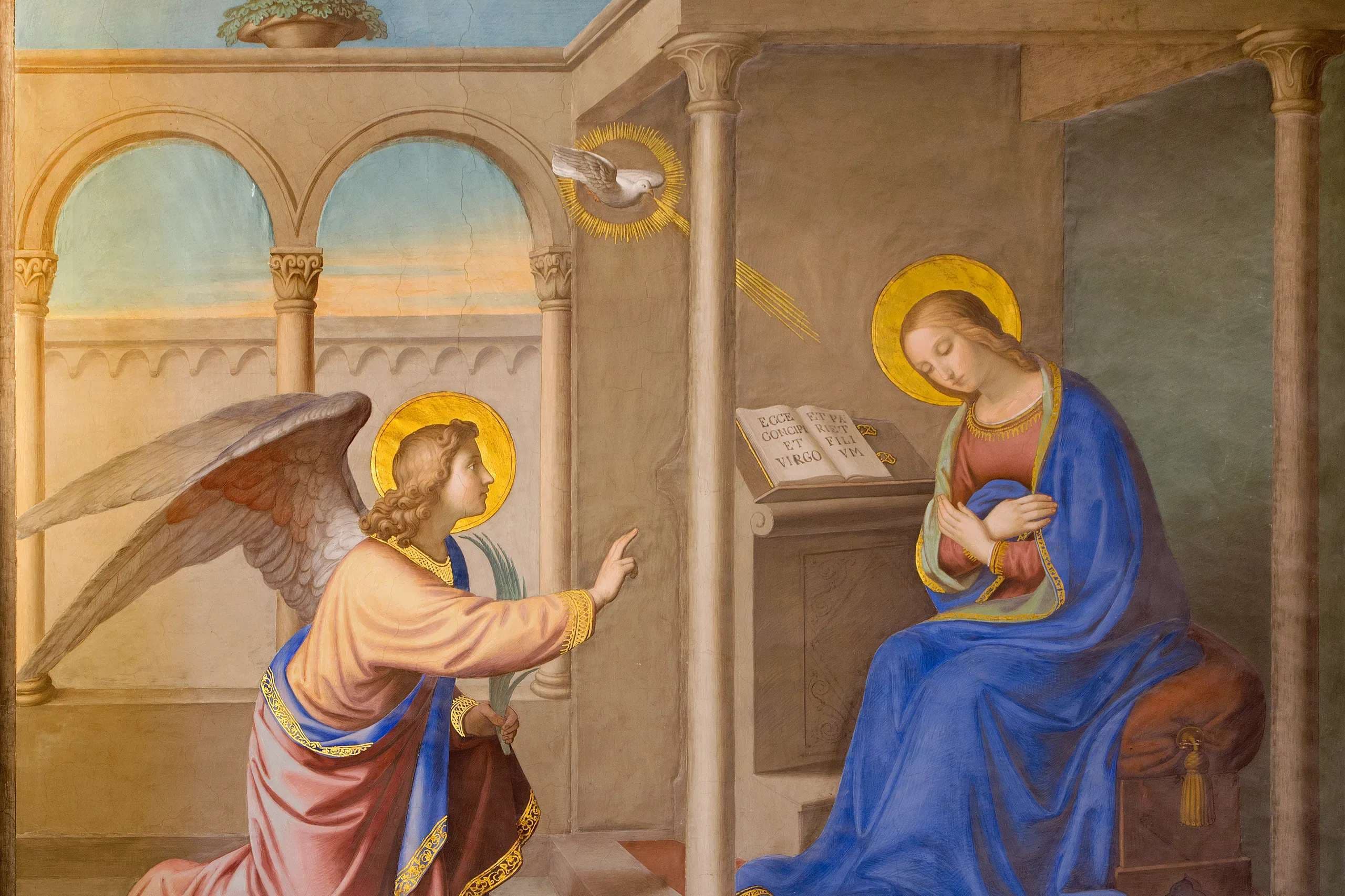
Nine months before Christmas, the Catholic Church observes the Solemnity of the Annunciation, when the angel Gabriel announced to the Blessed Mother that she would conceive and bear the Messiah. Not to be confused with the feast of the Immaculate Conception, which honors when Saint Anne conceived Mary, who was without sin, the Annunciation marks the day when Our Lady conceived Christ.
The first line of the Hail Mary prayer comes from the Angel Gabriel’s greeting at the Annunciation: “Hail, full of grace, the Lord is with thee: blessed art thou among women.” (Luke 1:28.)
When the Blessed Mother heard the angel’s greeting, Scriptures tell us that she was “troubled” by his greeting. Then the angel tells her, “Behold thou shalt conceive in thy womb, and shalt bring forth a son; and thou shalt call his name Jesus. He shall be great, and shall be called the Son of the most High; and the Lord God shall give unto him the throne of David his father; and he shall reign in the house of Jacob for ever. And of his kingdom there shall be no end.” (Luke 1:31-33.)
Countless saints have reflected on how Mary’s “fiat” (“let it be done”) to the angel’s greeting ensured the salvation of mankind.
St. Bernard of Clairvaux wrote in a homily praising the Blessed Mother: “The price of our salvation is offered to you. We shall be set free at once if you consent. In the eternal Word of God we all came to be, and behold, we die. In your brief response we are to be remade in order to be recalled to life.”
The whole human race, the saint continued, begs the Blessed Mother to answer, “yes.”
“Arise, hasten, open,” he wrote. “Arise in faith, hasten in devotion, open in praise and thanksgiving. Behold the handmaid of the Lord, she says, be it done to me according to your word.”
According to Aleteia, the Church began celebrating the Annunciation on March 25 in the 3rd or 4th century, but the reasoning was not simply counting backward from Christmas. Instead, it arose from the tradition that great prophets died on the same day they were conceived, and the ancients believed that Jesus’ crucifixion took place on March 25.
“He is believed to have been conceived on the 25th of March, upon which day also He suffered,” wrote St. Augustine in his 5th-century book On the Trinity. “So the womb of the Virgin, in which He was conceived, where no one of mortals was begotten, corresponds to the new grave in which He was buried, wherein was never man laid, neither before nor since.”
My Catholic Life adds that scholars believe that the solemnity of the Annunciation was established in the calendar before the feast of Christmas was. Third-century Christian texts also indicate that scholars believed that March 25 marks the creation of Adam, the fall of Adam, the fall of the angels, the sacrifice of Isaac by Abraham, and the passing of the Israelites through the Red Sea.
My Catholic Life also explains that the solemnity is both Christological and Marian – it arose around the time that the Church established the doctrine of Christ’s hypostatic union at the Council of Ephesus, teaching that Christ is one Person with two perfectly united natures, divine and human. This teaching means that Mary was the God-bearer (Theotokos), since she gave birth not just to a man but to God made Man.
“The solemnity we celebrate today originated around the time of this controversy, possibly to emphasize the theological teaching that emerged from the Council of Ephesus,” the website states. “Throughout Church history, when a theological truth is defined, that truth is then celebrated liturgically as a lived expression of the Church’s faith.”
In addition to honoring the Blessed Mother and Christ, the feast also celebrates God the Father.
“It reveals the beginning of the pinnacle of His perfect plan of salvation,” the article concludes. “That moment in time, the moment of the Incarnation, holds significance beyond comprehension. This moment was in the Father’s mind from all eternity and took place in a hidden way, known only to this lowly and humble virgin.”

Comments