How one Louisiana diocese is reimagining Catholic school for children with disabilities
National Catholic Schools Week offers an annual moment to reflect on the role Catholic education plays in family life across the U.S. For families of children with developmental disabilities and special learning needs, access to Catholic schooling can vary.

National Catholic Schools Week offers an annual moment to reflect on the role Catholic education plays in family life across the U.S. For families of children with developmental disabilities and special learning needs, access to Catholic schooling can vary.
Within the same family, some children may attend a Catholic school, while a sibling is educated elsewhere, typically homeschooled or a local public school, because often the Catholic school isn’t able to provide the level of support required for a student with a disability, despite families’ hopes for shared formation.
In the Diocese of Lake Charles, Louisiana, a new Catholic school is being developed to broaden that access, and the leaders of St. Nicholas Catholic Academy hope their approach can inform similar efforts in other dioceses.
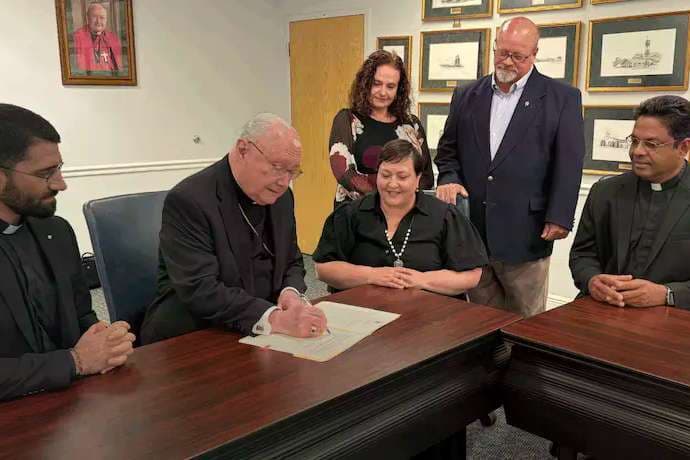
Diocese of Lake Charles Bishop Glen Provost and the academy’s founder, Christy Papania-Jones, signed a memorandum of understanding on Jan. 8 formally establishing the school, which is expected to open in the fall of 2027.
In interviews with CatholicVote, both Bishop Provost and Papania-Jones said the academy builds on work long underway in the diocese. More than a decade ago, Bishop Provost said, diocesan leaders began deliberately incorporating students with disabilities into existing Catholic schools, encouraging those schools to adapt so students could participate fully in Catholic education.
At the time, the bishop said, their approach set the diocese apart.
“In this initiative, our Catholic schools were indeed unique to our area and groundbreaking in many respects,” he said. “Students with special needs are and will remain a vital part of our Catholic school families.”
He said St. Nicholas Catholic Academy is intended to take that commitment “to a further level.”
For Papania-Jones, the idea for the academy emerged gradually over her years at the St. Nicholas Center for Children, an organization that provides therapy and other support for children with autism and other developmental disabilities and their families.
She began to notice a pattern of families who wanted Catholic education for all of their children but could not find space for those with special learning needs.
As an example, she noted that a school might have only one classroom for students with special needs, limited to five seats. When a child enrolls in first grade, that seat typically remains filled through eighth grade, leaving little flexibility to admit additional students later on.
The result, she said, is that families often make difficult compromises.
“We have families who have all of their children except one at a Catholic school,” she said.
Papania-Jones said families have consistently asked for smaller class sizes, specialized instruction, and therapy goals integrated throughout the school day — supports that are difficult to maintain in traditional school settings.
The academy’s mission, she said, is grounded in Catholic teaching and focused on honoring “the dignity, gifts, and potential of every student through Christ-centered formation of spirit, mind, and body.” Students who are able, she added, may eventually transition into other Catholic schools within the diocese.
Papania-Jones, whose son Bain has autism, spoke of this mission in personal terms.
“Bain has taught me more about faith through his actions than anyone else in my life,” she said.
Asked why the diocese was willing to make the commitment despite the challenges involved, Bishop Provost pointed to the Church’s long history of shaping its schools around those most in need.
“The Catholic Church has historically adapted its schools to meet the needs of students in every facet of society,” he said.
That pattern, he added, stretches across centuries — from medieval cathedral schools to Catholic schools founded by religious orders for children who otherwise would have gone without education.
The bishop grounded that history closer to home by pointing to the oldest girls’ school in the U.S, founded in New Orleans in the early 1700s and still in operation today.
“I see St. Nicholas Catholic Academy as an extension of the continuing efforts of not only individual Catholics but also the Catholic Church to provide for her children wherever they are found and in whatever circumstances,” Bishop Provost said.
During Catholic Schools Week, Papania-Jones said she hopes Catholics will see the academy as an invitation to wider belonging.
“Children with disabilities are in our neighborhoods, our churches, and our schools” she said, calling on Catholics to “open their hearts to families in need of compassion and acceptance.”
“Education leads to awareness, awareness leads to acceptance, and acceptance leads to inclusion” she said.
For Bishop Provost, the meaning of this effort is older than any single school.
He spoke of Catholic education as a formative presence that unfolds over time, often long after the classroom years have ended, recalling an encounter from years ago.
“I was in an airport waiting for a connecting flight, seated in my clerical suit and quite absorbed in reading a book,” he said. “A professionally dressed gentleman approached me and asked to be excused. He wanted to interrupt me to tell me thank you. He said, ‘I am what I am today because of Catholic education.’ He did not introduce himself and walked off as quickly as he had approached. He simply wanted to express his gratitude to a bishop for what Catholic schools had done for him.”
Bishop Provost said the moment stayed with him — not because it was unusual, but because it was familiar.
“Over my 50 years as a priest, I have experienced this same sort of gratitude, in one form or another, from former Catholic school students,” he explained. “The contribution of Catholic schools is invaluable.”
St. Nicholas Catholic Academy reflects a conviction that children with special needs belong fully within the vision of Catholic education. Permitted under revised canon law, the school will offer a setting intentionally structured around students who need individualized instruction, within what Bishop Provost called “the nurturing environment of Catholic education.”
Papania-Jones hopes that vision will not remain local. Drawing on the St. Nicholas Center’s experience as a statewide model for collaborative therapy, she said the academy is meant to be both sustainable and shareable.
“We hope to create not only a sustainable school,” she said, “but build a model that can be duplicated other places.”
“Long live Catholic education!” Bishop Provost said. “May it continue to grow and prosper for the good of those whom it serves.”


Comments