El-Sayed, Rogers trade personal and policy jabs in heated Michigan Senate debate
The candidates clashed over Israel, tariffs, health care, and their finances in a closely watched race that could help determine control of the Senate.

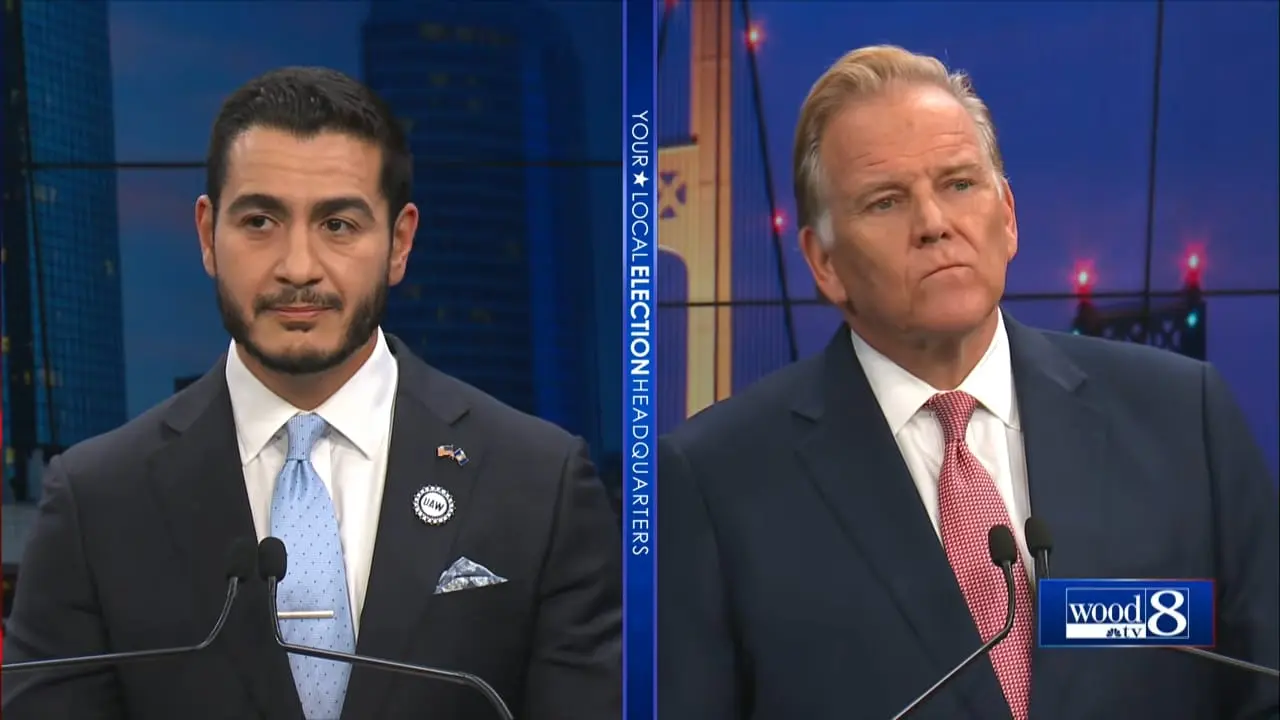
Democrat Abdul El-Sayed and Republican Mike Rogers clashed over U.S. support for Israel, President Donald Trump’s tariffs, the war with Iran, and their personal backgrounds during their first televised debate Oct. 8 for Michigan’s open U.S. Senate seat.
The hour-long debate, moderated by WOOD TV8’s Rick Albin in Grand Rapids, featured repeated interruptions and personal attacks. The two continued arguing during a commercial break, Albin said, calling it something he’d never seen in his 30 years of hosting debates.
The candidates are competing to replace retiring Democratic Sen. Gary Peters in a race that could help determine control of the Senate. The two will debate again Oct. 21 in Detroit on WXYZ-TV.
Support for Israel and the Iran war
Some of the sharpest exchanges concerned Israel and the war with Iran. El-Sayed declined to say which country posed the greater threat to the U.S., arguing that Iran threatened American interests while Israel had pushed Washington toward an unnecessary war.
“I’m just going to say that that’s a ridiculous hypothetical because here’s what’s happening right now: Our ostensible ally in Israel has lobbied us to go to war with Iran,” El-Sayed said at one point. “We have watched as Iran has responded by bombing all kinds of countries in the Middle East and then choking off the world’s energy supply. So, this is a situation in which I don’t think we should be a part.”
Asked again to choose between the two, he called it a “ridiculous question” and said both were “dangerous in their own way.” On supplying weapons to Israel, El-Sayed said he did not “want our tax dollars buying weapons for other countries. I don’t know what’s so hard about that.”
Rogers accused El-Sayed of failing to condemn the March attack on Michigan’s Temple Israel — which El-Sayed disputed — and of refusing to condemn other extremist groups.
“He can’t condemn Hamas. He can’t condemn the Muslim Brotherhood. He says his home is Egypt,” Rogers said.
>> 2016 video raises questions about El-Sayed’s citizenship status <<
The Republican alleged that El-Sayed has “taken money from groups associated [with] the Muslim Brotherhood” and from “individuals on his campaign who openly support Hamas, Hezbollah, Al Qaeda.”
Both candidates called for an end to the Iran war, but disagreed about its results: Rogers argued that U.S. military action had damaged Iran’s military and nuclear program, while El-Sayed said the conflict had produced a stalemate and strengthened Iran’s leverage over the Strait of Hormuz.
Personal jabs: Careers and wealth
In one contentious exchange, Rogers questioned El-Sayed’s medical credentials, saying he was “not really a doctor.” El-Sayed received a medical degree from Columbia University and a doctorate in public health from Oxford University but did not complete a residency and is not licensed to practice medicine.
“Matter of fact, if somebody came into his office and he tried to treat that patient, he’d go to jail,” Rogers said of El-Sayed. “So, listen to this guy and what he’s trying to sell here today.”
The candidates also attacked each other’s wealth and property holdings. El-Sayed accused Rogers of making $14 million from his corporate work after leaving Congress and questioned his continued ownership of a Florida home.
Rogers, in turn, questioned how El-Sayed had accumulated his wealth and acquired property in the United Arab Emirates.
“How does a guy who’s had less than four years of work experience — who, by the way, on the campaign trail said he has 10 — own a luxury property in the United Arab Emirates? He’s worth a million bucks,” Rogers said.
Health care, tariffs, and fuel costs
On policy issues, Rogers repeatedly argued that El-Sayed’s health care and economic proposals would impose unaffordable costs.
“We cannot afford Abdul,” he said, arguing that El-Sayed’s support for Medicare for All would raise costs by thousands of dollars per family and eliminate private insurance.
El-Sayed defended expanding health coverage and said families could keep private insurance. He also portrayed Rogers as unwilling to challenge Trump, calling him a “sock puppet for the Trump administration.”
On trade, Rogers faced questions about his shift from praising Trump’s tariff strategy to calling for an end to the trade dispute with Canada. He said he had contacted the administration that week to push for a deal, while continuing to argue that some tariffs had helped Michigan manufacturers.
“I would like to see the deal made,” Rogers said, later adding that, “Canada still has some high tariffs for U.S. goods, and they did it before this started. Those should be eliminated. There are tariffs that I think are too high and not helpful for us. We ought to get rid of those.”
>> Canada imposes retaliatory tariffs of up to 50% on roughly $20B in US goods amid trade dispute <<
Both candidates supported pausing the federal gas tax, but differed on other steps to lower fuel costs. El-Sayed said the government should consider price controls on domestic oil. Rogers opposed that proposal and called for a diesel rebate for farmers and a pause on diesel exports.
In a Truth Social post responding to the debate, Trump said Rogers “completely obliterated” El-Sayed.
“I won Michigan BIG, and know that Mike Rogers, a total winner, is the man for you!!!” Trump added.
El-Sayed holds a narrow polling advantage heading into the Nov. 3 election. As of Oct. 9, the RealClearPolitics average showed him leading Rogers 48.1% to 44.9%.
Michigan’s statewide in-person early voting period runs Oct. 24 through Nov. 1. Absentee ballots became available Sept. 24.
.jpg&w=3840&q=75)

Comments