EXCLUSIVE | Priest, missionary, communicator, contemplative: Discover the ‘whole Sheen’ in new book ahead of beatification
Longtime Sheen scholar Allan Smith discusses rarely seen photographs as well as the archbishop’s missionary legacy and hidden prayer life to show “America’s Apostle” in a fuller light.

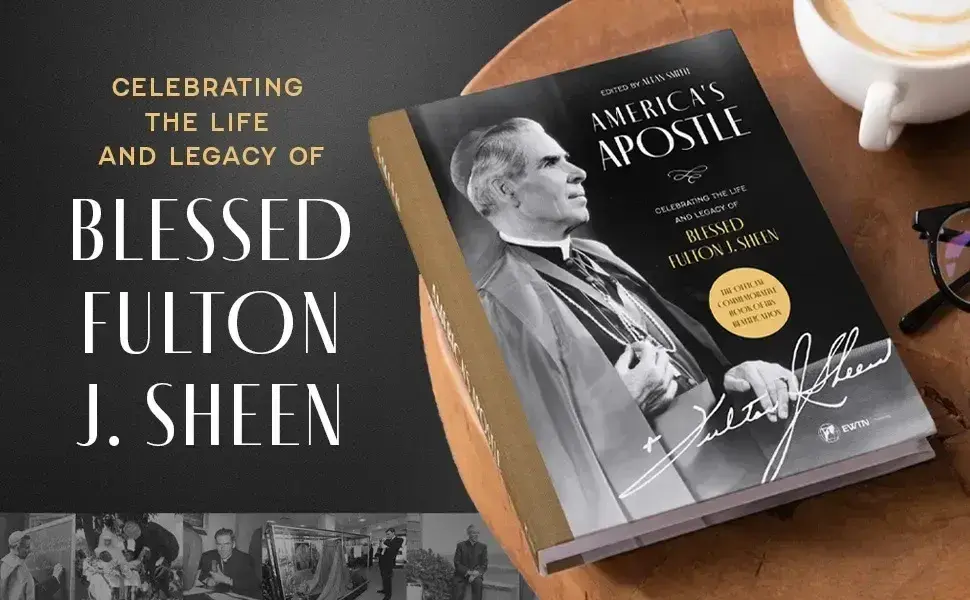
As Catholics prepare to celebrate the beatification of Ven. Archbishop Fulton Sheen next week, a commemorative book is introducing a new generation to the celebrated Catholic broadcaster and invites those already familiar with the archbishop to discover him anew.
America’s Apostle, published by Sophia Institute Press and EWTN Publishing, weaves together Ven. Sheen’s life, writings, spiritual practices, and rarely seen photographs, presenting the famed television personality not simply as a gifted communicator but as a priest whose expansive apostolate was rooted in prayer before the Blessed Sacrament.
Allan Smith, a longtime Sheen scholar, author, and member of the advisory board of the Archbishop Fulton J. Sheen Foundation, assembled and edited the volume. He has spent more than a decade preserving and promoting his teachings through books, radio, conferences, and other media.
In a Sept. 15 interview, Smith told Zeale News about the making of America’s Apostle and what even longtime devotees might discover about the soon-to-be Blessed Fulton Sheen.
.jpg)
Zeale News: How did this project come about and what does it mean to you?
Smith: This project came to me very quickly after the announcement that Archbishop Fulton J. Sheen's long-awaited beatification would finally move forward. Sophia Institute Press and EWTN Publishing wanted to create a special commemorative volume that would not simply mark the historic occasion, but help people understand the man the Church was placing before the faithful.
I was deeply honored when Sophia asked me to help assemble and edit the book. I have spent many years studying, editing, publishing, and speaking about Fulton Sheen, but this assignment felt different. We were no longer simply preserving the writings and legacy of a great Catholic communicator. We were preparing a book for the moment when the Church would formally present Fulton Sheen to a new generation as one of her Blesseds.
That realization affected the way I approached the entire project.
I did not want America's Apostle to be merely a biography or a beautiful coffee-table book, although Sophia and EWTN have certainly made it visually beautiful. I wanted readers to encounter the whole Sheen: the priest, missionary, teacher, communicator, spiritual father, man of prayer, and ultimately the disciple of Jesus Christ.
That is why the book moves from the meaning of beatification and Sheen's cause for canonization into his life and legacy, and then allows Sheen to speak for himself on the Cross, the Eucharist, priesthood and holiness, the Blessed Mother, the interior life, and the modern world and the Gospel. The final portion then moves from reading about Sheen to following his spiritual example, particularly through the Holy Hour and prayer.
For me personally, that was essential. Fulton Sheen should never become merely a museum piece from the golden age of radio and television. His own life was directed toward one purpose: leading souls to Jesus Christ. The introduction to America's Apostle makes precisely that distinction: behind the microphone and camera was a man whose public ministry was rooted in prayer before the Blessed Sacrament.
After spending so many years working with Sheen's words, there is something humbling about being asked to help prepare a book commemorating his beatification. In a sense, I have spent years introducing people to Fulton Sheen. With this book, however, the Church is introducing him to us anew.
And that may be what this project means most to me.
The beatification is not simply the culmination of Fulton Sheen's story. It is the beginning of a new chapter in his apostolate.
The book itself expresses that beautifully: his beatification is “not the end of his story” but, in many ways, a beginning for new readers to discover him and for the Church to receive him anew.
Zeale News: What do you think Sheen aficionados already familiar with his ministry will learn from this book?
Smith: For readers who already know and love Fulton Sheen, I think America’s Apostle offers something a little different from simply “learning more about him.” It allows them to see him whole.
Many people know one particular Sheen. Some know the television personality from “Life Is Worth Living.” Others know the author, the preacher, the philosopher, the missionary, or the great promoter of the Eucharistic Holy Hour. This book brings those dimensions together and helps the reader see that they all flowed from the same interior life.
The public Sheen and the hidden Sheen were not two different men.
Behind the television cameras was the priest who spent an hour before the Blessed Sacrament every day. Behind the famous voice was a man deeply devoted to prayer. Behind the intellectual brilliance was a missionary heart concerned above all with bringing souls to Christ. The book repeatedly returns to that hidden source of his strength.
I also think longtime readers may come away with a renewed appreciation for Sheen the missionary. His work with the Society for the Propagation of the Faith was not a secondary chapter in his life. It was central to his priestly identity. He spent years calling Catholics to look beyond themselves and support the Church in mission territories throughout the world. The book helps place that missionary dimension beside the better-known television and writing apostolate.
There is also something powerful about reading Sheen at the moment of his beatification. His familiar words take on a new context. The Church is now asking us not only to admire what he said, but to consider the holiness of the life from which those words came. The book places his writings on the Cross, the Eucharist, holiness, the Blessed Mother, the interior life, and the Gospel alongside the story of his cause and the spiritual practices that sustained him.
So even someone who owns many Sheen books may discover a new synthesis.
They may begin to see more clearly that the communicator, the missionary, the spiritual writer, and the man of prayer were all expressions of one vocation: to lead souls to Jesus Christ.
That, I think, is what the book offers the Sheen aficionado. Not merely new facts, but a new way of seeing the familiar.
Zeale News: What new insight did you gain during this process?
Smith: After spending so many years studying Fulton Sheen, I am sometimes asked whether there is anything left for me to discover about him. What surprised me during the preparation of America’s Apostle was not necessarily discovering one new fact, but seeing the familiar pieces of his life come together in a new way.
I came away with an even greater appreciation for the extraordinary unity between Sheen’s interior life and his apostolic life.
We remember the great communicator: the television cameras, the radio microphone, the books, the lectures, the converts, and the enormous audiences. We remember the brilliant mind and the famous wit. But as I worked through the material for this book, I kept being drawn back to the same question: Where did all of that come from?
Again and again, the answer was the Eucharist.
Sheen made his daily Holy Hour for more than 60 years. It nourished his soul, inspired his mission, and anchored his life. What struck me more deeply while assembling this book was that the Holy Hour was not simply one devotion among many in Sheen’s life. It was the organizing principle of his apostolate.
His contemplation became action.
The hour before the Blessed Sacrament became the lecture at Catholic University, the radio broadcast, the television program, the book, the retreat, the missionary appeal, the conversion instruction, and the personal encounter with someone who needed Christ.
The manuscript says something about the Holy Hour that captures this beautifully: for Sheen, it “was never an escape from the world. It was preparation to serve it.”
That insight became even more powerful when considered alongside his missionary work. The man kneeling silently before the Blessed Sacrament was the same man calling Catholics to concern themselves with souls on the other side of the world. As National Director of the Society for the Propagation of the Faith, he raised millions for the missions and regarded the missionary cause as one of his great loves.
Perhaps that is what I saw more clearly through this project: Sheen’s life moved in two directions at once, inward toward Christ and outward toward souls. The deeper he went into prayer, the farther his apostolate reached into the world.
And that is an important lesson for us today. We sometimes separate contemplation and evangelization, as though we must choose between praying and doing. Sheen’s life tells us otherwise. The strength to go out into the world is first received on our knees before Christ.
So perhaps the new insight was really a deeper understanding of something I had known for years:
The secret of Fulton Sheen’s public effectiveness was his hidden fidelity.
Everything the world saw began with what almost nobody saw. His daily Holy Hour.
Zeale News: Which of the photos or illustrations resonate most with you, and which ones do you consider to be rarely seen?
Smith: There are many remarkable photographs in America’s Apostle, but two sets particularly resonate with me.
The first is the photograph across pages 46 and 47 showing Bishop Fulton Sheen riding a bus with other bishops as they traveled to the sessions of the Second Vatican Council.
I love that photograph because it captures Sheen in such an ordinary and almost unexpected setting. We are accustomed to seeing him standing before television cameras, preaching from a pulpit, wearing his episcopal vestments, or addressing enormous audiences. Here we simply see Bishop Sheen on a bus, traveling alongside his brother bishops to participate in one of the most consequential gatherings of the twentieth-century Church.
There is something wonderfully human about it. It places Sheen not merely within American Catholic history, but within the life of the universal Church. He was there, participating with bishops from around the world in the deliberations of the Second Vatican Council. The book itself reminds us of this connection in another fascinating detail: Pope Benedict XVI later recalled that he had personally known Archbishop Sheen and had worked alongside him during the Council.
I would consider that bus photograph one of the rarely seen images in the book. It is certainly not among the iconic Sheen photographs that most people immediately recognize, and that is part of what makes it so special.
The second photograph that means a great deal to me appears on pages 64 and 65 and features Father Andrew Apostoli, C.F.R., with Pope St. John Paul II.
That photograph brings together two men who had a profound appreciation for Fulton Sheen. Father Apostoli had a particularly important connection to him. Archbishop Sheen ordained him to the priesthood during Sheen’s years in Rochester, and Father Apostoli later served for several years as vice postulator of Sheen’s cause for canonization.
Pope St. John Paul II, of course, also had a memorable personal connection with Sheen. During his 1979 visit to St. Patrick’s Cathedral, the Holy Father sought Sheen out, embraced him, and praised his lifelong witness to Christ and fidelity to the Church. America’s Apostle recounts that beautiful encounter near the beginning of the book.
So when I look at that photograph of Father Apostoli and Pope St. John Paul II together, I see more than two important figures in the modern Church. I see two men whose lives intersected with Fulton Sheen and who recognized something of his holiness and apostolic importance.
That is one of the great strengths of the photographic collection in America’s Apostle. The pictures do more than illustrate the text. They place Sheen within the living history of the Church. Some show the famous communicator the world remembers, while others reveal quieter and less familiar moments that even longtime Sheen aficionados may never have seen.
For someone like me who has spent so many years studying his life, those rarely seen photographs are a gift. They remind us that behind the familiar image of “Fulton Sheen” was a real priest and bishop moving through the extraordinary history of the 20th-century Church.
Zeale News: Why are the novenas and the other prayers important to this book?
Smith: My role was to help bring together the devotional material so that the book would not end simply with readers learning about Fulton Sheen, but would invite them to pray and to put into practice something of the spiritual life that sustained him.
That distinction was very important to me.
A commemorative book about a beatification can easily become retrospective. We can look at the photographs, read the biography, remember the television programs, and celebrate everything Archbishop Sheen accomplished. But beatification asks something more of us. The Church presents a Blessed not simply for our admiration, but for our imitation and intercession.
That is why the prayer section belongs at the heart of this book.
The devotional portion includes the official prayers associated with the Archbishop Fulton J. Sheen Foundation, the World Mission Rosary, and the Fulton Sheen Novenas of Daily Reflections. These help move the reader from reading about Sheen to praying with Sheen and asking for his intercession.
The World Mission Rosary is especially appropriate because Sheen's missionary work was such an important part of his priesthood. As National Director of the Society for the Propagation of the Faith, he worked tirelessly for the missions and helped Catholics recognize that the Church's concern for souls extends to every corner of the world.
The novenas serve another purpose. Nine days of prayer require us to slow down, return each day, reflect, and persevere. In that sense, they introduce readers to something characteristic of Sheen's own spirituality: fidelity in prayer.
And I think that is why these prayers are so important to America's Apostle. The book should not end when the reader closes the cover.
My hope is that someone finishes reading it and says, “Now I want to pray. I want to make a Holy Hour. I want to pray the Rosary. I want to ask for Fulton Sheen's intercession. And perhaps I want to become a little more faithful to Christ myself.”
If that happens, then the book has accomplished something much more important than commemorating a historic event.
It has helped continue Fulton Sheen's apostolate.
Zeale News: What other insights would you like to share?
Smith: Perhaps the final thing I would say is that I hope readers will understand that America’s Apostle is ultimately not a book about nostalgia.
It would be very easy to look at Fulton Sheen and remember a remarkable period in Catholic history: the bishop with the cape and pectoral cross standing before a blackboard, speaking without notes to millions of television viewers; the familiar voice on radio; the bestselling author; the brilliant lecturer and preacher.
All of that deserves to be remembered. But that is not ultimately why Fulton Sheen matters.
He matters because he still has something to say to the Church and to the world today.
One of the themes running throughout America’s Apostle is that the questions Sheen addressed have not disappeared. How do we remain faithful in a world that forgets God? How do we discover meaning in suffering? How do we hold on to truth amid confusion and division? The book argues that these questions have actually become more urgent, and that Sheen continues to speak because his message was anchored not in a particular cultural moment but in the Gospel.
There is also something wonderfully appropriate about calling this book America’s Apostle. An apostle is someone who is sent. Sheen spent his entire priesthood going out: into classrooms, parishes, radio studios, television studios, mission territories, books, retreats, and personal encounters. He used virtually every means available to him to bring Jesus Christ to souls.
If Fulton Sheen were with us today, I have little doubt that he would be asking the same question he asked of the technologies of his own day: How can this be used to bring one more soul to Christ?
But there is another side to his apostolate that I hope this book makes clear. Before Sheen was sent out, he knelt down.
The microphone came after the Holy Hour. The television camera came after the tabernacle. The apostolate came after the encounter with Christ.
That may be one of the most important things Fulton Sheen has to teach a new generation of Catholics. We sometimes think evangelization begins with finding the right platform, technique, program, or technology. Sheen reminds us that Christian evangelization begins with holiness.
The final sections of America’s Apostle were deliberately constructed to move the reader in that direction: from Sheen’s life and words into the Holy Hour, prayer, the World Mission Rosary, novenas, and ultimately a spiritual response of our own.
So my hope is that people will enjoy the photographs and discover things about Sheen they may not have known. I hope they will read his words and marvel again at how contemporary he sounds. But most of all, I hope they will close the book wanting to become holier themselves.
Because the Church does not raise up Blesseds merely so that we can say, “Look at the extraordinary life that person lived.”
She raises them up so that somewhere in our hearts we begin asking:
“What might God do with my life if I gave myself completely to Him?”
That, ultimately, is why Fulton Sheen's beatification matters.
And that is why I believe his apostolate is far from finished.




Comments