Gabbard: Iran lost its nuke program in 2025, made no effort to rebuild since
Director of National Intelligence (DNI) Tulsi Gabbard testified before lawmakers March 18 that President Donald Trump alone bears responsibility for the White House’s claim that Iran posed an “imminent” nuclear threat ahead of joint U.S.-Israeli strikes on the Middle Eastern Nation.
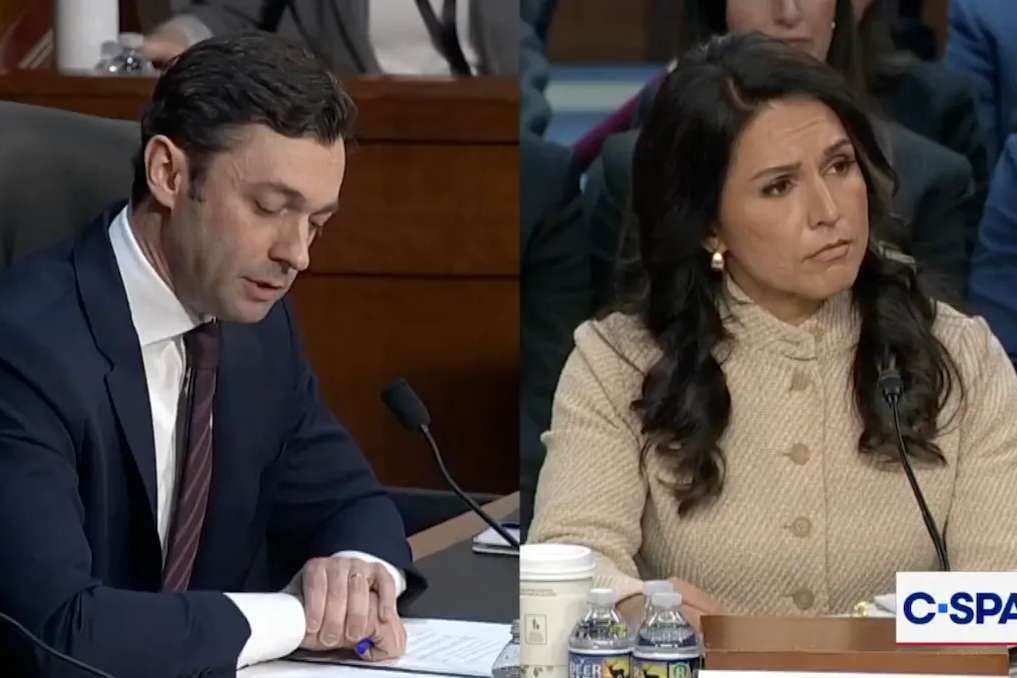
Director of National Intelligence (DNI) Tulsi Gabbard testified before lawmakers March 18 that President Donald Trump alone bears responsibility for the White House’s claim that Iran posed an “imminent” nuclear threat ahead of joint U.S.-Israeli strikes on the Middle Eastern Nation.
She also made it clear that the intelligence community believes the U.S. completely destroyed Iran’s nuclear enrichment program in 2025 and that Iran has made no effort to rebuild it since then.
Gabbard’s remarks came in the form of sworn testimony before the Senate Select Committee on Intelligence during its annual hearing on global threats to the U.S.
Georgia Democratic Sen. Jon Ossoff asked Gabbard during the hearing: “So the assessment of the intelligence community is that Iran's nuclear enrichment program was obliterated by last summer's airstrikes?"
“Yes,” Gabbard answered.
Ossof then quoted her written testimony, submitted the previous evening, which stated: "There has been no effort since then to try to rebuild their enrichment capability."
After Gabbard confirmed that his quotation of her statement was correct, Ossoff followed up, “And that’s the assessment of the intelligence community?” She answered, “Yes.”
Ossoff then quoted a statement issued by the White House March 1, immediately after the onset of the Iran war. The White House statement described the war as "a military campaign to eliminate the imminent nuclear threat posed by the Iranian regime."
Ossoff asked Gabbard whether it was “the assessment of the intelligence community that there was an ‘imminent nuclear threat posed by the Iranian regime?”
Gabbard answered that the “only person who can determine what is and is not an imminent threat is the President, and he made that determination.”
Throughout a number of back-and-forths and some crosstalk between Ossoff and Gabbard, the intelligence director maintained her position that Trump bears sole responsibility for the claim that Iran posed an imminent nuclear threat — a claim the President has made several times to justify his decision to initiate the Iran war.
"It is not the intelligence community's responsibility to determine what is and is not an imminent threat,” she repeated. “That is up to the President, based on a volume of information that he receives."
Gabbard’s testimony came hours after she released the Annual Threat Assessment of the Intelligence Community.
The document contained numerous mentions of new terroristic threats following recent actions taken by the U.S. and Israel in the Middle East.
“Some Shia worldwide, particularly in the Middle East and South Asia, responded to the killing of Iranian Supreme Leader Ayatollah Ali Khamenei on 28 February with anger and protests,” the assessment stated. “Prominent Shia religious leaders in Iran issued religious decrees calling to avenge Khamenei, which is likely to inspire at least some individuals to seek to conduct terrorist activities against U.S. targets worldwide.”
“Islamist terrorist groups and hostile actors have exploited HAMAS’s attacks against Israel and Israel’s response as a rallying call to plot attacks against Christian and Jewish targets in Europe,” the document states in its segment on Europe-Eurasia.
“While al-Qa‘ida and ISIS maintain the intent to launch operations targeting the U.S., the most likely terrorist attack scenario in the Homeland involves U.S.-based lone offenders,” another section of the document states, citing a number of examples of terrorist attacks. U.S.-based attackers “take inspiration from foreign terrorist ideologies and propaganda that often exploit world events such as the Gaza conflict to fuel radicalization and mobilization.”







Comments