Jerusalem is called to heal the world’s wounds, Cardinal Pizzaballa writes
In a thorough pastoral letter, Cardinal Pierbattista Pizzaballa reflected on the state of the Holy Land and how Christians can live out their vocation in the midst of the war.

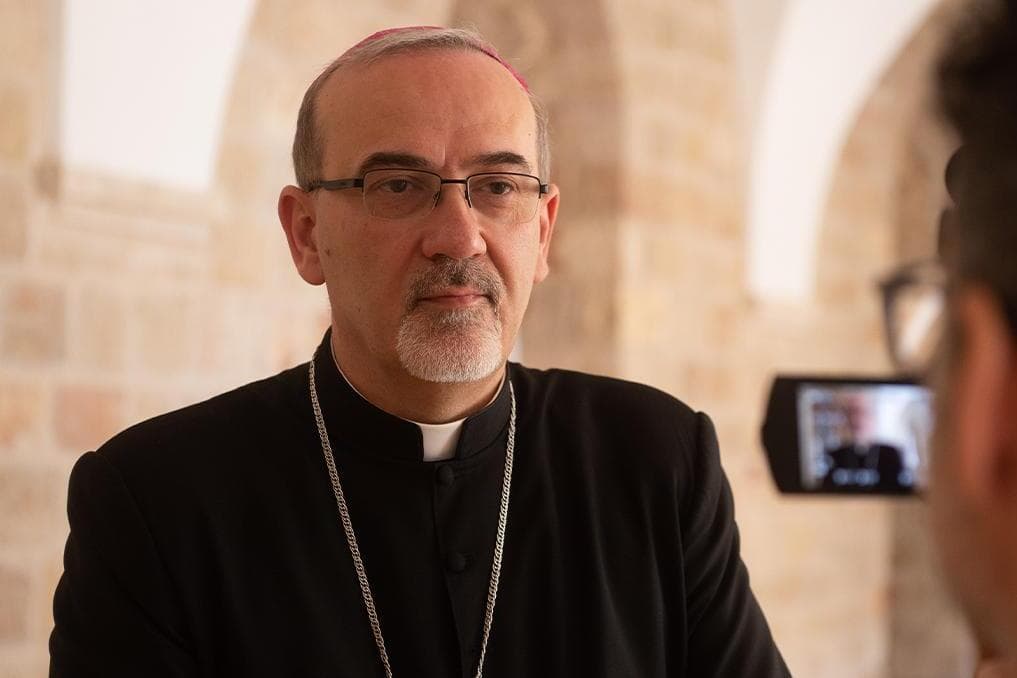
In a thorough April 27 pastoral letter, Cardinal Pierbattista Pizzaballa, the Latin Patriarch of Jerusalem, reflected on the state of the Holy Land and how Christians can live out their vocation in the midst of the war. Drawing on the book of Revelation’s depiction of the heavenly Jerusalem, the cardinal told the faithful that the earthly Jerusalem’s “ultimate and sublime task” is the healing of nations.
At the outset of the letter, Cardinal Pizzaballa wrote that he was seeking to answer the question “How can we, as Christians, as an ecclesial assembly, navigate our way in this situation of conflict – political, military, spiritual – a conflict we fear will continue for years to come?”
The nearly 18,000-word letter was divided into three sections: an assessment of current events, a scriptural vision for Jerusalem, and the scriptural vision applied to the present-day Church community.
In the first section, Cardinal Pizzaballa wrote that the Hamas attack on Israel on Oct. 7, 2023, and the Gaza war “are now largely considered watershed events that brought one era to a close and opened another, doing so in the worst possible way.”
“For the Palestinians, these events represent yet another dramatic phase in a long history of humiliation and displacement,” he wrote. “For the Israelis, on the other hand, these events represent something unprecedented, a violence that has brought back the horrors that occurred in Europe eighty years ago.”
The conflict, he continued, points to a deeper crisis of violence in the Western world.
“War has become the object of an idolatrous cult: we no longer sit down at table to avoid conflict, but rather consider war a possible, or even inevitable, outcome,” the cardinal wrote. “Civilians are no longer simply considered collateral damage, rather this damage is blamed on the enemy’s failure to surrender, or they are seen as instruments used to achieve the goals of war. War serves as an end in itself.”
In the section on the heavenly Jerusalem, Cardinal Pizzaballa wrote that the scriptural descriptions of Jerusalem serve as a model for the earthly Jerusalem. In the book of Revelation, he writes, a river of living water flows from the throne of God. On the riverbank, the tree of life grows, and its leaves are “for the healing of the nations.”
“This is the ultimate and sublime task of Jerusalem,” the cardinal wrote. “The tree of life, which in Eden was forbidden to humanity, is now in the heart of the City, accessible to all. Its leaves are not for a chosen few, but for the healing of the ‘nations,’ a term in Revelation that often denotes the unbelieving world, those who stand outside and do not yet know God. Divine mercy is not a privilege for a few, but a destiny offered to all.”
Likewise, it is the role of the Jerusalem Church to redeem the hatred, fear, and other devastating consequences of conflict, he wrote. It must be an example of forgiveness to the world, radiating the light of Christ to all.
“Jerusalem’s mission is not confined within its walls or closed within its gates. The spring of living water that flows from the heart of the Lamb irrigates the whole world,” he wrote. “Jerusalem is an ‘outlooking’ City, called to bear fruit for humanity. What it has received from on high is to be shared with all. It has a specific mission, which is uniquely its own: to “heal the nations.” Heal from what? The text does not specify, because it does not point to a single wound, but to the very root of wounded life. It does say, however, that what heals is its being alive, its participation in the life of God.”
The role of Christians, he added, is not merely that of third-party mediators between Israelis and Palestinians:
“They are, rather, salt, light, and leaven within the societies to which they rightfully belong. Predominantly Palestinian or Jordanian citizens, Christian Arabs, but also Cypriots and Israelis, Christians share the history, language, wounds, and aspirations of their peoples. They are not called to enclose themselves in a protected enclave, nor to flee, but to live their vocation to the full: to be part and parcel of society, sharing its fortunes, and helping to ferment it from within with a vision of humanity – and society – rooted in the Gospel.”
In his third and final section, on the practical way the church of Jerusalem can embrace its vocation to heal the world, he wrote about forgiveness at greater length.
“Forgiveness does not mean forgetting, nor can it mean justifying evil,” he wrote. “It means breaking the chain of hatred and bearing witness to this possibility, even when it seems impossible. I know this may all seem naïve. But it is our mission.”
He encouraged Christians to reject violence in their speech and actions, and to teach their children to reject it as well. He also urged trust in God’s plan for their community, and to welcome others, even those of different faith, origin, and ethnicity, as a gift.
In the conclusion of his letter, Cardinal Pizzaballa wrote that all of these things are only possible with God’s help. The joy of the Gospel, and not each person’s individual strength, is what the community must rely on.
“Let us return to Jerusalem with joy. Let us return to our lives with passion. Let us carry in our hearts God’s dream for God’s City, and let us allow that dream to become, step by step, day by day, our very lives,” he concluded. “May Mary, Mother of God and of the Church, Queen of Palestine and of all the Holy Land, Patroness of our Diocese, accompany us on this journey. May the blessing of God the Almighty and Merciful Father of all, descend upon each one of you.”


Comments