Louisiana bishop says faithful can no longer attend SSPX liturgy ‘even for purely devotional reasons’
The bishop is one of a number of U.S. bishops who have instructed the faithful to not attend Masses celebrated by local SSPX clergy in the wake of the schism.

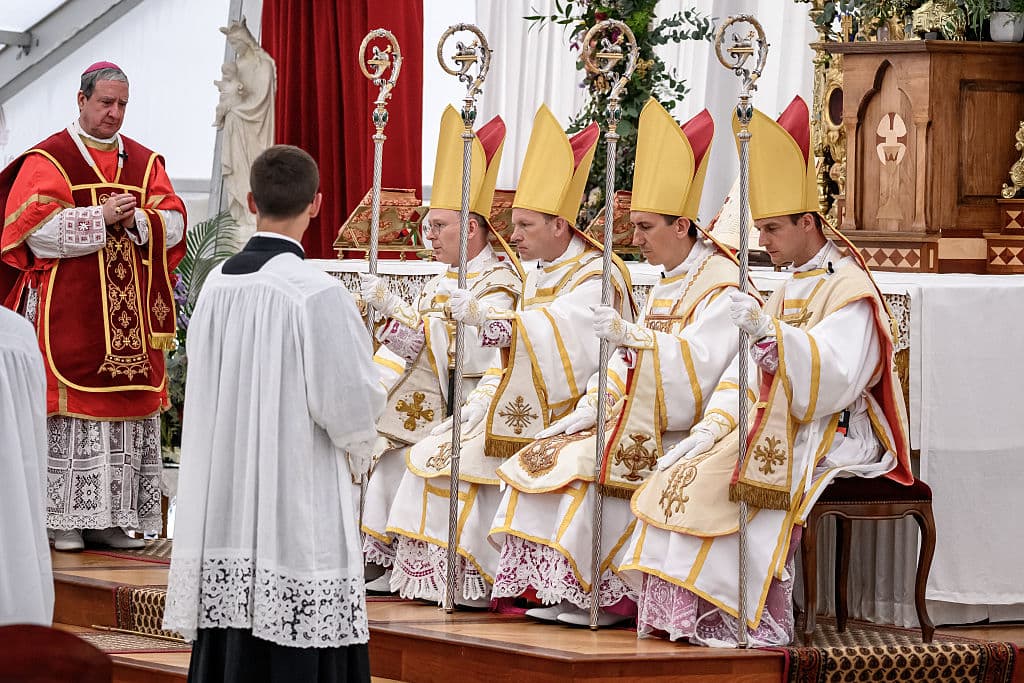
Bishop Michael Duca of Baton Rouge, Louisiana, issued a statement July 7 about the schismatic act carried out by bishops of the Society of St. Pius X (SSPX) and why the laity can no longer receive sacraments from SSPX priests or attend Masses celebrated by them.
The SSPX held episcopal consecrations July 1, ordaining four new bishops without a pontifical mandate from Pope Leo XIV, despite repeated warnings from the Vatican.
“This grave, schismatic act, which has resulted in their excommunication, constitutes a wound to ecclesial communion,” Bishop Duca said.
According to the bishop, there are two SSPX sites within the diocese of Baton Rouge: Our Lady of Sorrows and a spiritual and education center called Queen of the Most Holy Rosary that is under development.
Bishop Duca noted that he has collaborated with the priests at these locations for several years primarily to ensure marriages celebrated at the SSPX chapel were canonically valid. Pope Francis had granted SSPX priests the faculty to celebrate marriages in 2017, one year after he granted them the faculty to hear confessions. However, after the July 1 consecrations, the Vatican Dicastery for the Doctrine of the Faith (DDF) declared that SSPX priests’ celebration of the sacraments of Matrimony and Confession are now invalid. Bishop Duca said that considering the DDF’s decree, “delegation to priests of the Society to preside at weddings will no longer be granted.”
“Of particular importance for the lay faithful is the clarification that accompanied that decree,” he continued. “The Holy See has made clear that the clergy of the Society are now to be regarded as schismatic.”
This means that going forward, the sacraments celebrated by the SSPX are illicit, and in the case of the sacraments of Confession and marriage, are invalid, the bishop stated. The DDF also declared that the sacred ministers belonging to the SSPX, considered schismatics, “are subject to the excommunication prescribed by law.” For lay people, those “who formally adhere” to the SSPX “are to be considered schismatics and excommunicated,” according to the DDF, which cited a 1996 Vatican explanatory note that outlines the conditions required to constitute formal adherence.
Bishop Duca stated, “I wish to offer a word of reassurance. Excommunication does not fall upon those who have simply attended these liturgies out of a sincere desire to worship and who have never intended to reject the authority of the Holy Father or the teaching of the Church.”
“Yet, what the Church now asks is straightforward: knowing the situation as it now stands, the faithful of the Catholic Church can no longer take part in the celebration of Mass or in any Sacraments celebrated by a priest of the Society of Saint Pius X, even for purely devotional reasons,” he continued. “To do so now is to show unity with the teachings of the Society which have been declared to be in contradiction to the teaching of the Roman Catholic Church.”
He acknowledged that this is difficult to hear for some, especially those who have gone to SSPX liturgies “for spiritual reasons and who never affirmed or professed the Society’s contradictory theology.”
He encouraged these faithful to go to the local church that celebrates the Traditional Latin Mass on Sundays, St. Agnes Catholic Church.
Bishop Duca also outlined how those wishing to reconcile with the Church can do so. He said lay people who are formally a part of the Third Order of the SSPX or who have “habitually participated in the celebrations of the Priestly Fraternity, formally sharing their doctrinal positions but now aware that future communion with the Catholic Church is not possible, may reconcile with the Church through a profession of faith.” He encouraged those in this state to contact their parish priest or the bishop’s office.
“It is our duty to support the Magisterium of the Church and the authority of the Roman Pontiff,” he concluded. “Together, let us work together for the unification of all of Christ’s Church!”
>> US bishops offer pastoral responses after SSPX excommunications and schism <<
Comments