‘Magnifica Humanitas’: Pope Leo’s first encyclical places AI at service of humanity, not power
Pope Leo XIV published his first encyclical, Magnifica Humanitas, May 25, warning that artificial intelligence and other technological advances pose moral challenges that could reshape humanity’s understanding of truth, work, relationships, and human dignity.

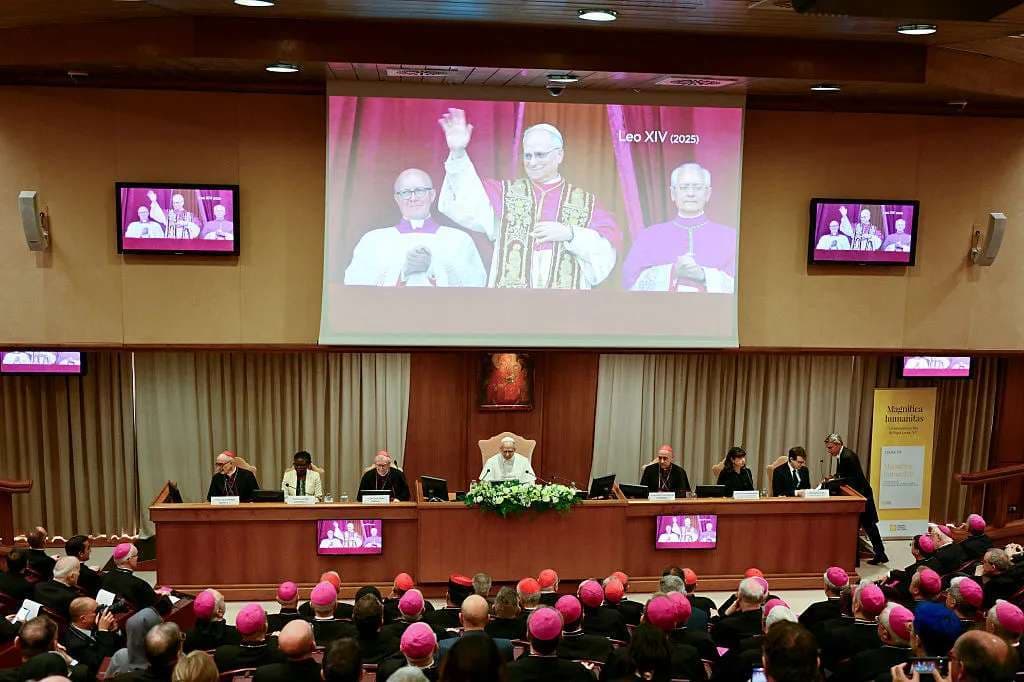
Pope Leo XIV published his first encyclical, Magnifica Humanitas, May 25, warning that artificial intelligence (AI) and other technological advances pose moral challenges that could reshape humanity’s understanding of truth, work, relationships, and human dignity.
“Humanity, created by God in all its grandeur, is today facing a pivotal choice: either to construct a new Tower of Babel or to build the city in which God and humanity dwell together,” the encyclical, subtitled “On Safeguarding the Human Person in the Time of Artificial Intelligence,” opens.
Pope Leo signed the encyclical May 15, the 135th anniversary of Pope Leo XIII’s 1891 encyclical Rerum Novarum, which addressed work, labor, and the unique challenges posed by the Industrial Revolution.
Magnificent humanity
Following Pope Leo XIII’s example, Magnifica Humanitas builds on Rerum Novarum and identifies AI, robotics, and other technologies as the defining factors of the age.
Pope Leo asserts that technology is not inherently evil but emphasizes that, as a tool, it conforms to the wishes of those who wield it. As such, he urges that safeguards and regulations be developed and implemented in ways that protect the common good, encourage flourishing and prosperity, and uphold the dignity of the person and human work.
A dynamic approach faithful to the Gospel
In the first chapter of Magnifica Humanitas, Pope Leo positions technological advances in the context of Catholic social doctrine, saying that the “new things” of each era require careful consideration and teaching from the Church.
“[A]rtificial intelligence should not be considered as merely yet another theme to be studied or an emergency to be managed, but rather as a development that challenges the categories of Social Doctrine from within, entailing its further development in fidelity to the Gospel,” he writes.
The Church’s social teaching is not “an external code of ethics imposed from above,” the Pontiff adds, but rather the result of dialogue with humanity for centuries in response to “new things.” He emphasizes that the Church accompanies humanity throughout the challenges progress can bring but maintains a distinction between ecclesial and political entities.
Foundations and principles of the social doctrine of the Church
Pope Leo further calls for technology to be used in ways that respect human dignity, which is rooted in man’s creation in the image and likeness of God. He cautions against jeopardizing human rights through technological progress and, citing the Catholic principles of solidarity and subsidiarity, urges that digital platforms and technologies be placed at the service of everyone without exclusion, guided by a desire to promote the common good.
“Technological innovations, including artificial intelligence, are not neutral, for they can foster participation and justice, or they can exacerbate inequality, control, and exclusion,” he wrote. “For this reason, they must be evaluated by asking a crucial question: Do they truly help individuals and populations to become more humane and fraternal, while respecting our common home and future generations?”
Technology and dominance. The grandeur of humanity in light of the promises of AI
Pope Leo held up the Tower of Babel as an example of progress that ultimately leads to domination and dehumanization, contrasting the construction of the tower with the rebuilding of the city of Jerusalem as seen in the Book of Nehemiah, which he said represents an understanding of a shared responsibility. Extending the biblical imagery to the 21st century, he writes: “We are called to reflect on the great ‘construction sites’ of our era and ask what are we building?”
“As technological development rapidly transforms languages, relationships, institutions and forms of power, we believers must and can choose which projects to work on and in what manner, so as to safeguard and value the grandeur of humanity that has been given to us as a gift,” he writes. “This is a choice not only for our future but also for our present, since artificial intelligence and other emerging technologies are already part of our daily lives.”
He cautions against the “technocratic paradigm” first denounced by Pope Francis, which is a worldview that risks dehumanization and the sacrifice of the person for progress and efficiency. Pope Leo calls for greater ethical and social progress to balance massive technological advances in order to guard against humans being “evaluated principally according to the outcomes they produce.”
He considers AI a “valuable tool that requires vigilance” but emphasizes that AI does not possess human qualities, such as love, work, emotions, responsibilities, or wisdom. He warns against utilizing AI to imitate relationships, saying that it risks extinguishing the desire to form human connections.
Citing St. Augustine, his spiritual father, Pope Leo recognizes the battle between love of God and neighbor and love of self that struggles in the heart of every man and society.
“As throughout history, these two loves continue to contend for dominance in our hearts today,” he writes. “The age of AI is no exception: the construction of Babel or the rebuilding of Jerusalem begins within each one of us.”
Safeguarding humanity at a time of transformation. Truth, work, freedom
In a world where disinformation is increasingly prevalent, AI has the power to increase confusion and poor communication further, Pope Leo writes. He also warns that digital surveillance and data systems increasingly monitor, predict, and shape human behavior in ways that risk undermining freedom and human autonomy. He further argues that trust between people and a mutual desire for education and the truth must be reestablished, while humans must rediscover the value of work as an action that “expresses and enhances the dignity of our lives.”
The encyclical also critiques economic systems that prioritize efficiency and automation at the expense of workers, arguing that labor is tied to human dignity and should not be overshadowed in favor of productivity. Pope Leo additionally upholds the value of the family and young people in society, noting that job instability particularly affects them and calling on governments to implement technological transformations to support the human person and contribute to a flourishing and prosperous society.
The culture of power and the civilization of love
The encyclical concludes with a commentary on technological advances in war and the need for peace. The pontiff warns that technology risks detaching human persons from ethics and responsibility, rendering “decisions about life and death more rapid and impersonal” and presenting “the use of force as an immediate and viable option.”
To counteract a modern technocratic Babel, Pope Leo points to Pope St. Paul VI’s phrase “the civilization of love,” saying that such a vision is increasingly necessary as the world becomes more interdependent.
“This is the guiding principle for technological processes: it is not enough for artificial intelligence to make us more efficient or connected; it must also serve to build a universal human family, with shared rights and duties, where digital proximity becomes a real opportunity for encounter and mutual care,” he writes.
In an age of military advancements, he urges greater ethical and moral responsibility to protect civilians and their societies. Pope Leo calls for a renewed “civilization of love” rooted in solidarity, peace, and human dignity rather than domination and technological supremacy.
A song of hope
Magnifica Humanitas ends on a hopeful note, challenging the fear instilled by the prospect of a rapidly developing future. Citing the Magnificat, in which Our Lady recognizes “God’s invisible work” and the great wonders he has already wrought, Pope Leo notes that her song points to broken humanity and divisions between classes while inviting a shift in perspective.
“With the same faith as Mary, let us become ‘weavers of hope’ in our world, sharing who we are and what we have, so that the presence of Jesus may grow among us and his Kingdom take shape,” he writes. “In the humble fidelity of daily life, even the era of Al can become a time in which the Holy Spirit brings about the civilization of love to fulfilment in our lives.”



Comments