‘Not today, Satan’: CatholicVote president upholds Fulton Sheen as a hero for the modern American age
Speaking ahead of Sheen’s beatification, CatholicVote President and CEO Kelsey Reinhardt reflected on seven lessons from the archbishop’s life and how American Catholics can learn how to confront the evils of the modern age from his example.
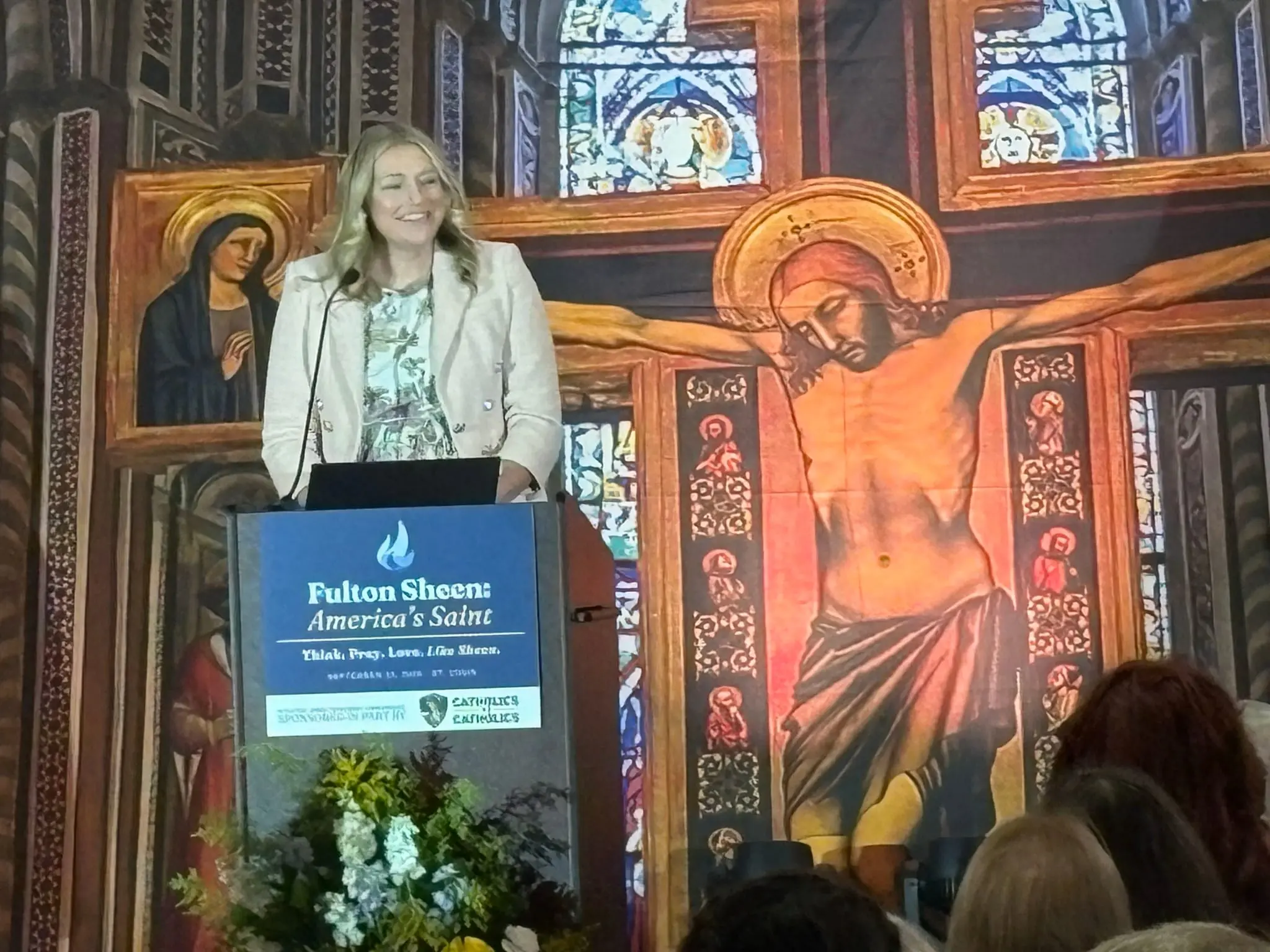
CatholicVote President and CEO Kelsey Reinhardt delivered the Sept. 23 keynote address at the Fulton Sheen: America’s Saint conference in St. Louis ahead of the beloved archbishop’s beatification the following day, encouraging American Catholics to look to Sheen as an example of love, truth, and clarity.
Echoing Sheen’s own book The Seven Last Words, Reinhardt structured her speech around seven lessons from Sheen’s own life, touching on his priesthood, his prayer life, and the “remedy” that he offered to the moral and political ills of his own age and future ages: Christ.
She recounted an episode shortly before Sheen’s death in 1979, when the newly elected Pope St. John Paul II visited New York. Sheen, then 84 years old, was kneeling in St. Patrick’s Cathedral, along with numerous other priests and bishops. The Holy Father singled out Sheen and lifted him to his feet, saying to him, “You have written and spoken well of the Lord Jesus Christ. You are a loyal son of the Church.”
“That’s it. That is the whole summary. That is what a life looks like when it is spent in full,” Reinhardt said.
“Today — in this extraordinary moment, gathered here in the heart of America, 50,000 of us strong — the Church raises Archbishop Fulton John Sheen to the altars,” she continued. “It says: this man lived well. This man died in the friendship of God. This man is now, with absolute certainty, in the presence of what he spent his life proclaiming: Jesus Christ.”
Reinhardt reflected on Sheen’s life and achievements, from his university teaching and ascension to the episcopacy to his renowned radio and television shows, the latter of which earned him an Emmy Award and 40 million weekly viewers. Yet perhaps his greatest accomplishment was guiding an estimated 42,000 souls into the Catholic Church over the course of his lifetime alone.
But none of that was “the point” for Sheen, Reinhardt said. Although he was an accomplished theologian and philosopher, a gifted orator, celebrated radio and television personality, and an influential figure in both the American Church and American public life, Sheen was a priest first, devoted to the service of Christ and His Church.
“All of it was in service of something that could not be televised, could not be measured in ratings or convert counts: the daily, costly, joyful fidelity of a priest to his calling,” Reinhardt said.
“The priest, he taught, is not a religious social worker,” she continued, emphasizing Sheen’s own view of the priesthood. “He is not a community organizer. He is not a therapist with a Roman collar. He is an alter Christus — another Christ — whose entire existence is configured to the mystery of the Incarnation, the Cross, and the Resurrection.”
Through his obedience to virtue, the teaching of the Church, and, above all, the love of Christ, Sheen entered into the priest’s unique role as an alter Christus, Reinhardt reflected. Even when Cardinal Francis Spellman penalized Sheen for standing up against him and refusing to surrender government funding for a diocesan program for the poor, insisting that the money was to be given to the poor, Sheen was obedient and accepted the retaliation in a spirit of humility.
“He understood something that our age has largely forgotten: obedience is not a degradation of the self. It is a participation in the Cross. And the Cross is where the real work happens,” Reinhardt said.
“Perhaps more emblematic of his holiness than his fame was the fact that he had willingly entered into the hidden Christ, the disfigured Christ, Christ cast aside and alone in the garden,” she continued. “He would write: ‘The priest is not his own.’ He was talking about every priest. He was also talking about himself. And his submission in suffering was, in many ways, his most eloquent sermon — the one that no television camera captured, but that God saw.”
This humility, obedience, and complete immersion in the priestly role of alter Christus, Reinhardt said, perfectly prepared Sheen to be a mirror of the love of God, which in turn channeled God’s love through Sheen into the hearts of the 42,000 people who the soon-to-be beatified archbishop shepherded into the Church.
“He had a gift — and I believe it was precisely that, a gift of grace, not merely of temperament — for making each person he encountered feel that they were the only person in the room. That their soul was the most pressing matter in the universe. Because for Fulton Sheen, it was,” she said.
“The common thread” in all the stories of converts who were influenced by Sheen, Reinhardt said, “is not that Sheen out-argued anyone. Rather, he loved them. Hours before the Blessed Sacrament allowed him to experience the love of God so thoroughly that his love overflowed into every human encounter. Forty-two thousand souls he loved into the faith.”
This love, burning so brightly, was a light against the darkness of the times in which Sheen lived, particularly the evil of communism, which Reinhardt noted has become resurgent in the present day under the name “socialism.”
“At a moment when many Western intellectuals were dazzled by the promises of Marxism, when the preferred posture of the educated class was either starry-eyed sympathy or prudential silence, Sheen said plainly what Communism was,” she said. “It is not a flawed economic theory, he argued. It was a religion — a counter-religion. A systematic attempt to replace the transcendent God with the immanent state, to replace the soul with the collective, to replace the hope of heaven with the promise of a perfected earth.”
Sheen keenly observed that communism and socialism appeal to many in the public not because they offer financial and economic stability and security but because they promise “the full surrender of the self to something greater than the self.” He understood, Reinhardt observed, that “the appeal of totalitarianism was spiritual. It offered a counterfeit of what the human heart genuinely needs.”
“The response to a counterfeit is not merely to expose it as false,” she added. “The response is to offer the real thing.”
In order to confront the socialism surging in the U.S. today, Reinhardt called on Catholics to follow Sheen’s example and “evangelize” the country. “This is not a battle of economies only – it is the battle for souls,” she said.
“The ideologies of our own moment are different in their vocabulary but they share the same deep structure,” she continued. “They offer totality. They demand the surrender of the self — of conscience, of reason, of the family's authority — to a collective will that claims the moral high ground but cannot withstand the scrutiny of natural law. They promise liberation and deliver a new servitude.”
Reinhardt cited examples from the present day, including the state of Massachusetts reportedly taking custody of a teenage girl when her Catholic parents objected to her “gender transition” and the state of California suing pregnancy centers that offer abortion pill reversal processes.
“Is it an accident that we are raising Fulton Sheen to the spotlight once again this year? No. It is the hallmark of God’s providence that he gives us saints to lead the way once again,” she said. “Fulton Sheen is the saint for our moment; for the convincing argument that buttresses political truths with evangelical calls to conversion. I have said this before, and I will say it again with Fulton Sheen as my witness: America’s political problems are spiritual problems. If we aim to change America, we must change the hearts of Americans!”
Reinhardt cited Sheen as an example of hope, which she differentiated from optimism. Optimism, she said, is a temperament, which falters in the face of evidence. Hope, however, cannot be defeated by evidence “because it is not grounded in evidence. It is grounded in faith in God.”
“Fulton Sheen spoke with the conviction of a man of hope rooted in its big sister, faith. The Light shines in the darkness and the darkness will not overcome it,” she said. “I see, especially among Catholics, but generally among Americans, a myth of progressive worsening. Things will only get worse: there is no reversal possible, there is no cure for the ills of the day, there is no — I will say it — there is no hope. But this is precisely what he is offering us tomorrow through his beatification: hope.”
Referring to her years discerning in a Dominican convent, she related a “legend” that God will deny no prayer on the day that a sister takes her final vows. Surely, she reasoned, God will deny no prayer on the day of Sheen’s beatification.
“Fulton Sheen met his moment of darkness and today is proof that the darkness did not overcome him, nor will it overcome us. He offers us the certainty that God is not finished. That the arc of history bends toward the one who holds history in his hands. That defeat, in the economy of grace, is never final,” she said.
The source of Sheen’s courage and clarity, his eloquence and love, was all rooted in the time he spent in adoration before Christ in the Blessed Sacrament. Sheen spent an hour every day adoring Christ for 61 years of his life. Every day, when entering the chapel, he is said to have quipped, “Not today, Satan.” The final day of his life was no different: Sheen died Dec. 9, 1979, kneeling before the Blessed Sacrament.
“Fulton Sheen's most significant witness to us — to all of us, priests and laity alike — forward across fifty years, is this: The encounter with Jesus Christ in the Eucharist changes us,” Reinhardt said.
“If there is to be a renewal of Catholic culture in America it will not come primarily from politics. It will not come from litigation or legislation, though these matter and we pursue them,” she told the gathered crowd. “It will come from people who spend an hour before the Blessed Sacrament, from families that build their week around the Mass, from parishes that understand that the tabernacle is the living heart of everything they do. ‘Not today, Satan.’ This fight is for you, too.”
Reinhardt reflected that the manner of Sheen’s death, kneeling before the Blessed Sacrament for the final time, was his “final sermon — the one no camera captured, the one God saw. It said, without words: At the end, when there is nothing left to say and no audience except God, without speaking, he said, still kneeling: ‘I am yours. I have always been yours. I will always be yours.’”
“The world is waiting. It does not know it is waiting, but it is. It is waiting for beauty. It is waiting for people whose lives show, quietly and constantly, that there is a truth older than any ideology, a love deeper than any politics, a hope that does not depend on the news cycle — because it comes from somewhere the news cycle cannot reach,” she concluded. “We have it. Or rather: He has us. Blessed Fulton John Sheen, help us become what you were: not just a saint, but a saintmaker.”
Reinhardt’s speech was received with a standing ovation by conference attendees and numerous “amens.” Other speakers at the event included Father Jason Charron of Holy Trinity Ukrainian Catholic Church in Carnegie, Pennsylvania; author Dale Ahlquist; non-profit organizer Jason Jones; Catholic convert Tammy Peterson, wife of psychologist and podcaster Jordan Peterson; Sister Dede Byrne of the Little Workers of the Sacred Hearts of Jesus and Mary; author Arthur C. Brooks; and Catholics for Catholics founder John Yep.
.jpg&w=3840&q=75)


Comments