Ohio Catholic Montessori school brings holistic education to all ‘regardless of means’
A small Catholic Montessori school in Steubenville, Ohio, is working to provide a holistic approach to education for all children, grounded in a mission to form the whole person and serve all families.

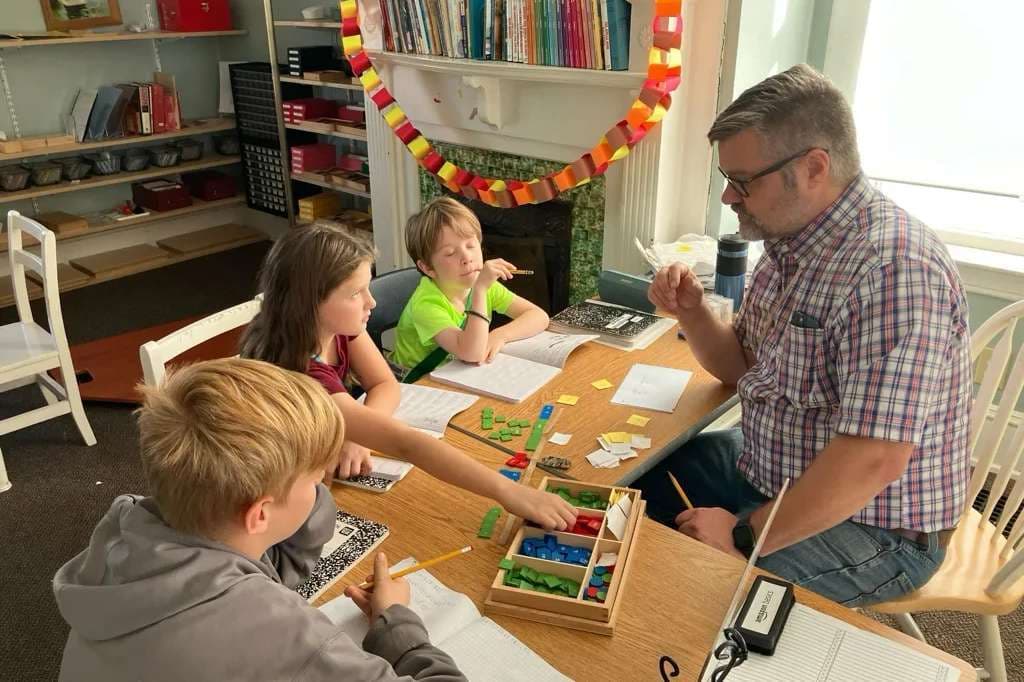
A small Catholic Montessori school in Steubenville, Ohio, is working to provide a holistic approach to education for all children, grounded in a mission to form the whole person and serve all families.
In a recent interview with Zeale News, Tom and Noëlle Crowe explained that they founded Hilltop Montessori School to expand access to a Montessori education, citing the teaching style’s benefits, especially for children from difficult circumstances.
“The way [Montessori] approaches children is the most respectful way possible, and it’s a way that looks first and foremost at ‘What do the children need? What do we know about their development?’ and therefore ‘What can we give them?” Noëlle said, adding that it isn’t based on standardized information children need to know.
She continued, “It’s really about what children need to develop into fully functioning, healthy adults. And Montessori is not just about education and the way we think of it in terms of importing academic knowledge. It’s about the full person.”
The school’s founding
The Crowe couple opened Hilltop in 2018 after being married for just five months. They had little savings, no major investors, and two students, Noëlle said.
However, the school slowly started to grow, overcoming numerous financial obstacles along the way. Hilltop now serves 41 students across preschool and elementary programs, and Tom and Noëlle also plan to expand the curriculum this fall to include a secondary school.
According to Tom, one motivating factor in the school’s founding was research that suggested a Montessori education can narrow or eliminate typical achievement gaps associated with family income, presenting a unique opportunity for Hilltop to make a strong impact in Steubenville’s low-income neighborhoods.
They said Montessori education in the U.S. is typically available to wealthier children, but their hope was to make Montessori available to everyone, serve both the children and the community, and contribute to the neighborhood’s revitalization. Hilltop relies on donors and fundraising to provide families with financial aid and keep tuition lower than most Montessori schools in the U.S.
“Regardless of means, whether it’s a lot or a little, we want to be able to serve the children,” Noëlle said, adding that their students are from a variety of backgrounds.
She later added, “Maria Montessori did start with poor children. In the United States [Montessori] tended to be for pretty wealthy children, and we didn’t want that to be the case.”
The Montessori Movement
Catholic physician Maria Montessori started developing her educational model in Rome over a century ago, rooted in her beliefs that education is about the entire person and that children desire purposeful, real work.
According to Tom and Noëlle, the Montessori teaching method shows children how to develop independence and practical skills and instructs them in a hands-on way that involves their senses. Though not geared explicitly at Catholics, Noëlle said that the method is infused with Catholic principles.
Rebecca Feeley, one of Hilltop’s teachers — called “guides” — described the teaching model as a “unified education in a fragmented world.”
Noëlle added that “Montessori is the only methodology that actually represents the fact that we are body and soul.”
At Hilltop, different skills and subjects are integrated in each lesson. Tom said that math lessons can include brief tangents on the roots of words or instruction on the history of specific theorems and mathematicians. Other lessons can easily pivot to focus on spelling or beautiful penmanship. The educational method allows students to be curious, ask questions, and see the connections between different academic disciplines.
“There’s never been a time where I was like, ‘well, we can’t talk about that now,’” he said.
Students used a variety of skills in another of Tom’s lessons, which Noëlle described as a “poetry café.” She said students prepared poems, baked scones, and organized an event in which they listened to one another recite. Tom and Noëlle said the lesson drew on the students’ public-speaking and decision-making skills as well as practical life skills such as following directions, measuring, and baking.
Creating a community
Feeley said through the Montessori model, Hilltop has been building community in Steubenville. She said parents are deeply involved in their children’s education and the school has facilitated meaningful relationships, unity, and dialogue between different viewpoints, allowing children and families to learn how to live as a society and community.
Lucy Bernetsky, Noëlle’s assistant in a primary classroom, said she’s seen the school make a tangible difference in the neighborhood community and Steubenville since she started at Hilltop in 2022.
“The hilltop has come alive again, swarming with families that are seeking faith filled, holistic education for their children,” she said, later adding, “This school has brought so much joy to my life and to the life of Steubenville — I know that its impact will be felt for many years to come.”






Comments