Patriarch barred from Holy Sepulchre on Palm Sunday in Jerusalem
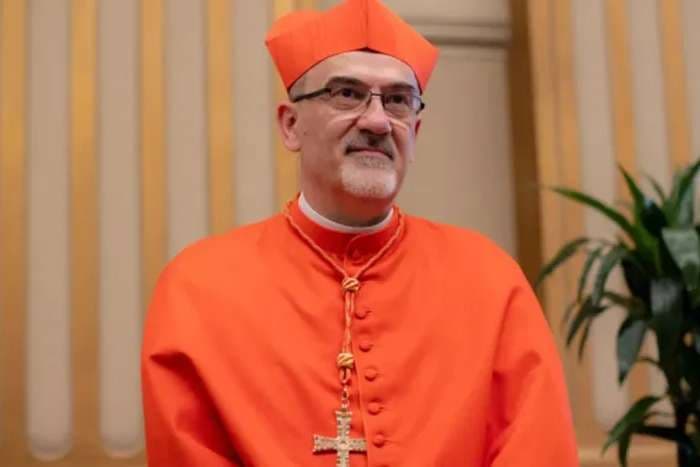
On the day Christians worldwide call Palm Sunday—the opening of the most sacred week of the liturgical year—Israeli national police stopped Cardinal Pierbattista Pizzaballa, the Latin Patriarch of Jerusalem, from entering the Church of the Holy Sepulchre.
Editorial Note: Below is a message sent to supporters from CatholicVote President and CEO Kelsey Reinhardt.
Something happened this morning in Jerusalem that I cannot let pass without comment.
On the day Christians worldwide call Palm Sunday—the opening of the most sacred week of the liturgical year—Israeli national police stopped Cardinal Pierbattista Pizzaballa, the Latin Patriarch of Jerusalem, from entering the Church of the Holy Sepulchre.
Let me be precise about what this means. The Church of the Holy Sepulchre stands on the ground of the Crucifixion, Burial, and Resurrection of Jesus Christ. It is the most sacred site in Christendom. And the Latin Patriarch, the highest Catholic authority in the Holy Land, was turned away at its door.
Not at the head of a crowd. He was not leading a procession. He and three priests, a private delegation, were well within every restriction Israel’s Home Front Command established for public gatherings.
“For the first time in centuries,” the Christian Patriarchs of Jerusalem declared today in a joint statement, “the Heads of the Church were prevented from celebrating the Palm Sunday Mass at the Church of the Holy Sepulchre.”
For the first time in centuries.
I believe in Israel’s right to security. I believe in the legitimacy of sovereign nations to make prudential decisions about public order, especially in wartime. And I want to be very clear: the security challenges Israel faces are real, and the Christian community is not indifferent to them.
But this is precisely where a distinction must be made: one that the Christian Patriarchs themselves articulated with precision, and that even the United States Ambassador to Israel, Mike Huckabee, did not hesitate to make publicly.
Ambassador Huckabee, who is by any measure a friend of Israel, called today’s decision “an unfortunate overreach” that is “difficult to understand or justify.” He noted what the joint statement also made clear: the Home Front Command’s own guidelines restrict gatherings to 50 people or fewer. The Patriarch’s delegation numbered four.
Four people. Private. Without ceremony. Below every threshold.
The Israeli government’s stated explanation (that the Patriarch was barred for his own personal safety) does not hold up under scrutiny. Churches, synagogues, and mosques throughout Jerusalem have operated within the 50-person restriction without incident. The Patriarch and the Custos of the Holy Land, by their own account, have complied with every wartime restriction since the conflict began. They canceled public gatherings, banned attendance, arranged broadcasts for the hundreds of millions of faithful worldwide who look to Jerusalem this week.
What was denied today was a pastor entering a church with an agreement to livestream the Mass precisely due to the imposed restrictions, not a crowd attempting to flaunt security measures.
The joint statement, signed not by one tradition but by the full community of Christian Patriarchs and Heads of Churches in Jerusalem—representing Catholics, Greek Orthodox, Armenian, Coptic, Syriac, and Ethiopian faithful alike—called the decision “a manifestly unreasonable and grossly disproportionate measure” and “an extreme departure from basic principles of reasonableness, freedom of worship, and respect for the Status Quo.”
Italian Prime Minister Giorgia Meloni, one of Israel’s closest European allies, called it “an offense not only to the faithful but to any community that respects religious freedom” and summoned Israel’s Ambassador to Italy. French President Emmanuel Macron condemned the action and affirmed that worship must be guaranteed in Jerusalem for all religions.
These are not Israel’s critics speaking. These are Israel’s friends.
I want to say something directly to the government of Israel, and I ask that it be received in the spirit it is offered, namely as honest counsel from people who genuinely want Israel to succeed and who understand what is at stake in the Christian world this week.
The goodwill of the Christian community toward Israel is not automatic. It is earned, and it is fragile. It rests, in significant part, on the conviction that Jerusalem’s holy places are protected and accessible; that Israel is not an adversary of the faith traditions that call Jerusalem sacred. When the Latin Patriarch of the Holy Land is turned away from the Tomb of Christ on Palm Sunday, something breaks. It breaks in the hearts of believers across every Christian tradition. And it breaks in the moral imagination of the many Christians who have been willing, in the face of enormous cultural pressure, to stand with Israel and against antisemitism.
Pope Leo has said clearly that the Catholic Church does not tolerate antisemitism, and that to combat it is a demand of the Gospel itself. I hold that position without reservation. But there is a pastoral reality that Israel’s government would do well to weigh. The people most willing to answer that call, the faithful who have followed their Church’s teaching in defending the Jewish people, are the very same people watching their Patriarchs barred from the most sacred site in their faith at the start of the most sacred week of their year. The decision made today does not serve the cause of those still willing to stand. It makes their witness harder to sustain, and gifts easy ammunition to those who have long sought to portray Israel as hostile to Christian and Muslim worship alike.
In short, this was a grave and unnecessary wound to inflict on so many who still are counted among Israel’s friends.
President Isaac Herzog has stated that the State of Israel holds an “unwavering commitment to freedom of religion for all faiths and to upholding the status quo at the holy sites of Jerusalem.” We receive that statement with respect and with a precise understanding of what it now requires.
For more than a billion Christians entering the most sacred days of their calendar, there is one way—and only one—to give those words their substance. The government of Israel must guarantee the Patriarch the full, free, and uninterrupted celebration of the Holy Triduum, the sacred three days, from the evening of Holy Thursday through Easter Sunday, which form the irreducible heart of Christian worship.
The Patriarchs have never asked for special treatment or exemption from reasonable security measures. They are asking for something far more basic: that religious freedom be upheld in a way that is plainly achievable and fully consistent with two thousand years of continuous Christian worship—something the State of Israel is entirely capable of guaranteeing, even under present threats.
And so we pray. We pray for Jerusalem, for the Holy Land, for the peace that surpasses all understanding to reign in our hearts and in this world.
Finally, we beseech the King of Kings whose sacred feet sanctified the steps to Calvary and whose sepulchre—site of his Crucifixion, Burial, and Resurrection—is the ground of all hope that we may not be silent in the face of persecution but say with even the very stones of Jerusalem: all praise to Jesus Christ now and forever.
Go forward bravely,
Kelsey Reinhardt
President & CEO
CatholicVote
Comments