Pentagon outlines progress, casualties, next steps as Iran war enters third week
Senior U.S. defense officials held a press briefing March 19 as the U.S.-Israeli war with Iran entered its third week, saying American forces have significantly weakened Iran’s military, addressing the deaths of U.S. service members and indicating the conflict could continue without a clear end date as the Pentagon weighs a potential multibillion-dollar funding request to sustain operations.

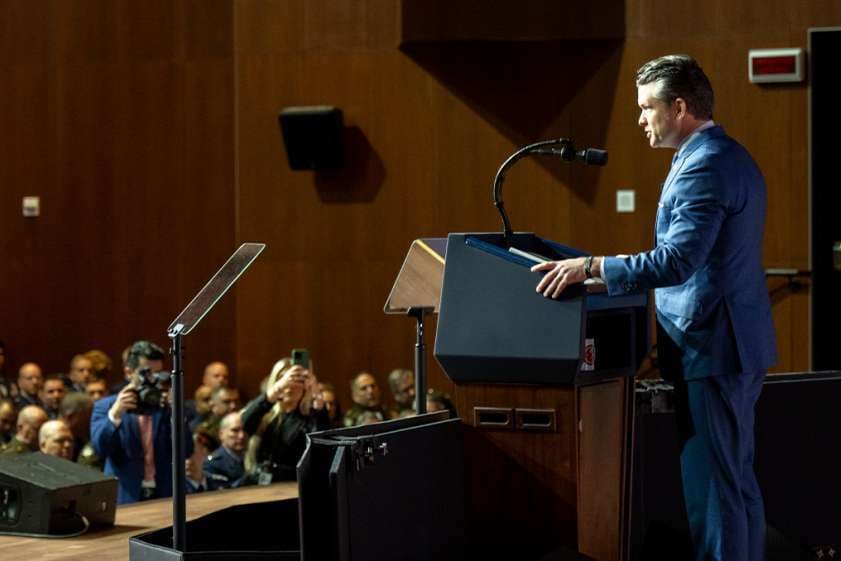
Senior U.S. defense officials held a press briefing March 19 as the U.S.-Israeli war with Iran entered its third week, saying American forces have significantly weakened Iran’s military, addressing the deaths of U.S. service members and indicating the conflict could continue without a clear end date as the Pentagon weighs a potential multibillion-dollar funding request to sustain operations.
Officials detail scale of strikes against Iran
Officials said at the briefing that American forces have struck more than 7,000 targets in Iran and significantly degraded its military capabilities, as the conflict with Tehran entered its third week with no clear timeline for an end.
Defense Secretary Pete Hegseth said the U.S. campaign, known as “Epic Fury,” remains focused on dismantling Iran’s missile, drone, and naval capabilities while preventing it from developing a nuclear weapon.
“Our objectives, given directly from our America first president remain exactly what they were on day one” Hegseth said. “These are not the media's objectives, not Iran's objectives, not new objectives, our objectives, unchanged, on target and on plan, destroy missiles, launchers and Iran's defense industrial base so they cannot rebuild, destroy their navy and Iran never gets a nuclear weapon, our objectives from day one.”
Hegseth said U.S. forces have applied “overwhelming force” across Iran, striking thousands of military targets and infrastructure sites.
He said Iran’s ability to carry out attacks has been significantly reduced, with “ballistic missile attacks against our forces down 90 percent,” along with similar declines in drone strikes. Still, he acknowledged that Iran retains some capability and continues to launch attacks.
Gen. Dan Caine, chairman of the Joint Chiefs of Staff, said U.S. forces are expanding operations deeper into Iranian territory and continuing strikes against missile sites, naval assets, and military infrastructure.
“Each day we continue to attack deeper into Iranian territory,” Caine said, adding that U.S. forces recently used heavy “penetrator” weapons to target underground storage facilities for cruise missiles.
Caine said U.S. forces have destroyed more than 120 vessels and dozens of mine-laying platforms and are targeting Iran’s ability to project power beyond its borders.
“The pressure will continue,” he said.
U.S. deaths mourned
A reporter at the press briefing prefaced a question by noting that Caine and Hegseth had spoken eloquently about the 13 U.S. service members that have been killed so far in the conflict, asking what lessons could be learned from their deaths.
Caine responded about the lessons learned, stating that he would not discuss tactics, but explained the process for evaluating plans, noting that they “plan for literally everything” and ask a series of questions afterward.
“Did we execute our plan, yes or no? If we did, did it work? If not, why not? If we didn't execute our plan, but did something better, what's the lesson learned associated with that? And then how do we quickly capture those lessons after every loss or every engagement and quickly adopt those lessons and then share them across the entirety of the joint force?” he said. “And inside the joint staff, we've tasked our J7 Directorate under the lead of Lieutenant General Liszewski, a U.S. Marine, to be extremely entrepreneurial in harvesting and capturing those lessons in a proactive and not reactive way.”
He later added, “I've asked them to look rigorously, to check our egos at the door, to remember this is about what's right, not who's right, and to be clinical around the way we look at lessons learned because we owe it to the force to do that.”
Officials did not respond to confirm the total during the conference.
The briefing came a day after traveling with President Donald Trump to Dover Air Force Base in Kent County, Delaware, to receive the remains of U.S. service members who were killed in the conflict. Caine identified the fallen troops and said they “represent the best of our nation,” adding that “our entire joint force mourns with you today.”
U.S. officials say war ‘on plan’ with no clear end date
The Pentagon is weighing a potential supplemental funding request to Congress that could reach $200 billion to sustain operations and replenish munitions, Hegseth said.
He said the campaign would continue without a fixed timeline, emphasizing that decisions about when to conclude operations would be made by the President.
“We wouldn’t want to set a definitive timeframe,” he said. “We are very much on plan.”
Caine said Tehran still retains weapons capabilities.
“They came into this fight with a lot of weapons,” he said. “We are continuing to hunt and find them and kill them, and we will continue to do so.”
Hegseth also said the U.S. is working with regional allies, including Israel and several Gulf states, to counter Iran’s actions. He described Israel as “an incredible and capable partner.” The Gulf states that have supported the effort are Saudi Arabia, the United Arab Emirates, Qatar, and Bahrain.






Comments