Poll: French nationalist likely to defeat left-wing and moderate candidates in 2027 presidential election
The National Rally’s Marine Le Pen is expected to win the lion’s share of ballots in the first round of voting in France’s presidential election next year — before moving on to defeat potential challengers from both the left and the center in the presidential run-off.
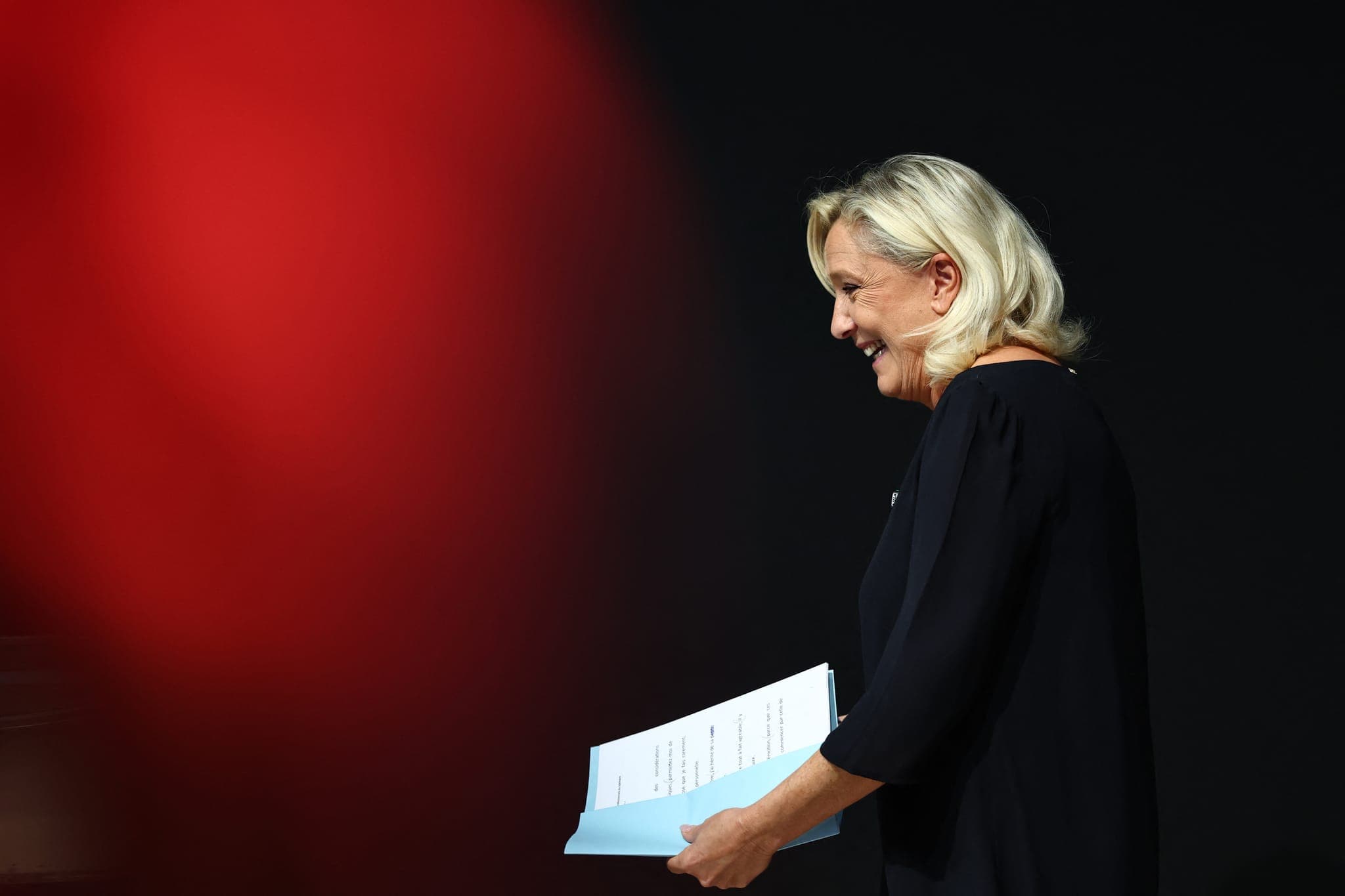
New polling anticipates a likely victory for French nationalist Marine Le Pen in next year’s presidential election as growing discontent with immigration policies is propelling conservative and nationalist parties to major wins across Europe.
In five different electoral scenarios proposed in Toluna Harris Interactive’s Sept. 28 survey, Le Pen, the longtime leader of the populist and immigration restrictionist National Rally party, and Jean-Luc Melenchon, head of the far-left party La France Insoumise, would both advance to the presidential runoff elections. Given a choice between Le Pen and Melenchon, voters would overwhelmingly support Le Pen.
In France, all presidential candidates run against each other in the first round of voting, regardless of party affiliation. If no candidate wins an outright majority of the vote, the two with the highest shares of the vote advance to a run-off.
In the first round of voting in 2022, Le Pen finished with 23% of the vote, behind incumbent Emmanuel Macron, who scored 28%. In the run-off, Le Pen won more than 40% of the vote, the highest share for any French nationalist in the history of the French Republic.
According to Toluna Harris Interactive, Le Pen is expected to win 35% of the vote in three first-round election scenarios and 36% in the other two, while Melenchon is expected to win either 17% or 18%. In the hypothetical run-off against Melenchon, Le Pen is expected to win nearly 69% of the vote and claim the French presidency.
Against centrist Édouard Philippe, the former prime minister of France and the current mayor of Le Havre, Le Pen would still win, but by a narrower margin: She would take 57% of the vote against Philippe’s 43%.
Le Pen was barred from running for president in 2025, when a French court convicted her on charges of embezzlement. The National Rally leader was accused of using party funds intended for European Parliament candidates on campaigns for party candidates in national elections. In addition to being fined, she was barred from running for public office for a five-year period.
In July 2026, the Paris Court of Appeal upheld the conviction but effectively reversed the presidential ban, reducing the prohibition to a period of 45 months, suspending 30 months of the sentence, and counting the remaining 15 months as already served. Le Pen immediately announced her candidacy for the 2027 presidential election. The Cour de Cassation, France’s highest court of law, is expected to deliver a final ruling on the conviction and its penalties in April, shortly before the first round of voting in the presidential election.
In the wake of the Macron administration’s response to the COVID-19 crisis, worsening mass immigration, and the continuing Islamization of France, Le Pen’s National Rally has made significant gains in major elections. In 2024, the party made significant gains in the European Parliament, prompting Macron to call a snap parliamentary election to bolster his own coalition.
The move initially backfired, and National Rally candidates across the country won the first round of voting. However, Macron’s left-of-center party Ensemble brokered deals with the left-wing New Popular Front coalition, which included Melenchon’s party, to have either Ensemble or left-wing candidates drop out of three-way run-off races in order not to split the vote and hand National Rally wins across France.
Such electoral tactics have failed to keep National Rally from winning over voters. The party gained a record 14 seats in the French Senate over the weekend, through a series of special elections. This is the first time that National Rally has cleared the 10-seat Senate threshold required to form a caucus.
Le Pen hailed the party’s expansion in the Senate as “a historic victory” and “a major milestone” in a Sept. 27 X post.
“The results go beyond what we could have hoped for; the breakthrough is widespread, confirming the acceleration of the National Rally's establishment across the entire territory,” she said.
Since its founding in 1972 by Le Pen’s father, Jean-Marie Le Pen, the National Rally (then called the National Front) has advocated for populist and nationalist policies, including stringent immigration restriction, defense of French national identity, and potentially withdrawing from the European Union.
The surging popularity of Le Pen’s presidential campaign and National Rally’s candidates and policies comes as conservative and immigration restrictionist parties across Europe rise in power and popularity.
Alternative for Germany (Alternative für Deutschland or AfD) won two major state elections over a two-week period, taking the largest share of seats in the state parliaments of Mecklenburg-Western Pomerania and Saxony-Anhalt. Like Le Pen and National Rally, AfD has been labeled “far-right” by political opponents and has been targeted by state security forces for investigation and prosecution. Also like National Rally, AfD is a vocal opponent of mass immigration and the Islamization of Germany.





Comments