Pope Leo XIV urges unity and hope in Angola, clarifies response to Trump
Pope Leo XIV continued his apostolic journey across Africa this weekend with a stop in Angola, where he met with the country’s president, civil servants, and diplomatic corps and visited a Marian pilgrimage site, renewing his calls for peace and hope at both events.

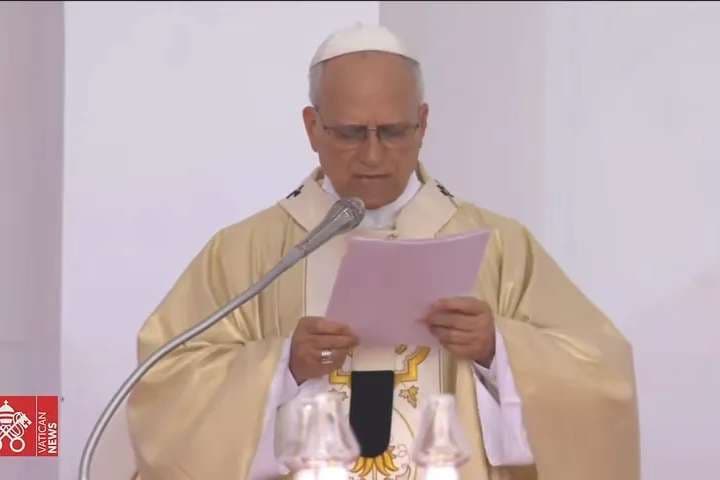
Pope Leo XIV continued his apostolic journey across Africa this weekend with a stop in Angola, where he met with the country’s president, civil servants, and diplomatic corps and visited a Marian pilgrimage site, renewing his calls for peace and hope at both events.
Pope Leo addresses relationship with President Donald Trump
Speaking en route to Angola from Cameroon, Pope Leo told journalists that President Donald Trump’s comments on social media last week — which criticized the Pontiff as being “weak” and “terrible for foreign policy” — have lent a “certain narrative that has not been accurate in all of its aspects” to his apostolic journey. He said that though remarks he has made throughout the trip might appear otherwise, he is not “trying to debate” Trump.
“Just one little example: the talk that I gave at the prayer meeting for peace a couple of days ago was prepared two weeks ago, well before the President ever commented on myself and on the message of peace that I am promoting,” he said. “And yet, as it happens, it was looked at as if I was trying to debate again the President, which is not in my interest at all.”
During the address, which was given April 16 in Cameroon, Pope Leo had decried the violence of war and those who spend billions on “killing and devastation,” saying that the world “is being ravaged by a handful of tyrants.”
The Pontiff’s first day in Angola: ‘Make Angola a project of hope’
After touching down in Angola, Pope Leo met with President João Lourenço at the presidential palace. The meeting was also attended by several civil authorities and members of the diplomatic corps.
He praised the Angolan people for their joy that he said “not even the most adverse circumstances have been able to extinguish.”
“For the entire world, Africa is a reservoir of joy and hope, which are virtues that I would not hesitate to call ‘political,’ because her young people and her poor continue to dream and to hope,” he later continued. “They are not content with what already exists; they strive to rise above, to prepare themselves for great responsibilities, and to take an active part in shaping their own future.”
Pope Leo discussed conflict that has arisen in Angola over rich natural resources, noting that when powerful entities seek to extract and exploit the resources, disastrous harms are inflicted on the Angolan people. He encouraged Angola’s leaders to “believe in the manifold nature of its riches,” saying that making the common good the country’s priority, ahead of other interests, will result in growth.
Returning to the theme of joy, the Pontiff encouraged Angola to allow the virtue to flourish and cultivate community, which he said can aid in making “Angola a project of hope.” The Pope highlighted the Church’s role in creating community, saying that the Church can “foster the growth of a just model of coexistence, free from the various forms of slavery imposed by the elite who are laden with much wealth but false joys.”
“Only together can we multiply the talents of this wonderful people, even in the urban peripheries and the remotest rural areas, where life is vibrant and the future of the people is being prepared,” he said.
Pope Leo celebrates Mass, encourages adherence to Church doctrine
Pope Leo began his second day in Angola by celebrating Mass, during which he urged the Angolan people to remember that Jesus walks with them, even as he walked with the disciples on the road to Emmaus. He reflected on Angola’s war-torn history, saying “When one is long immersed in a history so characterized by pain, one can risk losing hope and remaining paralyzed by discouragement, just like the two disciples.”
However, the Pontiff pointed to the truth of the Resurrection as encouragement for the people, saying that Jesus “walks beside us as we journey along the path of suffering and bitterness, opening our eyes so that we may recognize his work and granting us the grace to start afresh and rebuild the future.”
Above all, he encouraged pursuing a relationship with Jesus, especially in the Mass and his Real Presence in the Eucharist.
“It is here that we encounter God,” he said. “For this reason, we must always be vigilant regarding those forms of traditional religiosity that certainly belong to the roots of your culture, but at the same time risk confusing and mixing magical and superstitious elements that do not aid your spiritual journey. Remain faithful to what the Church teaches, trust your pastors, and keep your gaze fixed on Jesus, who reveals himself in the word and in the Eucharist.”
Renewed calls for peace
Pope Leo offered a brief address before the Regina Caeli, expressing sadness at escalating violence in Ukraine and calling for renewed dialogue in pursuit of peace. He also addressed the ceasefire in Lebanon, saying that it “offers cause for hope.” He encouraged diplomats to find a peaceful solution to the war.
“Christ has conquered death, and it is with this certainty that all of us, united with him and in him as one Body, commit ourselves today and every day, despite obstacles and difficulties, to spreading around us the fruits of Easter that are love, true justice and peace,” he concluded.
The Pontiff visits Marian pilgrimage site
The Pope’s day concluded with a visit to the Marian Shrine of Mama Muxima — which means “Mother of the Heart” in Kimbundu — where he prayed a Rosary, joined by youth and members of the Legion of Mary.
In an address, he said the experience was an "intense and fervent moment with the living and young Church of Angola,” which he said forms a community “where one can truly feel the freshness of faith and power of the Spirit.”
According to Vatican News, the Mama Muxima shrine was built in the 16th century and has become a devotional center for Angolans, offering spiritual refuge during years of war. Pope Leo said that the shrine has sustained Christian life in Angola, saying “For a long time now, Mama Muxima has quietly worked to keep the heart of the Church alive and beating.”
He reflected on Mary’s motherly love and told young people in attendance that they are called to emulate Our Lady’s concerns and “be workers for justice and bearers of peace.”
The Pontiff later added, “It is love that must triumph, not war! This is what the heart of Mary — the heart of the Mother of all — teaches us. Let us set out, then, from this shrine as “messenger angels” of life, bringing Mary’s tender embrace and God’s blessing to everyone.”



Comments