During his apostolic journey, Pope Leo invokes St. Augustine in call for servant leadership in Cameroon
As he continued his 11-day apostolic journey across Africa, Pope Leo XIV on April 15 arrived in Cameroon’s capital, Yaoundé, where he met with the country’s president, addressed government officials, and visited an orphanage run by Catholic nuns.

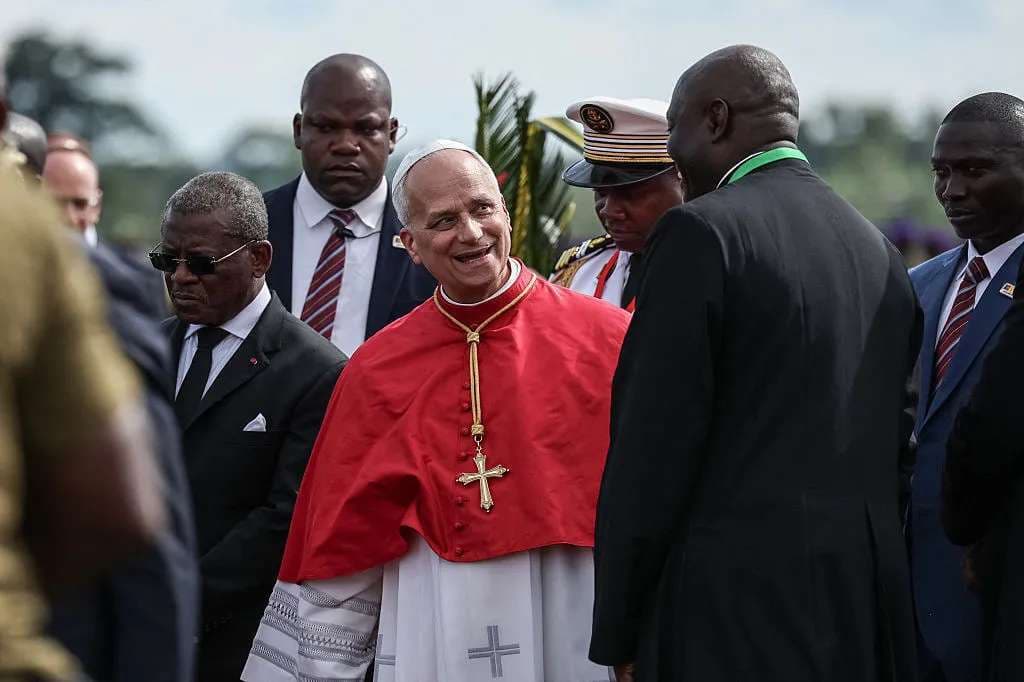
As he continued his 11-day apostolic journey across Africa, Pope Leo XIV on April 15 arrived in Cameroon’s capital, Yaoundé, where he met with the country’s president, addressed government officials, and visited an orphanage run by Catholic nuns.
After receiving a formal welcome ceremony upon arriving in Yaoundé, Pope Leo traveled to the presidential palace for a courtesy visit with Cameroon President Paul Biya, the 93-year-old leader who has been in power since 1982. He then spoke with government authorities, civil society representatives, and diplomats at the palace.
The visit comes at a sensitive time for Cameroon, where roughly 29% of the population is Catholic and where a separatist conflict has strained the country’s English-speaking regions, according to AP News. Rebels have been fighting since 2017 for greater independence from the French-speaking majority. The outlet also reported that on the eve of the Pope’s arrival, the main separatist groups announced a three-day pause in fighting to allow safe travel for the visit and for pilgrims.
Pope Leo addresses government authorities
Speaking at the palace, Pope Leo described himself as a “shepherd and a servant of dialogue, fraternity, and peace” and emphasized that he wishes to “strengthen the bonds between the Holy See and the Republic of Cameroon, which are founded on mutual respect, the dignity of every human person, and religious freedom.”
He highlighted a global sense of discouragement but pointed to a continued desire — especially among young people — for justice and lasting peace.
Drawing on the teachings of Saint Augustine, Pope Leo told leaders that political authority should fundamentally be a form of service. Leaders should act “not from a love of power, but from a sense of the duty they owe to others,” he said.
“Peace, in fact, cannot be decreed: it must be embraced and lived. It is a gift from God, which unfolds through patient and collective effort,” Pope Leo remarked at another point in the address. “It is everyone’s responsibility, beginning with civil authorities. To govern means to love one’s own country as well as neighboring countries; the commandment ‘love your neighbor as yourself’ is equally applicable to international relations!”
Addressing ongoing violence in parts of the country, Pope Leo lamented the human toll of conflict and called for rejecting violence in favor of a peace “founded on love and justice.” He also urged leaders to invest in young people, describing them as “the hope of the country and of the Church.”
The Pope called for deeper interreligious dialogue and encouraged religious leaders to take part in mediation efforts. He also pointed to the Church’s ongoing commitment to education, healthcare, and charitable service.
Concluding his address, Pope Leo invoked a blessing on the nation: “May God bless Cameroon, assist its leaders, guide civil society, enlighten the work of the Diplomatic Corps and grant the entire Cameroonian people — Christians and non-Christians, political leaders and citizens — the grace to welcome the Kingdom of God and so build together a future of justice and peace.”
Pope Leo visits the Ngul Zamba Orphanage
Pope Leo also visited the Ngul Zamba Orphanage, run by Catholic nuns. He told the children “you form a true family here” and encouraged them not to define their future by suffering but to remember they are “called to a future that is greater than your wounds.”
“In a world often marked by indifference and selfishness, this home reminds us that we are the ones who need to look after our brothers and sisters,” he said, “and that, in God’s great family, no one is ever a stranger or forgotten, no matter how small he or she may be.”
He also thanked staff and the religious sisters for their care, which he described as a concrete expression of love that gives the children stability and hope.
“By caring for these children, you are getting a foretaste of the joy that the Lord has promised to those who serve the little ones (cf. Mt 25:40),” the Holy Father said.
He will also hold a private meeting with Cameroon’s bishops on April 15 and is staying in the country until April 18 before continuing his trip to Angola and Equatorial Guinea.
>> ‘Here Saint Augustine loved his flock’: Pope Leo visits Annaba, site of ancient Hippo <<




Comments