Rep. Smith says Rubio faces ‘tall task’ in India amid religious freedom concerns
Rep. Chris Smith, R-N.J., said in an op-ed published May 21 that Secretary of State Marco Rubio faces a “tall task” during his upcoming trip to India, warning that the country is considering legislation that he said could pose an imminent threat to religious liberty and damage ties between Washington and New Delhi.

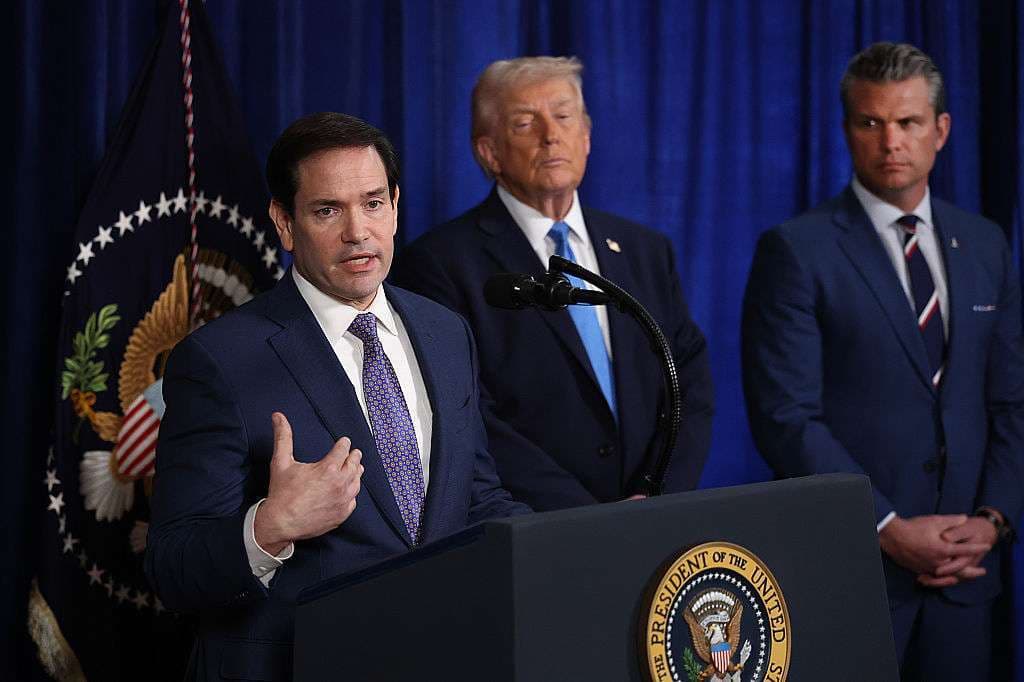
Rep. Chris Smith, R-N.J., said in an op-ed published May 21 that Secretary of State Marco Rubio faces a “tall task” during his upcoming trip to India, warning that the country is considering legislation that he said could pose an imminent threat to religious liberty and damage ties between Washington and New Delhi.
Rubio will travel to India from May 23-26, where he will visit Kolkata, Agra, Jaipur, and New Delhi, according to a press release from the U.S. Embassy and Consulates in India. He and senior Indian officials are scheduled to discuss energy security, trade, and defense. But Smith argued the administration faces a choice between advancing those ties and confronting Modi's government over religious freedom.
“Prime Minister Narendra Modi’s government is poised to pass a law that could do lasting damage to the relations between our two countries,” Smith wrote.
Smith urged Rubio to press Prime Minister Narendra Modi’s government over a bill that proposes amendments to India’s Foreign Contribution Regulation Act (FCRA), which governs organizations receiving foreign funding.
India's cabinet approved the bill in March, and it was introduced in parliament shortly afterward. If the proposed amendments pass, the government could seize all the assets, such as land or buildings, of a church or charity that lets its foreign-funding license lapse.
“In effect, the total property of entire churches and dioceses could soon be at risk of being taken over by the Indian state,” Smith wrote.
India's major Christian denominations have formally protested the bill, saying it violates constitutional rights. Parliament is expected to take it up this summer.
The congressman framed Rubio’s visit as a key test of whether the Trump administration would publicly prioritize religious freedom concerns alongside its broader geopolitical partnership with India.
Smith, a longtime advocate of international religious freedom, argued the proposed law could allow authorities to confiscate church property over what he described as routine technical violations.
“The effect is that, for an error in a single transaction, the entire property of a church, including equipment, land, schools, hospitals, and bank funds, could vest immediately in a government-designated authority,” he wrote.
India's Catholic Bishops' Conference has echoed that alarm, calling the bill "undemocratic, unconstitutional, and contrary to the principles of natural justice." The bishops warned in March that the legislation would allow the government to seize assets without first going through a court — granting what they called "dangerous overreach" into minority institutions. The bishops have formally appealed to Home Minister Amit Shah and members of parliament to strip the bill of its asset-seizure provisions.
Smith warned that because many churches, dioceses, charities, and aid organizations rely at least in part on foreign donations, the law could expose large portions of India’s Christian institutional network to state control.
He also warned that the bill’s provisions could apply retroactively and extend even to organizations that received only limited foreign funding.
“The entire assets of a diocese, owning perhaps hundreds of churches, could be seized for an error in processing a single small foreign donation,” Smith wrote.
As an example, Smith pointed to the temporary 2022 suspension of the foreign-funding license held by the Missionaries of Charity, the order founded by Mother Teresa.
“Under these amendments, all of the order’s assets could have been seized outright and permanently lost, even though the license was eventually restored,” he said.
Over the past decade, India's government has revoked or suspended the FCRA registrations of more than 20,000 organizations, according to International Christian Concern. More than 70% of the NGOs whose licenses expired as of January 2022 were aligned with Christian programs, the group said.



.jpg&w=3840&q=75)
Comments