Secretary Rubio says Catholicism helped build America and remains vital to its future at CUA conference
Secretary of State Marco Rubio delivered a virtual address April 9 to a conference at the Catholic University of America arguing that Catholicism is not a late addition or outlier in the American story, but one of its deepest civilizational roots – and one that will remain essential as the nation approaches its 250th anniversary.
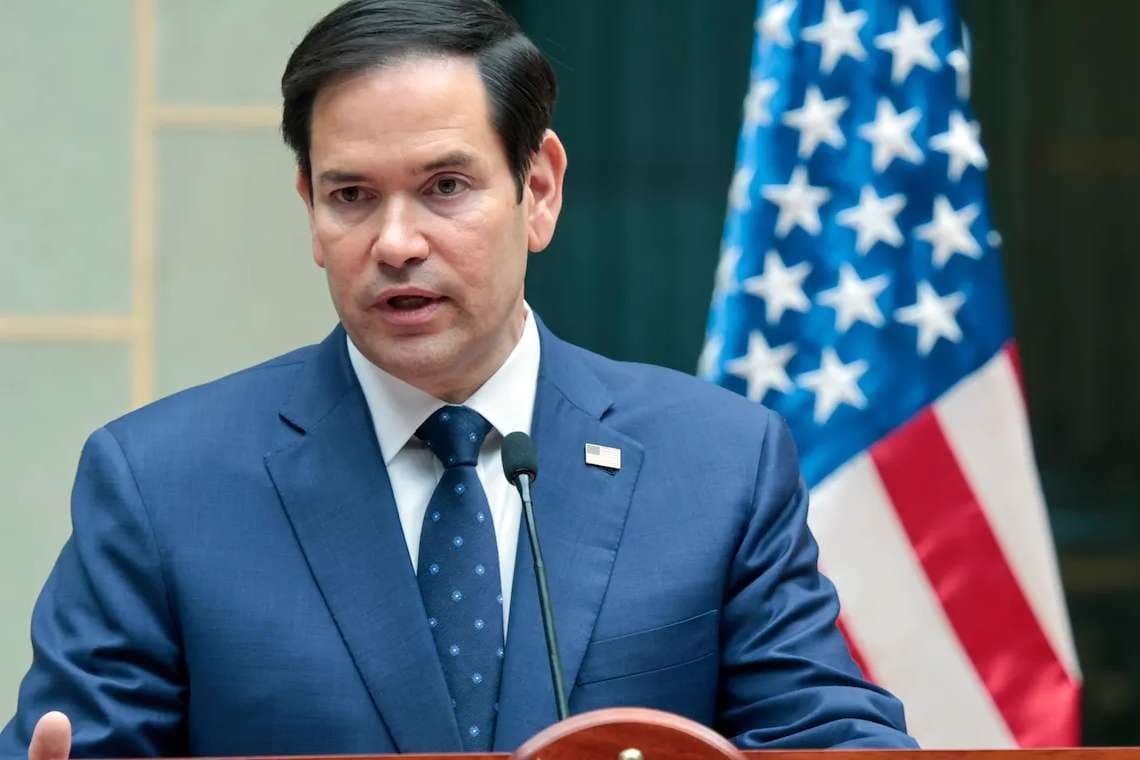
Secretary of State Marco Rubio delivered a virtual address April 9 to a conference at the Catholic University of America arguing that Catholicism is not a late addition or outlier in the American story, but one of its deepest civilizational roots – and one that will remain essential as the nation approaches its 250th anniversary.
The April 9 symposium, titled “Endowed by Their Creator: Catholicism, the Declaration of Independence, and the American Experiment at 250,” was hosted by the university’s Center for the Constitution and the Catholic Intellectual Tradition, together with Notre Dame’s Center for Citizenship and Constitutional Government and CUA’s Carroll Forum for Citizenship and Public Life.
In remarks that blended history, political philosophy, and civilizational memory, Rubio pushed back against claims that the Catholic faith is at odds with the American founding. Instead, he argued that Catholicism helped prepare the cultural and moral soil from which the nation grew.
“In 1895, Pope Leo XIII penned an encyclical to the Catholic Church in the United States,” Rubio said. “‘All intelligent men are agreed,’ he wrote, ‘that America seems destined for greater things. Now, it is our wish that the Catholic Church should not only share in, but help to bring about this prospective greatness.’”
Rubio then explained that the Church did not merely arrive later to bless the American project from a distance. It was present at the beginning, helped shape the civilization from which the United States emerged, and still has a role to play in the country’s moral and political renewal.
“But, as the Holy Father noted, the Church had already been here from the start,” Rubio said.
He rooted that claim in a long Catholic history on the continent, beginning with Christopher Columbus and extending through explorers, missionaries, settlers, and martyrs. Rubio described Columbus as the man who “renewed the West’s confidence in itself” and helped launch “that great age of discovery, exploration, and expansion from which America was born.”
Rubio also rejected the idea that Catholicism is somehow alien to the American experience.
“Some have claimed that the Catholic faith is a foreign import to our country,” he said. “Only one of the 56 men who signed the Declaration of Independence was Catholic: Charles Carroll of Maryland, for whom one of this conference’s hosts is named. Just two Catholic names appear on our Constitution itself.”
“But,” Rubio continued, “the Catholic faith has always been part of the American story.” He pointed to concrete historical markers: “The first Christian service on our soil was a Catholic Mass. The oldest permanent settlement in the United States is the town of St. Augustine, planted by Spanish Catholics on the coastal sands of my home state of Florida.”
From there, Rubio widened the frame. He argued that Catholic missionaries, soldiers, and pioneers were not marginal figures in the settlement of the continent, but central actors in its early exploration and the naming of its landmarks.
“In missions and settlements, wilderness forts, and trading posts stretching from the first colonies to the distant frontier, Catholic explorers, soldiers, priests, and pioneers consecrated this new world to their ancient faith and christened its land with Catholic names,” Rubio said. “Maryland, St. Louis, San Francisco, Santa Fe, almost every region of what is now the United States was first explored and mapped by Catholics.”
That Catholic presence was not, he argued, an accident of geography or empire, but the fruit of a specifically Catholic imagination: one capable of thinking across civilizations, frontiers, and vast spans of time.
“This is no coincidence,” Rubio said. “Christianity taught the West to think in continents and centuries, rather than villages and seasons. The Church calls us, as Christ told St. Peter, to ‘duc in altum,’ to ‘put out into the deep.’”
That civilizational and missionary impulse, Rubio suggested, did not end with the age of exploration. It flowed into the American founding itself. He noted that although Catholics were a tiny minority at the time, they flocked to the revolutionary cause.
“It is the same spirit that led 56 Americans to pledge their lives, fortunes, and sacred honor to each other in the cause of independence two and a half centuries ago,” he said. “Catholics in the colonies flocked to join them, enlisting to fight for the patriots at a rate far exceeding their share of the population.”
Rubio then turned to the meaning of the founding and challenged the now-standard reading of the American Revolution as a purely secular and modern event severed from older Christian and moral traditions.
“It is popular today to claim the founding was merely a brainchild of the Enlightenment,” Rubio said, “but the revolution was not a radical rupture with the past. It was a renewal of an older inheritance fitted to the unique experience of a free, Christian people in the new world.”
That inheritance, he said, was rooted not simply in procedure or political innovation, but in a moral order.
“That inheritance draws upon the ancient liberties of the English Constitution and common law,” Rubio said, “but it roots these traditions upon a fixed and unchanging moral order governed by the laws of nature and nature’s God.”
The core of Rubio’s case was that the American experiment only makes sense when understood in light of truths that precede the state. Rights are not invented by governments, and liberty cannot survive if cut loose from virtue and duty.
“This fundamental truth endows man with not just rights, but with duties,” Rubio said. “It conceives of freedom and virtue as inseparably linked.”
He added that this moral understanding is written into the structure of the republic itself, which is “built not to sanction license, but to restrain passion, check ambition with ambition, and secure the common good.”
Rubio acknowledged that most of the principal founders were not Catholic. But he insisted that the political system they helped establish emerged from the same broad Christian civilization that also produced the great Catholic intellectual tradition.
“It is true, of course, that most of the men who wrote our founding documents were not Catholics themselves,” Rubio said, “but the system that gave us belongs to the same civilizational tradition that produced the towering cathedrals of Rome and the philosophy of Augustine and Aquinas.”
“America was a gift where the Church and the civilization it made was reborn, discovering itself anew in the wilderness,” he said. “It is at once modern and ancient.”
Rubio closed by placing the country’s 250th anniversary in an explicitly spiritual frame. In his telling, the American story is not merely a tale of institutions or expansion, but of providence, inheritance, and responsibility.
“It has been 250 years since a new people declared themselves to the world,” Rubio said. “At the time, less than 2% were Catholic, but the nation they built would come to serve as one of the proudest and most enduring testaments to the eternal truth of our faith.”
“To look upon the history of this golden land is to see the face of God,” he said.
The Center for the Constitution and the Catholic Intellectual Tradition later said Rubio’s address was among the highlights of the daylong symposium, which examined the relationship between the Catholic intellectual tradition, the Declaration of Independence, and the future of American constitutional self-government.


Comments