Trump makes profane threats as Iran war escalates
The President’s profanity-laced threats preceded two hours of U.S. strikes and renewed Iranian attacks, while Pope Leo XIV and other Catholic leaders have pressed for diplomacy.
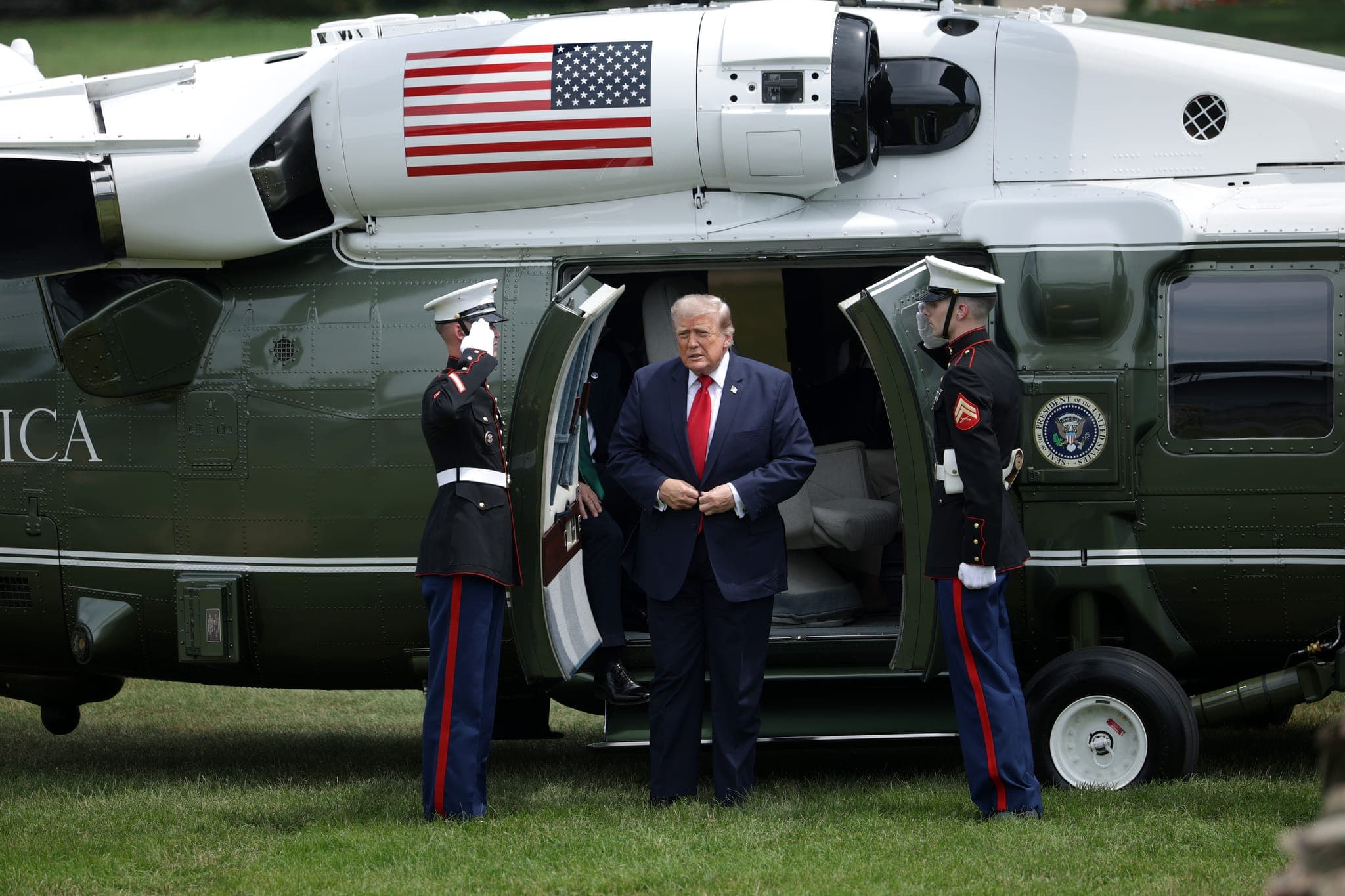
President Donald Trump vowed retaliation July 29 after Tehran fired ballistic missiles at American forces in Jordan, telling Fox News, “We’re going to beat the f***ing sh*t out of them.”
“We’ll be hitting them hard,” Trump added in the phone interview. “They’re going to get a beating.”
Speaking at the White House later that day, the President said Iran “took a shot, so it’s our turn.” Asked whether he would always retaliate when Iran attacks, Trump replied, “Will I always hit back? Pretty much.”
Trump also claimed that “they’ve already apologized,” though he did not specify whom he meant, and no Iranian apology was independently confirmed. “But we’ve got to smack them a little bit,” he said.
The remarks continued a pattern in which Trump paired talk of diplomacy with threats of overwhelming force after the U.S. abruptly suspended its bombing campaign over the weekend. On Monday, he said Washington and Tehran were having “good talks,” but also warned at a Michigan rally, “You can’t bribe them. You’ve got to beat them, and we’ll beat the hell out of them.”
The pause followed 13 consecutive nights of U.S. attacks. Trump said strikes would resume if talks failed, while a senior Iranian official told Reuters that Tehran would halt its own attacks only as long as Washington held its fire.
According to U.S. Central Command, Iran’s Islamic Revolutionary Guard Corps launched multiple ballistic missiles July 28 in an “attempted surprise attack” on U.S. forces in the Middle East. Iran said it targeted Muwaffaq al-Salti Air Base and a U.S. military command site in Jordan. Jordan said it intercepted five missiles, while CENTCOM said all the Iranian missiles were intercepted.
U.S. forces answered from 8 p.m. to 10 p.m. Eastern time the same day with what CENTCOM called a “heavy wave” of attacks on dozens of Revolutionary Guard targets, including command centers, missile and drone facilities, coastal surveillance and defense sites, and maritime capabilities.
More than 50,000 U.S. service members remain deployed in the region, according to CENTCOM.
Iran launched another round of attacks July 30. The Revolutionary Guard claimed to have struck U.S. aircraft at Azraq in Jordan and American assets at Ali Al Salem Air Base in Kuwait. CENTCOM denied that any U.S. aircraft were damaged, saying the missiles and drones were intercepted or failed to reach their targets.
Jordan reported intercepting another five missiles. Kuwait’s Defense Ministry, however, said an Iranian strike hit a building owned by a Chinese company, killing one worker and causing major damage.
Iranian state media said the U.S. strikes killed three civilians and wounded two children on Qeshm Island, killed three Revolutionary Guard members in Zanjan Province, and damaged student dormitories in Ahvaz.
The war also appeared to be spreading across still more of the region. An unidentified drone caused fires aboard two gas vessels at Egypt’s Damietta port, including a U.S.-owned storage tanker, while U.S. and Saudi forces struck Iran-aligned groups in Iraq. The strikes marked Saudi Arabia’s first publicly acknowledged participation alongside U.S. forces in the war. Iraq condemned them as a violation of its sovereignty.
The escalation is unfolding as domestic opposition grows. The Senate failed in a 49-50 vote July 30 to discharge from committee a resolution that would have directed the removal of U.S. forces from hostilities with Iran that Congress has not authorized. Sens. Susan Collins, R-Maine, Lisa Murkowski, R-Alaska, and Rand Paul, R-Ky., supported the motion, while Sen. John Fetterman, D-Pa., was the only Democrat to oppose it.
A new Associated Press-NORC poll found 64% of U.S. adults believe the war has not been worth fighting, compared with 33% who believe it has. Roughly three in 10 approve of Trump’s handling of Iran.
Addressing crises in the Holy Land and across the wider Middle East, Pope Leo XIV issued his latest region-wide appeal for peace July 26 amid the brief halt in U.S. bombing. The Holy Father called on all parties “to suspend the attacks and urgently reopen paths of dialogue and diplomacy.”
Archbishop Timothy Broglio, who oversees Catholic chaplains serving U.S. troops, responded to the latest American casualties July 20 by urging the faithful to “pray for peace among nations and a quick resolution to the current dispute.” Broglio previously said the U.S. war did not satisfy Catholic just-war principles.
.jpg&w=3840&q=75)


Comments