‘Be not afraid’: Scott Hahn reflects on the scriptural legacy of Pope John Paul II
For Scott Hahn, Pope St. John Paul II did more than inspire — he shattered stereotypes, bridged divides, and ultimately drew Hahn into the Catholic Church.
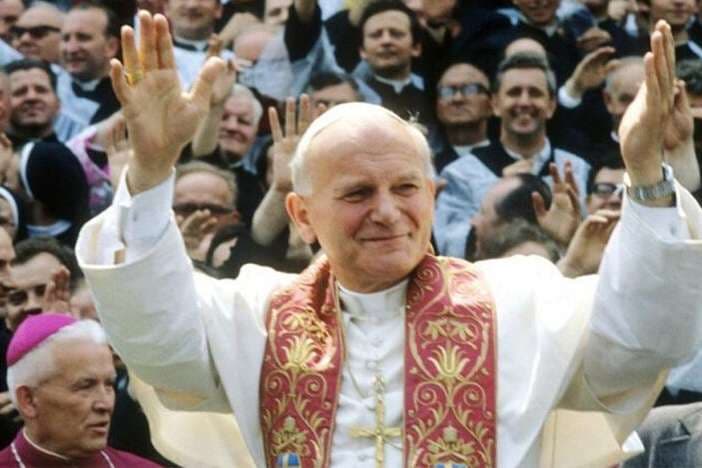
Oct. 22 marks the feast of Pope St. John Paul II, a saint whose memory remains vivid for millions who lived during his extraordinary pontificate. But for theologian and convert Scott Hahn, this modern saint did more than inspire — he shattered stereotypes, bridged divides, and was one influence that ultimately drew Hahn into the Catholic Church.
“In John Paul, we saw a man whom God had endowed with prodigious natural gifts: genius-level intelligence, profound poetic sensibilities, charm and affability, telegenic good looks, steely toughness, and perfect comedic timing,” Hahn recalls in an Oct. 14 Angelus article. “I was first attracted to those natural qualities.”
At the time, Hahn was still a Protestant minister — “instinctively anti-Catholic” he writes — yet he couldn’t help but admire the pope’s clarity and courage.
“You name the social issue — abortion, euthanasia, pornography, communism — and he was all over it,” Hahn writes. “He had a philosopher’s ability to state his case with precision. Yet he had an actor’s ability to make his point with economy: a single line or a symbolic gesture.”
But admiration grew into something deeper — and more unexpected.
“Gradually and grudgingly, many of us in the Protestant world came to admit that he was effective in the culture wars, not because of his bully pulpit or his media savvy or his philosophical suavity, but because of his superior command of Scripture.”
This quality set him apart from many who became pontiff after the Reformation, according to Hahn.
“It’s not that these men were unscriptural or anti-scriptural. But their methods were scholastic, emphasizing ever-finer distinctions in thought,” he writes. “Moreover, their pastoral style set the tone for preachers and teachers throughout the Catholic world. So many Protestants found Catholic literature easy to dismiss as insufficiently biblical.”
From the moment he stepped onto the world stage, Pope John Paul II signaled a different kind of leadership, according to Hahn.
“We should have known from his first words as pope that the world was in for something different,” Hahn notes. “He began with ‘Be not afraid,’ the exhortation of prophets and angels — and God himself — uttered whenever history had taken a momentous turn.”
Those words would become a signature of the pontiff’s 26-year papacy and a spiritual call to millions around the world.
Noting that nearly three quarters of the 205 citations in the pope’s first encyclical were scriptural, Hahn said he thought at the time that this was a pope who could speak to Protestants.
“But it was more than that,” he continues. “He could speak to the whole world, because Scripture speaks to the whole world — because God’s word speaks to hearts that God himself created and redeemed.”
The power of the Word eventually drew Hahn into full communion with the Catholic Church in 1985.
“From then on, just the act of calling that man Papa could move me to tears,” he writes.
However, as Hahn notes, Pope John Paul II didn’t want to be a lone biblical voice — he called all Catholic clergy and educators to follow his example.
“Because he was fluent in Sacred Scripture, John Paul could speak with moral and spiritual authority to the world, to the Church, and to the churches,” Hahn concludes. “He still speaks to us and with greater power, as a saint of the Church.”
>> Scott Hahn explains why the Rosary is an extraordinary prayer <<



Comments