Bishop Barron warns of growing Marxist philosophy among US political leaders
Bishop Robert Barron of the Diocese of Winona-Rochester, Minnesota, said he is increasingly concerned that “a Marxist philosophy is taking hold” among some American political leaders, citing Rep. Alexandria Ocasio-Cortez’ recent comments responding to a speech by Secretary of State Marco Rubio. He encouraged the faithful to attend closely to the language of their representatives.

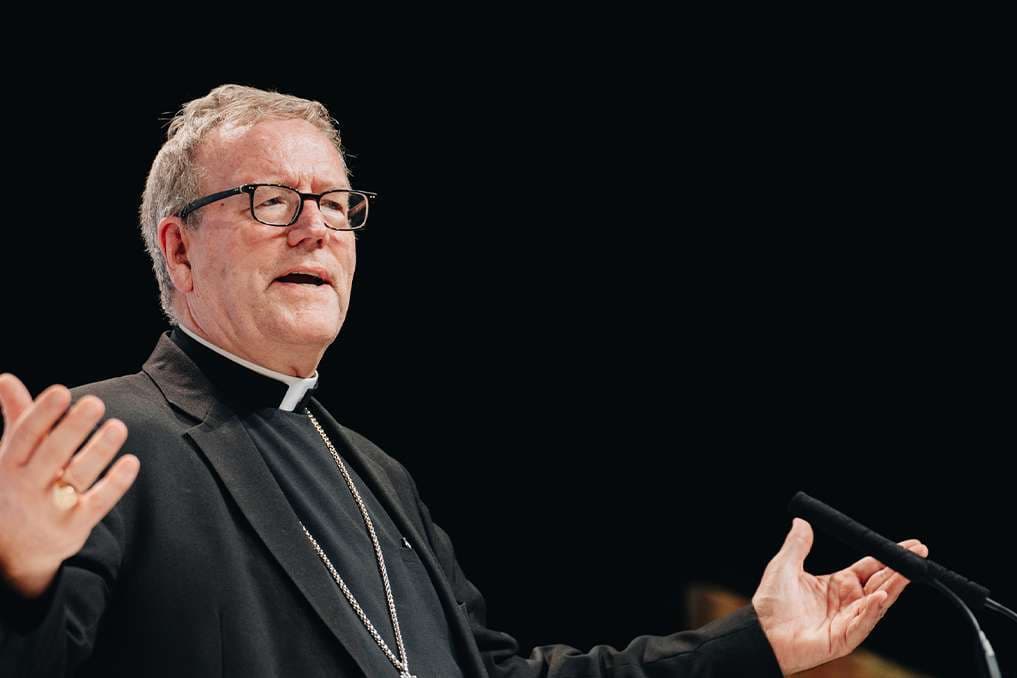
Bishop Robert Barron of the Diocese of Winona-Rochester, Minnesota, said he is increasingly concerned that “a Marxist philosophy is taking hold” among some American political leaders, citing Rep. Alexandria Ocasio-Cortez’ recent comments responding to a speech by Secretary of State Marco Rubio. He encouraged the faithful to attend closely to the language of their representatives.
In a Feb. 16 video posted to X, Bishop Barron — one of the most followed Catholic bishops on social media — reflected on Rubio’s Feb. 14 address at the Munich Security Conference, where the secretary of state spoke about a shared Western culture uniting Europe and the United States.
According to the bishop, Rubio referenced “Gothic cathedrals and Dante and Shakespeare and even the Beatles” as expressions of a common cultural inheritance. “His point was we’ve got to get beyond just our political differences and find our sources in the great culture that unites us,” Bishop Barron said.
Rubio’s larger claim — that “culture is grounded in cult,” meaning religion undergirds civilization — struck the bishop as resonant with the thought of Pope Benedict XVI and the Catholic historian Christopher Dawson, both of whom argued that Christianity is not incidental but foundational to the West.
Then came the response from Rep. Alexandria Ocasio-Cortez, who described such appeals to Western culture as “thin,” saying culture itself is “ephemeral” and always changing, suggesting attention should instead be directed to material conditions and class struggle.
“Well, all of that, everybody, is right out of the Marxist playbook,” Bishop Barron said in his video.
To dismiss Western culture as insubstantial, he argued, overlooks the durable structures it produced.
“The culture that gave us all those great figures,” he said, “that gave us the rule of law, that gave us respect for the rights of the individual, that gave us our democratic political system, that gave us the university system, that's ‘thin’?”
He acknowledged that cultures evolve, saying it is “a banality,” but that change “doesn’t mean for a second we can’t identify the key elements within a culture that give it its character.”
“To say that’s ‘thin’ strikes me as deeply problematic,” he said.
For the bishop, the deeper issue lies in Karl Marx’s claim that culture is merely a “superstructure” resting upon economic forces and class struggle. When political rhetoric reduces society to material conditions and power dynamics, he suggested, it echoes that framework.
“What’s worrying me,” he said, “is the extent to which political leadership on the left in America is becoming unapologetically Marxist. The mayor of New York City, you know, ‘the warmth of collectivism.’ He's calling for the confiscation of private property, of seizing the means of production, all language right out of the Communist Manifesto.”
He noted that Marx himself wrote that “the first critique is a critique of religion,” and historically Marxist regimes often targeted religious institutions early and aggressively.
Then, in a closing appeal, Bishop Barron urged viewers to listen carefully to the language used by their political leaders.
“Attend to the language,” he said. “In a way, they’re telling us who they are and what they’re for. And I think that should be very concerning to everybody.”
.jpg&w=3840&q=75)



Comments