Bishop Varden draws on Benedictine wisdom to chart a path on migration
The Nordic Bishops’ Conference president told fellow bishops that nations must balance guarding their identity with the Christian duty to welcome the stranger.
.jpg&w=3840&q=75)
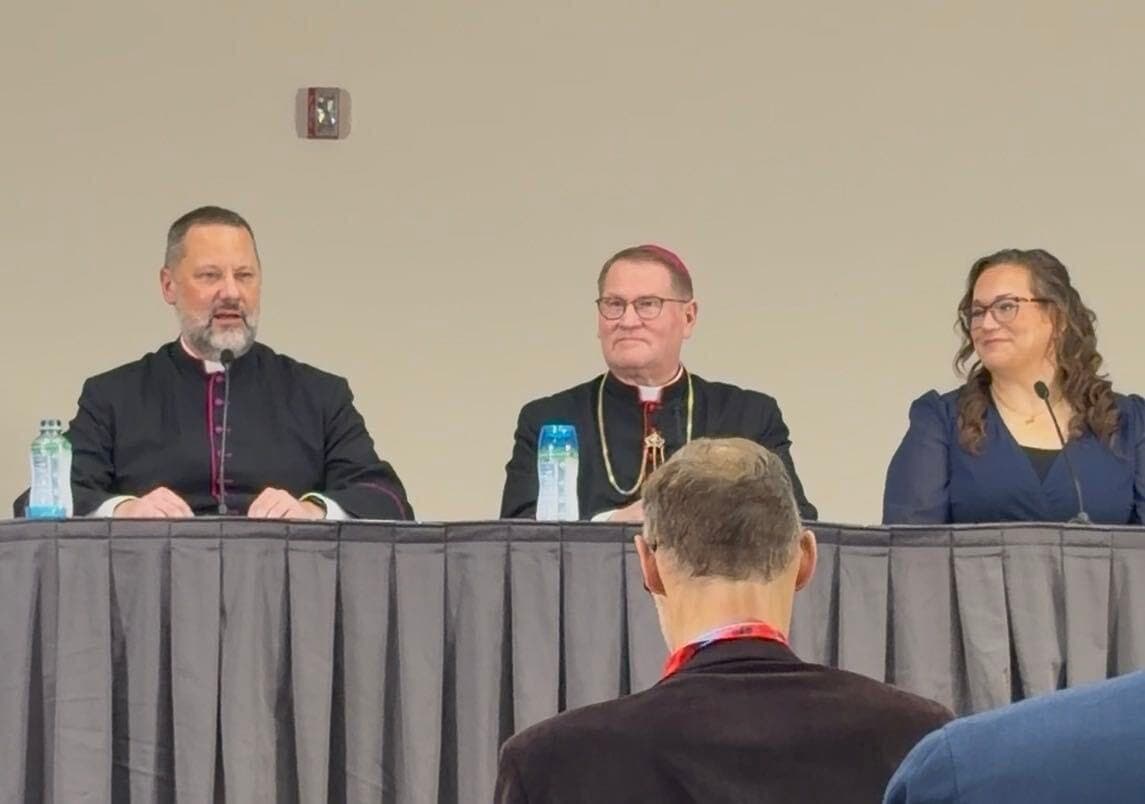
As much of the world grapples with multiple uncertainties ranging from technological advances to migration surges, Bishop Erik Varden, president of the Nordic Bishops’ Conference, drew upon his Benedictine spirituality to suggest a way that countries and individuals can build “a true society, where, in God’s name, all can build a life together.”
Bishop Varden explained that The Rule of St. Benedict distinguishes between guests and those seeking to join the community. All “guests … must be received as if they were Christ himself. … A guest, however, will stay for a while, then leave, once he has been comforted and fortified,” he noted.
But when it comes to “those who wish to enter and remain, those who would become citizens of the monastic microcosm, St. Benedict’s approach is different,” Bishop Varden explained. In this case, St. Benedict “urges that postulants’ motives be tested” by keeping them waiting for a while and telling them “all the ‘difficult and hard things’ community life entails” before they could commit to a “covenant of coexistence.”
Bishop Varden made the remarks Sept. 22 in a speech opening the conference’s autumn plenary assembly in Paderborn, Germany. Invoking the Tower of Babel and Pope Leo XIV’s recent encyclical on artificial intelligence, Magnifica Humanitas, he framed the choice facing the West as one between “exclusion or communion, privileges for a small class of the elect,” or creating a genuine society.
The Norwegian bishop said the rise of populist movements across Europe reflects a legitimate grievance — a widespread feeling of being “at the mercy of forces beyond our control,” citing extreme weather, melting Arctic ice, war, mass migration, and fears that artificial intelligence will make young people obsolete. “That cries of protest should arise in such a context is natural, even healthy,” he said.
But a country can falter, he warned, when it defines itself by only one of two necessary things: a common origin or a shared purpose. A nation fixated on ancestry alone, he said, can fall into “a form of ancestor worship that is idolatry,” while one guided only by an ideal is susceptible to ideologies that will cause it to “flounder when what was once a fixed objective proves unrealisable or simply passes out of fashion.”
The remedy, he said, is to “look simultaneously back and forward,” nurturing heritage while remaining open to what newcomers bring. This means that Christians are faced with what Bishop Varden described as a challenge that is both cultural and political. We must “foster national unity and character, at risk in an era suffused with global media, bombarded by the advertising of global trade; while yet cordially caring for the needy and the stranger,” according to the bishop.
Bishop Varden said the lesson for responding to current migration crises in Europe and elsewhere cuts both ways. “Any true belonging confers, not primarily privilege, but responsibility,” he said of migrants, adding that before applying Benedict’s standard to newcomers, citizens “should, for honesty’s sake, apply them critically to ourselves” — a challenge, he suggested, for populist movements to examine whether they themselves are living up to their responsibility to the nation.
He also pointed to demographic trends, noting that no Nordic country’s birth rate meets the 2.1 replacement level, meaning that “without immigrants, our services, industries, and welfare systems would collapse.” That reality, he said, should make us “humble — and grateful for those who arrive to maintain our common home.”
Bishop Varden closed by urging Catholics, who belong simultaneously to a local community and a universal Church, to model the tension he described: “rooted and free, grateful for what we have received and eager to share it with others.”




.jpg&w=3840&q=75)

Comments