Charlotte bishop grants interview to local paper, says pastoral vision is central to ministry amid pushback on changes
As the two-year mark of his tenure leading more than half a million Catholics in the Diocese of Charlotte, North Carolina, approaches, Bishop Michael Martin has promulgated his pastoral vision for the diocese, where tensions persist over previous changes.
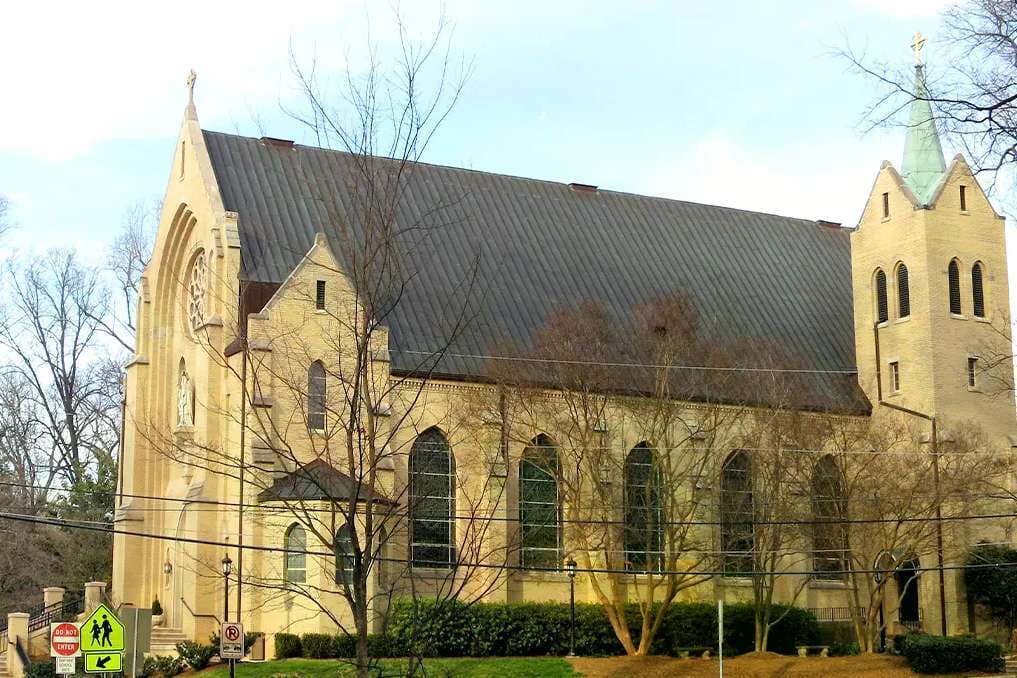
As the two-year mark of his tenure leading more than half a million Catholics in the Diocese of Charlotte, North Carolina, approaches, Bishop Michael Martin has promulgated his pastoral vision for the diocese, where tensions persist over previous changes.
This week, The Charlotte Observer published an interview with Bishop Martin in which he elaborates on his vision and addresses the widespread criticisms of liturgical changes he initiated in May 2025.
Earlier this month, Bishop Martin released his pastoral vision and a video outlining what he sees as the path forward for the Diocese of Charlotte: a Church that moves beyond quiet belief to bold evangelization, which he likened to being a Carolina Panthers fan versus a Carolina Panthers player. The bishop says this vision is the heart of his ministry.
“What I’m most passionate about is the vision I’ve just put forward. That’s what gets me out of bed every day,” he told the Observer. “That’s what I want to spend time on. That’s where I want to really pour resources into and engage quite a bit.”
Bishop Martin insists the initiative is not something novel or self-generated.
“I didn’t sort of dream this up,” he told the outlet. “It’s, I hope, an inspired way of framing what Jesus and the Church have already been telling us for 2000 years.”
Yet even as he casts a forward-looking vision, controversy lingers over changes he has already implemented.
In May 2025, Bishop Martin limited the Traditional Latin Mass to one chapel, citing Pope Francis’ 2021 motu proprio, Traditionis Custodes. A leaked draft of additional liturgical changes was released days later, as Zeale News previously reported.
In his written statement, he explained: “It is my heartfelt desire and prayer that this implementation of Traditionis Custodes will further promote the concord and unity of the Church among the People of God in the Diocese of Charlotte so that, as Jesus prayed to His Father, we may all be one.”
In December, tensions resurfaced when Bishop Martin ordered the removal of altar rails and kneelers used during Communion. He said the move was intended to bring the diocese in line with liturgical norms established after the Second Vatican Council.
“It’s my responsibility to say, Hey folks, here’s our norm. Here’s why this is our norm. And here’s why this is beautiful too,” he told the Observer. Still, he acknowledged the difficulty: “But even though that might be beautiful and good, it ... can be a challenging message to present without folks getting a little upset.”
The removal of altar rails and kneelers from the church doesn’t prohibit parishioners from kneeling if they choose, the bishop said, according to the Observer.
In January, changes prompted 31 priests to submit dubia, or formal questions, to the Vatican questioning the bishop’s authority to make the changes, as Zeale News reported.
“I’m not afraid of questions,” Bishop Martin said. “And again, if I’m doing this incorrectly, I want to be corrected. I’ll change if that’s what the Holy Father wants.”
Among parishioners, reactions are divided, according to the Observer. For example, John Martin, a parishioner at St. Thomas Aquinas Catholic Church, said he believes the bishop has overreached.
“I think he’s doing a disservice for the parishioners,” he said, arguing that communities “have grown, have flowered in the face of the tradition.”
He noted to the outlet that kneeling to receive the Eucharist is an outward expression of what he believes about the True Presence.
Mary Catherine Surface, who has attended St. Matthew Catholic Church in Charlotte since 2004, expressed similar concern.
“His stated desire is to create unity, but the Church has always taught that unity doesn’t mean everyone has to express their Catholic faith in exactly the same way,” she wrote.
Yet, others are encouraged. Clay Presley, who attended St. Peter Catholic Church for 17 years, said the bishop is a “breath of fresh air,” adding that he appreciates that he’s willing to sit and have a conversation, adding, “I’m learning something from him.”
>> Charlotte diocese laity stand up for traditional practices that feed their faith <<

.jpg&w=3840&q=75)
Comments