Christians in Holy Land face threats to homes and worship access ahead of Holy Week
Christians in the Holy Land are facing growing restrictions and security threats ahead of Holy Week as radical settlers expand illegal incursions into a predominantly Christian town in the West Bank.

Christians in the Holy Land are facing growing restrictions and security threats ahead of Holy Week as radical settlers expand illegal incursions into a predominantly Christian town in the West Bank.
Last Christian town in West Bank faces escalating settler incursions
Vatican News reported March 19 that radical Jewish settlers are engaging in an increasing number of violent attacks on Palestinian civilians and villages in the West Bank, including coordinated raids and incursions.
Following sweeping decisions by the Israeli cabinet to expand settlements, Vatican News reported, settlers escalated their incursions into Taybeh, the West Bank’s last fully Christian Palestinian town. Taybeh faced repeated attacks on homes and property, according to the report.
Settlers took control of a cement factory and quarry March 19, where they conducted Talmudic prayers and rituals. Eyewitnesses said settlers planted Israeli flags on the land.
“Their presence has continued for a second consecutive day, effectively asserting control over the area,” the report stated.
Taybeh’s Latin parish priest, Father Bashar Fawadleh, said Israeli police briefly intervened to remove the settlers, but the settlers then returned shortly afterward to continue their prayers and rituals.
“They came back in 15 or 30 minutes. And now they are inside the land,” he told Vatican Radio.
Fr. Fawadleh explained that earlier incidents had been concentrated in the eastern part of the town. The new incursions on the western outskirts of the city, he warned, appear to signal a “new phase” of a broader effort to expand territorial control.
The priest also highlighted the daily hardships faced by residents, including military barriers and checkpoints restricting movement between villages and cities in the region.
Fr. Fawadleh described the situation as “very difficult,” but said “we still have hope.”
“We are raising our voice to say that we are a civilian Palestinian people. We want to live in peace. We want to live in justice,” he said.
Fr. Fawadleh appealed to the international community to bear witness to what is unfolding and to take steps to ensure the safety and protection of the local population.
“We ask the world to come and see, to stop these actions, and to allow us to live in safety and peace.”
The Church of the Holy Sepulchre remains closed
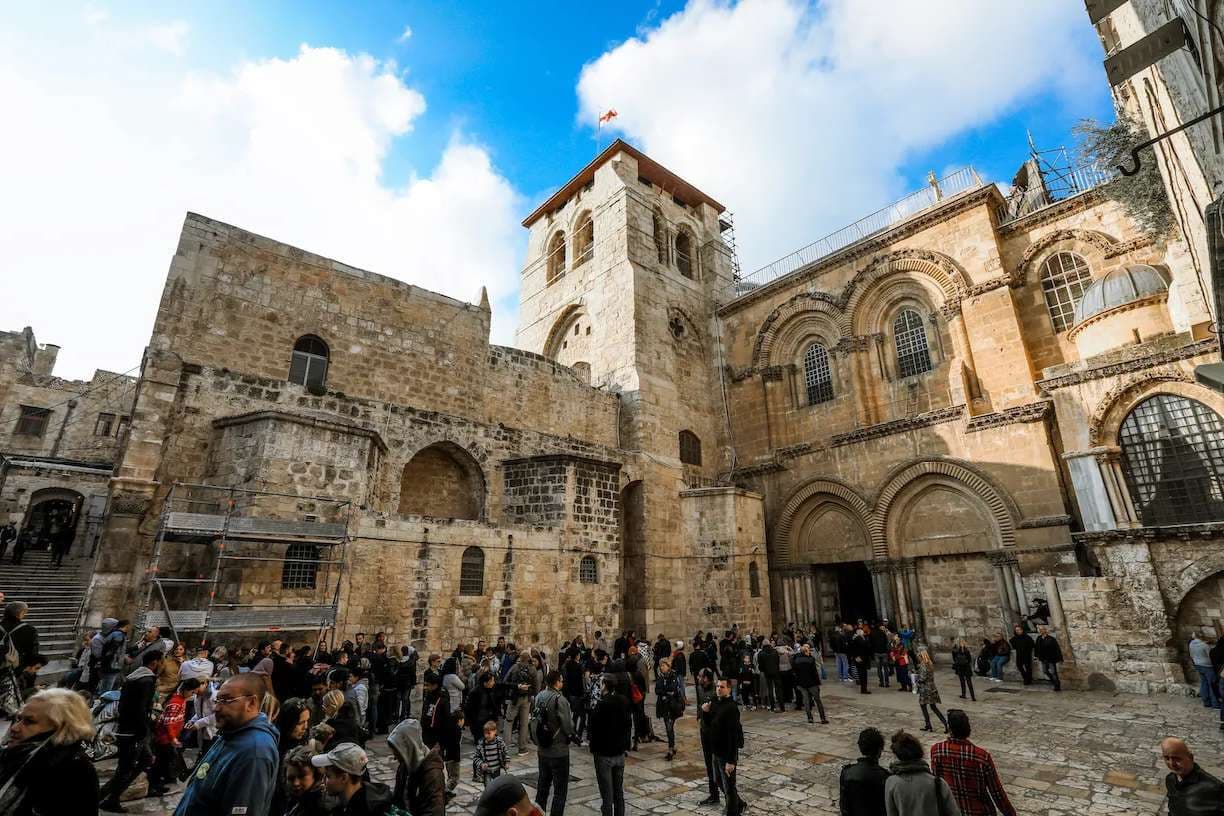
The Church of the Holy Sepulchre, also known as the “Church of the Resurrection,” contains Calvary, the place of the crucifixion and death of Jesus, and the Tomb of Jesus, from which He rose on the third day.
The Franciscan friars of the Order of Friars Minor have served as guardians for the site on behalf of the Catholic Church for eight centuries, and say the locations are “inseparable” elements of Christ’s Paschal mystery. Their ownership is shared with the Greek Orthodox and Armenian Apostolic churches under a longstanding arrangement governing its use and administration, according to the friars.
Israeli authorities closed the Church of the Holy Sepulchre in Jerusalem’s Old City beginning Feb. 28 as part of broader restrictions on religious sites amid security concerns due to the ongoing war, according to a March 16 report from Catholic Near East Welfare Association (CNWEA), the papal agency directing the Pontifical Mission for Palestine.
In a Feb. 28 statement, Israel’s Civil Administration said all major holy sites in the Old City — including the Western Wall, the Temple Mount and the Church of the Holy Sepulchre — would remain closed “for security reasons in light of the current tensions in the region.”
Joseph Hazboun, regional director of the office of CNEWA in Jerusalem, said, “The decision was framed as a precaution against potential attacks and to prevent mass gatherings during a period of heightened alert.”
Hazboun said that while other churches have remained open, he expects the Church of the Holy Sepulchre to stay closed to the public “until the end of the war and the cessation of rocket fire from Iran on Israel.”
As Holy Week begins March 29, Hazboun said services at the church are expected to be limited to clergy, similar to restrictions once imposed during the spread of COVID-19.
According to the report, church leaders have been in talks with Israeli authorities about allowing limited Easter observances. Sami el-Yousef, chief executive of the Latin Patriarchate of Jerusalem, said, “The church leaders intend to meet with representatives of the police to impress on them the need to allow Easter celebrations, even if at a reduced capacity.”
As part of the restrictions, Israeli authorities also sealed off Jerusalem’s Old City during a significant night in the Muslim holy month of Ramadan, preventing worshippers from accessing the Al-Aqsa Mosque, Hazboun said.
“Thousands ended up observing the night near the gates of the Old City,” Hazboun said. Old City residents, including Christians, were not permitted to leave.



Comments