Enes Kanter Freedom declares for 2027 WNBA Draft, challenges league over transgender eligibility
The former NBA center says the league must apply its inclusion principles equally, while its new agreement says only women may play but does not define the term or address gender identity.
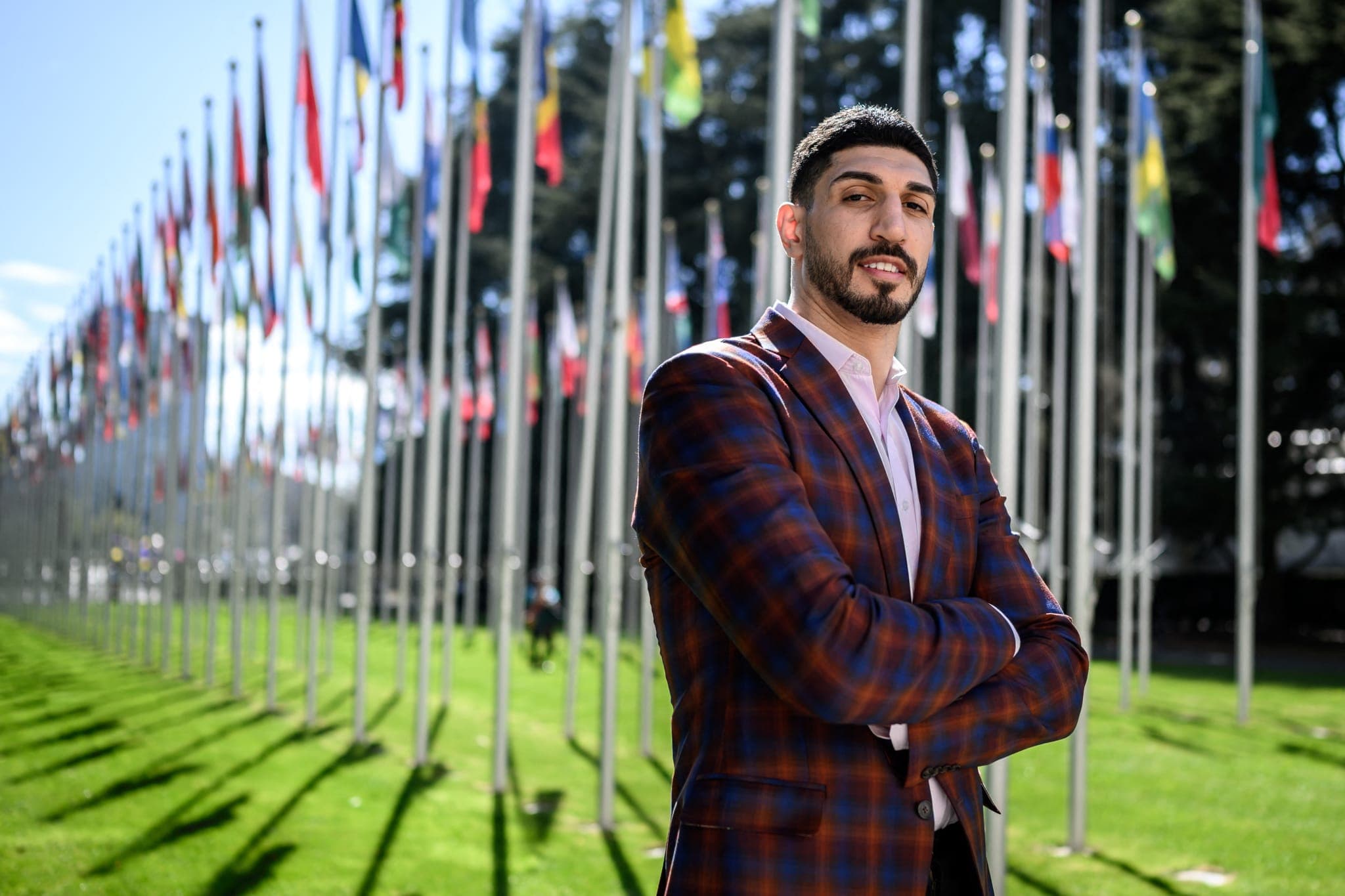
Former NBA center Enes Kanter Freedom declared himself a prospect for the 2027 WNBA Draft Aug. 7, mounting a pointed challenge to a league that has not publicly explained whether male athletes who identify as women may compete.
“If simply declaring who you are is all that’s required, then I meet every single requirement necessary to compete in the WNBA,” Freedom said in a video posted on social media.
Freedom said his team had examined the league’s eligibility rules and “governing framework surrounding self-identification and inclusion” before he announced his decision.
“I am definitely not here to mock, make fun of, or disrespect any community or personal choices,” he added. “I am simply asking that the current rules be applied equally to everyone — the rules that represent the very values many WNBA players and coaches have publicly advocated for.”
Freedom concluded by saying he and his team were prepared to press for “equal” and “consistent” application of the rules. “See you at training camp,” he said.
The announcement does not establish that the WNBA has accepted Freedom as a draft candidate, and he did not publish a league filing or response. His challenge instead targets a consequential gap in the league’s publicly available policy.
Article XIII of the 2026 collective bargaining agreement between the WNBA and the Women’s National Basketball Players Association states, “Only players who are women are eligible to play in the WNBA.” The 409-page agreement does not define “woman” or “women,” however, and neither “transgender” nor “gender identity” appears in the document.
The agreement gives detailed age, college, and international-player requirements for the draft. It does not explicitly say that self-identification alone makes a male athlete eligible. It’s what it leaves unsaid, however, that could amount to a loophole — one that Freedom’s announcement is likely meant to highlight: the requirements make no mention of a hormone standard or other process for resolving a “transgender” applicant’s eligibility.
That ambiguity had become more than a hypothetical question days before Freedom released his announcement. As OutKick reported, Julie Tétart, a 34-year-old male athlete who identifies as a “transgender” female, averaged 21 points and 20 rebounds per game for Monaco in France’s second-tier women’s league during the 2025-26 season. Tétart told the outlet that playing in the WNBA was a childhood dream and that he would not reject an offer.
According to OutKick, neither the WNBA nor the players’ association answered repeated questions about whether Tétart satisfies the agreement’s women-only rule.
Freedom, 34, would make the sex-based competitive disparity especially conspicuous. The NBA lists him at 6 feet, 10 inches and 250 pounds. The Utah Jazz selected him third overall in the 2011 NBA Draft, and he averaged 11.2 points and 7.8 rebounds over an 11-season career.
It is not the first time Freedom has used the WNBA to make his case against male participation in women’s sports. In 2023, he said he could identify as a woman, adopt the name “Enesha,” and dominate the league, asking whether that would be fair to women who had pursued the sport since childhood.
His latest announcement follows a rapidly escalating debate inside the WNBA. Indiana Fever guard Sophie Cunningham told ESPN that she wanted to protect “young girls in sport who shouldn’t have to go against biological men.”
Cunningham’s comments invited a firestorm of opposition from left-wing activist groups and pro-LGBT league figures. But she also elicited praise from Vice President JD Vance and women’s-sports advocates.
Seattle Storm minority co-owner Celeste Keaton later approached and berated two teenage fans of Cunningham’s who attended a game with signs expressing support for her stance on women’s sports. Cunningham responded after the incident by sticking up for the girls, praising them in an X post “for standing up for what they believe” and promising she would contact them. “Truly embarrassing of the co-owner,” she added in reference to Keaton. “Unfortunately shows the type of leader she is.”
Former collegiate swimmer Riley Gaines, who has become a national advocate for protecting women’s sports, praised Freedom’s declaration Aug. 7. “Genius. Perfect,” Gaines wrote on X. “Waiting to see which WNBA team recruits @EnesFreedom.”
The dispute comes amid a wider political fight over preserving sex-based athletic categories. As Zeale News reported, CatholicVote is urging senators to amend or reject a college-sports bill that the group warns could jeopardize state laws reserving women’s and girls’ teams for female athletes. The Supreme Court held June 30 that states may base eligibility for female teams on biological sex without violating Title IX or the Equal Protection Clause.
>> Congressional Republicans demand WNBA accountability over violence toward Caitlin Clark <<

.jpg&w=3840&q=75)
.jpg&w=3840&q=75)



Comments