EXCLUSIVE | Fr Mike Schmitz on lay participation in Mass, ‘The Bible in a Year’ milestone
After Ascension Presents' "The Bible in a Year" surpassed one billion downloads in March, the podcast's host, Father Mike Schmitz, spoke with Zeale News about the historic achievement and why he thinks it’s been this successful.

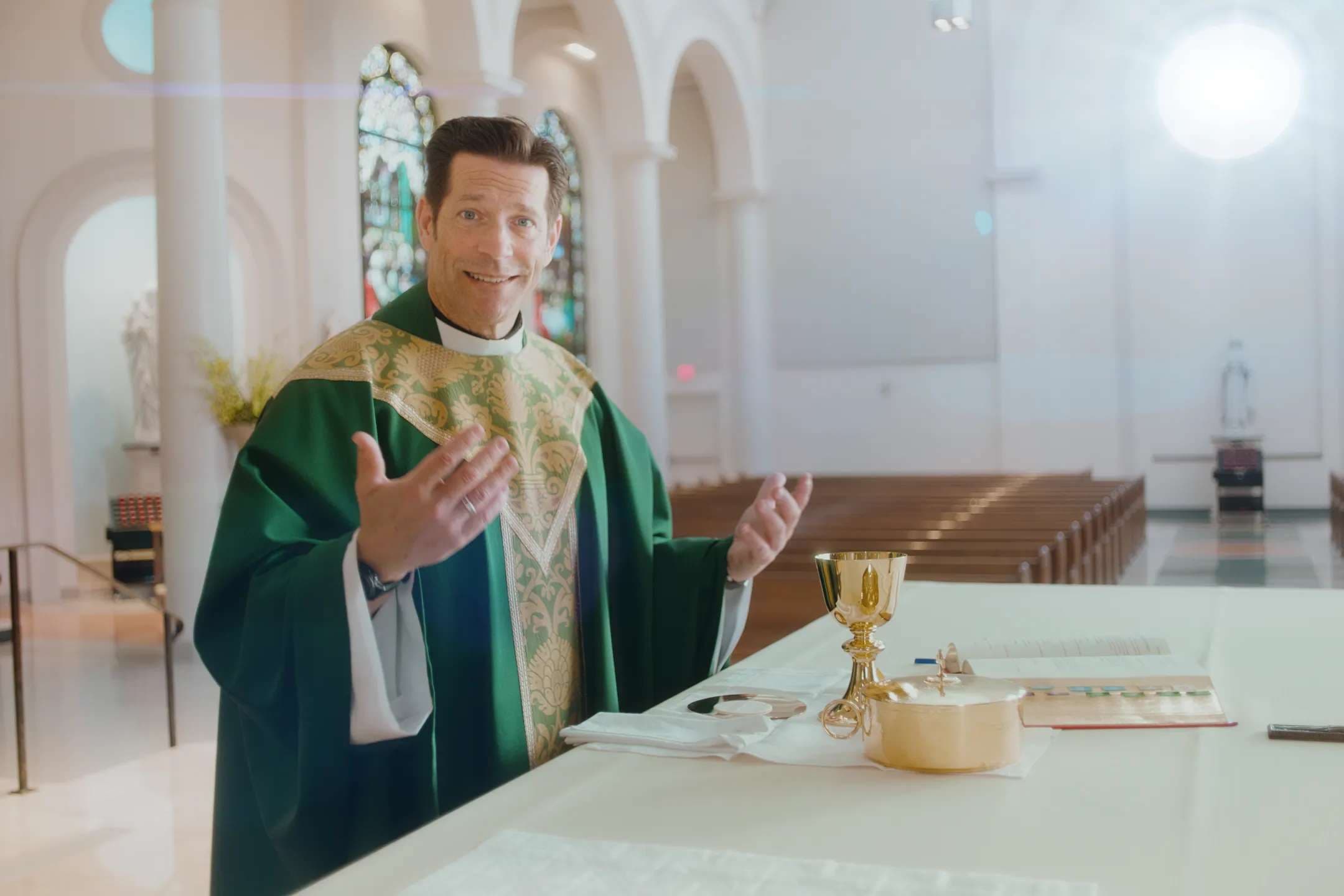
After Ascension Presents' "The Bible in a Year" surpassed one billion downloads in March, the podcast's host, Father Mike Schmitz, spoke with Zeale News about the historic achievement and why he thinks it’s been this successful. He also offered insights about his new video that walks through the parts of the Mass, sharing about how he sees both projects as opportunities to support people in their faith journeys.
What made ‘The Bible in A Year’ take off?
For Fr. Schmitz, the unprecedented success of the Scripture podcast has several key factors; the first, he told Zeale News in an April 3 phone interview, is that many people are longing to know what the Bible contains but finding it intimidating to approach alone.
“There’s kind of this overreaching desire in so many people to know what's inside the Bible,” Fr. Schmitz said.
>> EXCLUSIVE | Fr. Mike Schmitz on surge of Catholic converts: ‘We’re made for God’ <<
He reflected that this desire to learn more about Scripture is a goal many Catholic and non-Catholic Christians have; they attempt the challenge but encounter difficulties. He shared that he himself had attempted to complete around a dozen Bible in a year programs but failed every time, as he found staying on top of it challenging.
The podcast helps meet that desire to go deeper with Scripture in an accessible way, according to Fr. Schmitz, who reflected that the podcast designers “made it easy”: “You just [have] to press play and someone reads the Bible to you,” he said.
Listeners also benefit from how the podcast follows the chronological story of salvation history outlined in Catholic scriptural scholar Jeff Cavins’ “The Great Adventure Bible Timeline.” Fr. Schmitz credited Cavins’ work for helping listeners to “never really lose the story” as they walk through the Old and New Testaments.
He likened the timeline structure to a map that shows participants where they are and where they are going, bolstering their confidence. Fr. Schmitz said he tries to be a guide for following that map.
The next helpful factor is that each episode of the podcast ends with a commentary that suggests particular aspects of the Bible passage to reflect on, explains key points, or provides a summary to help listeners who may have missed something, Fr. Schmitz explained.
But beyond the podcast’s accessibility and structure, the deeper reason it became a widespread phenomenon is that people had a spiritual hunger, according to Fr. Schmitz.
He reiterated that the “critical factor,” as he called it, for the podcast’s success is the desire so many people have to engage with Scripture.
Baptismal priesthood and the liturgy: Fr. Schmitz’ hope for ‘Catholic Mass 101’ explainer
Adding to his other projects with Ascension Presents, Fr. Schmitz also recently undertook an initiative to teach people more about the liturgy. On March 19, the media outlet published a 40-minute video in which Fr. Schmitz explains every part of the Mass. This video, he explained, is not only for new Catholics or for those who have been Catholic a long time; it is for anyone interested.
The video has since garnered almost 830,000 views on YouTube.
Fr. Schmitz said that his hope for the video’s impact is that it inspires the lay faithful to have a deeper understanding of their role in the liturgy.
“I want every person to be able to engage in the Mass in such a way that they're actively worshiping God, not just watching the priest pray,” he said.
Fr. Schmitz told Zeale News he has been walking people through the Mass for several years already. He was inspired to do them after seeing Father Stan Fortuna, a priest with the Franciscan Friars of Renewal, do a teaching Mass on a VHS tape around the time when he was first ordained.
“And I remember thinking, ‘Oh my gosh, this is something we have to do,” he recalled.
Fr. Schmitz is now the director of Youth and Young Adult Ministry for the Diocese of Duluth, Minnesota, and a chaplain at the University of Minnesota-Duluth. At least once a year, he will do a teaching Mass where he will pause for brief moments during the celebration of the liturgy and explain the purpose and history of the priest’s actions and prayers.
“Over the years, it has been very well received,” Fr. Schmitz said.
The OCIA candidates are all invited and they always attend, he explained, and many students who are raised Catholic also attend.
“But then also we have people in the community who will show up, and it’s one of those consistent responses — not only from the OCIA people [who] have seen it’s great because it’s kind of an intro — but for those who have been going to Mass their whole lives,” Fr. Schmitz said. Someone like this could be 85 years old and share that they “had no idea” and now will never go “to Mass the same,” he explained.
Fr. Schmitz said his reaction to that kind of response is, “Wow, we need to do this often. We need to explain — you can’t ever fully explain the mystery — but to do our best to uncover, or to reveal the heart of the mystery.”
“It’s for everybody, really, truly,” he added.
He noted that in the filmed version of the teaching Mass, he is not actually celebrating the liturgy, which allows for video editing and for viewers to not be concerned about the celebration of the Mass being interrupted. He then reflected on what main takeaways he hopes viewers have from watching it.
“For almost the entirety of the time that I’ve been doing a teaching Mass, [I’ve wanted people] to be able to pray the Mass,” Fr. Schmitz said, “and to know what’s going on and to be attentive to those movements of the Mass. That’s always been a big goal.”
“But then as I’ve done it over the years, and just my understanding has grown, and some things that I have grown in my understanding and appreciation of different aspects of the Mass, I go back to the Second Vatican Council, and how the drive of the liturgical reforms was meant to be full and active participation,” he explained. “So, what does that mean?”
Growing up hearing that, he thought that participation meant someone can be a lector or an extraordinary minister of the Eucharist. However, he later came to understand that this participation actually is rooted in a reality deeper than external practices.
He said he now realizes that “the baptized Christian, is meant to exercise what I call their kingdom priesthood, your baptismal priesthood of the faithful.”
He noted that the Eucharist “is both a noun and a verb,” with the verb being “the offering of the sacrifice,” which has implications for how the faithful are involved in the Mass.
“And yet the problem is, so many of us, we go to Mass, and we just simply watch the priest pray,” Fr. Schmitz said. “So the goal of the teaching Mass is not only to unpack it — ‘here's mysteries and here's what this means’ — but [to show] what this means so that you can, as the kingdom priest, unite your prayers to with the ministerial priest, who’s united his prayers to the great high priest Jesus, to offer up the sacrifice and to worship God.”
.jpg&w=3840&q=75)
Comments