Feast of St. Thérèse celebrates the ‘Little Flower’ whose simple path to holiness reached the world
The young Carmelite’s hidden life gave rise to a spiritual path that would reach Catholics around the world and later earn her recognition as a Doctor of the Church.

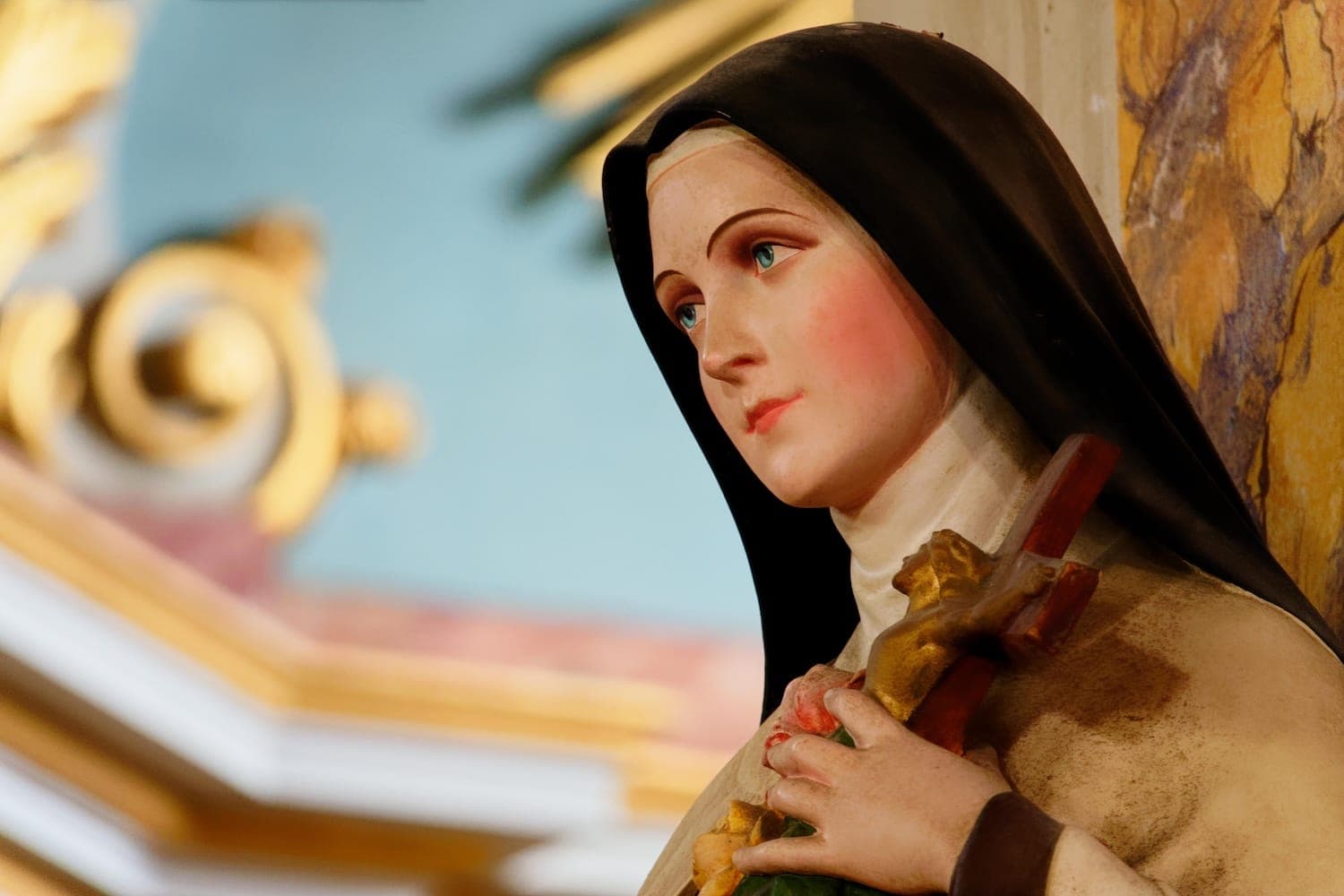
Catholics celebrate the feast of St. Thérèse of Lisieux Oct. 1, honoring the young Carmelite whose quiet life and simple trust in God would leave an influence far beyond the walls of her monastery.
Known as the “Little Flower,” Thérèse died at only 24 years old after spending nine years in the Carmel of Lisieux in France. Yet the spirituality that took shape there — centered on love, humility, and confidence in God — would eventually lead the Church to recognize her as one of its Doctors.
Born in Alençon, France, in 1873, Thérèse lost her mother when she was 4 and moved with her family to Lisieux. From a young age, she desired the contemplative life, following two of her sisters who had entered Carmel before her.
Her age initially prevented her from entering. During a pilgrimage to Rome in 1887, the 14-year-old Thérèse appealed directly to Pope Leo XIII for permission to become a Carmelite at 15. She entered the monastery the following year.
Within Carmel, Thérèse came to understand holiness not as something reserved for those capable of extraordinary accomplishments but as a life of love and trust offered to God in seemingly small things. Her spirituality became known as the “little way,” rooted in an awareness of her own littleness and confidence in God’s mercy.
She also developed a deep missionary desire despite living behind the walls of a cloister. Thérèse supported missionaries through prayer and sacrifice and sought to draw souls to Christ through the hidden offering of her own life. The Church later named her patroness of the missions alongside St. Francis Xavier.
Much of what Catholics know about Thérèse’s interior life came through writings that would one day become a spiritual classic. At the request of her religious superiors, she began recording memories of her childhood, religious life, and relationship with God. Three autobiographical manuscripts were eventually published under the title Story of a Soul.
Through those writings, the spirituality developed in Carmel reached readers around the world. Thérèse wrote about her confidence in God’s mercy, her vocation to love within the Church, and the trial of faith she experienced as tuberculosis weakened her body near the end of her life.
She died Sept. 30, 1897. Her final words were an expression of the love that had shaped her vocation: “My God … I love you!”
Thérèse was canonized by Pope Pius XI in 1925. More than 70 years later, Pope St. John Paul II proclaimed her a Doctor of the Church, a title given to saints whose teaching has made an enduring contribution to the Church’s understanding and life of faith.
Pope St. John Paul pointed particularly to the depth beneath the apparent simplicity of her spirituality, describing her teaching as a “science of love” born from her knowledge of Christ and personal experience of grace.
Thérèse’s influence also reached another prominent Catholic voice who has received renewed attention following his Sept. 24 beatification: Blessed Fulton Sheen.
In 1973, the centenary of Thérèse’s birth, Sheen preached an 11-sermon novena devoted to the Little Flower. The talks were later collected in Archbishop Fulton Sheen’s St. Thérèse: A Treasured Love Story, which draws extensively from Story of a Soul and explores her faith, humility, perseverance, prayer, and understanding of divine love.
Sheen was particularly interested in Thérèse’s love of Scripture and in the missionary power of a contemplative life. Despite never traveling to the missions, Thérèse offered prayer and sacrifice for missionaries — a hidden apostolate Sheen understood as capable of bearing fruit far beyond what could be seen.
That contrast remains at the heart of the Little Flower’s legacy. Thérèse lived only 24 years and never traveled far from Carmel where she spent most of her adult life. Yet through a life offered in small acts of love, her writings and spirituality traveled where she never could, drawing generations of Catholics toward the same confidence in God that marked her little way.







Comments