FIERCE: The Catholic ministry reminding female athletes of their identity
Two weeks after standing outside the Supreme Court, one sentence from that day sticks with Samantha Kelley. She had 3 minutes at the microphone Jan. 13 at a rally connected to legal cases shaping the future of women's sports. The crowd was divided. Supporters gathered near the stage; a counter-rally pressed in behind, blaring music and screaming. She had asked ahead of time whether the event would begin with prayer. It would not — the gathering was bipartisan, secular. But she was told she could pray within her own remarks.

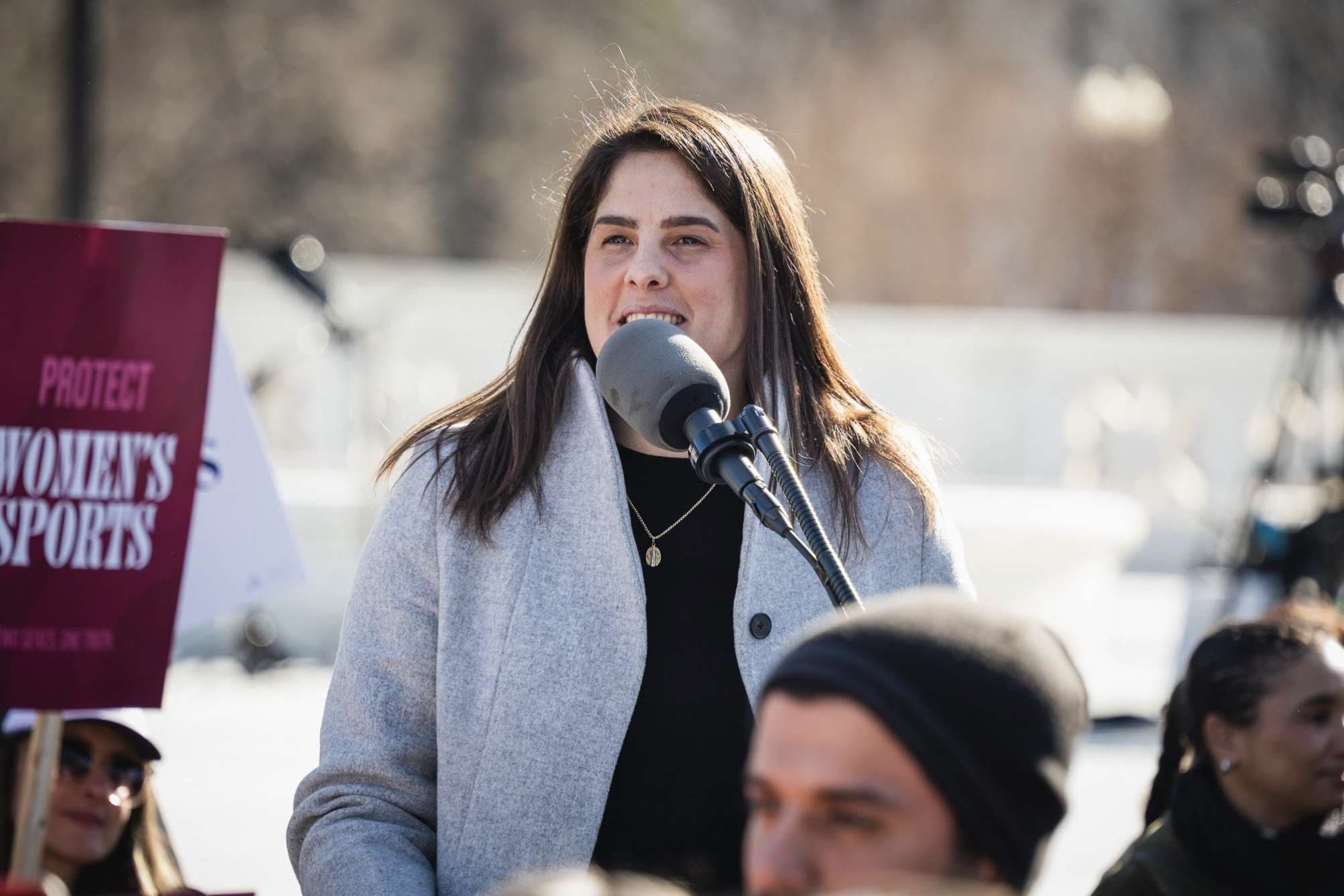
Two weeks after standing outside the Supreme Court, one sentence from that day sticks with Samantha Kelley.
She had 3 minutes at the microphone Jan. 13 at a rally connected to legal cases shaping the future of women's sports. The crowd was divided. Supporters gathered near the stage; a counter-rally pressed in behind, blaring music and screaming. She had asked ahead of time whether the event would begin with prayer. It would not — the gathering was bipartisan, secular. But she was told she could pray within her own remarks.
So she planned her time accordingly. With only a few minutes to speak, she said she intended to spend “about half” of her speech in prayer. The atmosphere, she recalled later, felt spiritually intense.
“The face of evil was very real,” she said, adding quickly that she didn’t mean the individuals present. She felt called, she said, “to pray against evil and just asked for His healing power.”
What she wasn’t prepared for was what she would feel called to say next.
“Right before I stepped up, the Lord said to me, ‘Proclaim you’re a Catholic,’” Kelley recalled in a Jan. 30 Zoom interview with Zeale.
“I originally wasn’t going to do that,” she said. “But the biggest reason why I was there was because of my beliefs and because of my faith… to proclaim that – and nobody else proclaimed that – that, I felt, was a really powerful witness.”
So she said it. She identified herself publicly as a Catholic Christian before a national audience.
For Kelley, her speech on the Supreme Court steps was not about staking out territory in a culture war. It was, she says, an act of obedience — and an extension of prayer.
In many ways, it revealed what FIERCE, the Catholic ministry she founded for female athletes, has been about all along.
A ministry before a movement
The moment at the Supreme Court brought new attention to FIERCE, but the ministry itself began long before that.
“I started FIERCE because I felt like what women were dealing with in sport was unique,” Kelly told Zeale. “There wasn’t any support specifically for women in regards to how women should approach sport. ‘Can I be both feminine and athletic?’ That kind of core question.”
The answer, she tells the young women she works with, is yes. But the ministry’s work quickly grew beyond that single question.
Kelley pointed to the range of realities she was seeing among female athletes: eating disorders, body image pressure, identity confusion, sexual pressure, and the sense that worth rises and falls with performance.
“All of the issues is what we kind of wanted to bring light to,” she said, “but fundamentally, before that, remind women that they are daughters of God. Their identity is not in their performance. It’s just a gift that they’ve been given. We always start with the identity of who you are before the stats, before the whatever.”
FIERCE now works primarily with high school and college athletes, as well as some professional athletes, through retreats, talks, clinics, mentorship, books, and chapters forming on teams and campuses. Its focus is what Kelley calls “physical, mental, spiritual growth, integration.”
This formation-first approach shaped how the ministry entered the public debate around women’s sports.
The novena
FIERCE’s response to the Supreme Court cases began with organizing a nine-day novena supporters could pray to prepare for the rally.
“I think from an overall perspective, prayer is the most important thing that we can do,” Kelley told Zeale. “Inviting people into something that could have real spiritual power was kind of our motivation.”
She said the nine-day format was intentional.
“Novena, specifically, I think it’s a little bit more hardcore, you know, it’s like nine days you got to commit to praying,” she said. A one-time prayer service “would have been a one-time event,” she added, but the novena allowed “a wider range of people to be able to join in from anywhere and pray alongside us.”
Even at the rally itself, prayer remained central.
“I felt a strong call from the Lord to really carry the graces from that novena over and pray in front of the Supreme Court,” Kelley said. Amid the shouting and counter-protest, she experienced the moment as intensely spiritual.
“Under the name of Jesus, it wasn’t me,” she said, “it was all in His authority.”
Sport as formation
For Kelley, the debate goes beyond policy or fairness to the goodness and beauty of sport itself.
“One of my favorite quotes about sport is from John Paul II. He says that sport is a gymnasium for human virtue,” she said.
In her view, sport forms young people in ways that few other things still do.
“When you play a sport, you can’t be on your phone,” Kelley explained. “You have to interact with people. You have to interact with people very different from you. You have to come together for a common goal. You have to learn how to suffer. You have to learn how to persevere. You have to learn how to lose well.” She added, with a laugh, that she is “very anti ‘everybody gets a trophy,’” before stating, “You have to learn to win with humility.”
For young women in particular, she sees sport as a path to confidence and resilience. But FIERCE’s distinctive emphasis is theological.
For Kelley, the debate only makes sense when placed inside a larger vision of what sport is for. FIERCE, she said, is different because “we believe that sport is an avenue with which you live out your femininity.”
The question she said she hears constantly from young women — Can I be feminine and athletic? — reveals how deeply the two have been set against each other.
But her answer is based on the Catholic understanding of the body-soul union: “You're a woman and so you are feminine in your being, like you just are.”
She spoke extensively about Pope St. John Paul II’s Theology of the Body, which she said “deeply formed her.”
“The height of your femininity revealed through your body is your receptivity and your ability to bear life… Of course, motherhood, but in a real spiritual way,” she said.
She noted that in women’s sports, there’s more teamwork and more passing than in men’s sports, because “women have a natural openness to each other, a natural receptivity.”
“The greatest desire of a woman is to care for her team,” she explained.
She believes competition does not suppress femininity but expresses it — even in individual sports, where “receptivity to suffering and offering it up for a greater prayer” becomes part of what she calls “the beauty of your femininity.”
This is the good FIERCE is defending. Sport, Kelley insists, is a path of formation: “We want to lead with beauty. We want to fight the negative narrative. We want to show women that this is such a path to holiness.”
She is not blind to the harms of athletic culture, noting that “it can shred you and tear you down.” But that, she says, is precisely why formation matters. According to Kelley, the goal is not simply protecting a category of competition, but protecting a space where young women learn who they are.
Ministry, not advocacy
Even if the court rulings go in the direction she hopes, Kelley does not see the moment as an ending. She described these cases as only the beginning, noting that the legal question before the court centers largely on whether states have the authority to protect women’s sports. Broader battles, she said, would still lie ahead.
A favorable outcome would matter. “This is exciting, and I think can set a precedent and will be a victory for women, absolutely,” she said, but “we need to remind people that the fight will not be over.”
She added, “We can be empowered and emboldened, and I think at FIERCE, we'll be both of those things.”
Asked what comes next for FIERCE, Kelley is careful to define the organization’s role.
“We’re not an advocacy group, we’re a ministry,” she said. “When there is an issue that affects God’s design for women’s sports, of course we will be the voice. I will be the voice on behalf of women. I will stand up for women. I will stand up for truth. But we’re here to serve the athlete, serve the athlete who’s in and on the ground.”
That service now includes new initiatives: Team- and school-based chapters, a relaunched video podcast, formation for coaches through “Fierce Coach,” and resources for former athletes through “Fierce Forever,” including an “athlete retirement course.”
Still, she returns to its deeper purpose: beauty.
“That’s what’s going to captivate and change hearts,” she said.


Comments