In greeting to new Canterbury archbishop, Pope Leo urges cultivating a reconciled Christian community
In a message greeting the new leader of the Church of England, who was installed March 25, Pope Leo XIV encouraged ongoing ecumenical dialogue and pursuit of a unified and reconciled Christian community.

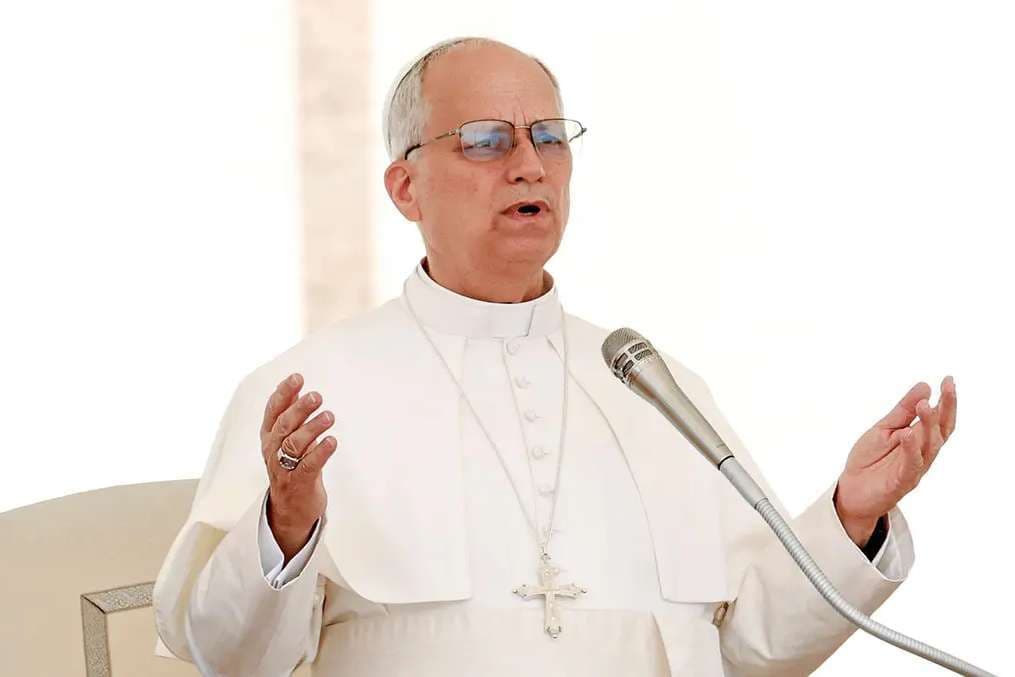
In a message greeting the new leader of the Church of England, who was installed March 25, Pope Leo XIV encouraged ongoing ecumenical dialogue and pursuit of a unified and reconciled Christian community.
“With this assurance of God’s abiding presence, I send prayerful greetings to Your Grace on the occasion of your Installation as Archbishop of Canterbury,” Pope Leo told Sarah Mullay, who was appointed by the Church of England to be the next archbishop of Canterbury, at the beginning of the March 20 message, which the Vatican Press Office published March 26.
“I know that the office for which you have been chosen is a weighty one, with responsibilities not only in the Diocese of Canterbury, but throughout the Church of England as well as the Anglican Communion as a whole,” Pope Leo continued. “Moreover, you are commencing these duties at a challenging moment in the history of the Anglican family.”
The Church of England elected Mullay as the next archbishop of Canterbury in 2025, prompting controversy among some Anglicans. She is the first woman to be appointed to lead the Church of England. In October of last year, the leader of the Anglican Communion’s Church of Nigeria spoke out against the appointment expressing concerns of her support of gay “marriage.”
In the message, the Pope said he prays for her to be strengthened with wisdom, be guided by the Holy Spirit in her service to her communities, and be able to “draw inspiration from the example of Mary, the Mother of God.”
The Pontiff then reflected on the historical and ongoing ecumenical dialogue between the Catholic Church and Anglicans, recalling how Saint Pope Paul VI and Anglican Archbishop Michael Ramsey met in Rome in 1966 and issued a joint declaration committing Catholics and Anglicans to “a new stage in the development of fraternal relations, based upon Christian charity.”
Pope Leo said this joint declaration marked a “fresh chapter of respectful openness” and has borne positive fruits.
The predecessors’ meeting also led to an agreement to begin a special theological dialogue that eventually became the Anglican-Roman Catholic International Commission (ARCIC). Pope Leo said the ARCIC “has contributed enormously to a growth in mutual understanding” and enabled them “to witness together more effectively.”
“This is especially vital given the manifold challenges facing our human family today,” Pope Leo added. “I am grateful, therefore, that this important dialogue continues.”
The Pontiff then acknowledged that there are still disagreements, writing, “At the same time, we also know that the ecumenical journey has not always been smooth.”
He noted that “despite much progress,” the late Pope Francis and Anglican Archbishop Justin Welby had “acknowledged frankly that ‘new circumstances have presented new disagreements among us.’”
Pope Leo said that at least for him, it is essential to continue to have charitable dialogue, writing, “Nevertheless, we have continued to walk together, because differences ‘cannot prevent us from recognizing one another as brothers and sisters in Christ by reason of our common baptism.’”
“For my part,” Pope Leo wrote, “I firmly believe that we need to continue to dialogue in truth and love, for it is only in truth and love that we come to know together the grace, mercy and peace of God, and thus can offer these precious gifts to the world.”
The Pontiff concluded by reiterating the importance of achieving Christian unity, noting that Christ Himself prayed for this.
“What is more, the unity which Christians seek is never an end in itself, but is directed towards the proclamation of Christ, in order that, as the Lord Jesus himself prayed, ‘the world may believe,’” he wrote, citing John 17:21.
He then echoed the sentiments that Pope Francis made in 2024 in an address to primates of the Anglican Communion, when the late pontiff said “it would be a scandal if, due to our divisions, we did not fulfil our common vocation to make Christ known”.
Pope Leo wrote: “Dear sister, I willingly make these words my own, for it is through the witness of a reconciled, fraternal and united Christian community that the proclamation of the Gospel will resound most clearly.”
“With these fraternal sentiments, I invoke upon you the blessings of Almighty God as you take up your high responsibilities,” the papal message concludes.


Comments