Iran war day 33: Trump, Iran’s president deliver dueling appeals to Americans
President Donald Trump and Iranian President Masoud Pezeshkian issued rival appeals to Americans April 1, as Trump defended the war effort and Pezeshkian questioned whether the war serves American interests. At the same time, several world leaders addressed their countries about the instability and economic tribulations much of the world now faces as a result of the war.

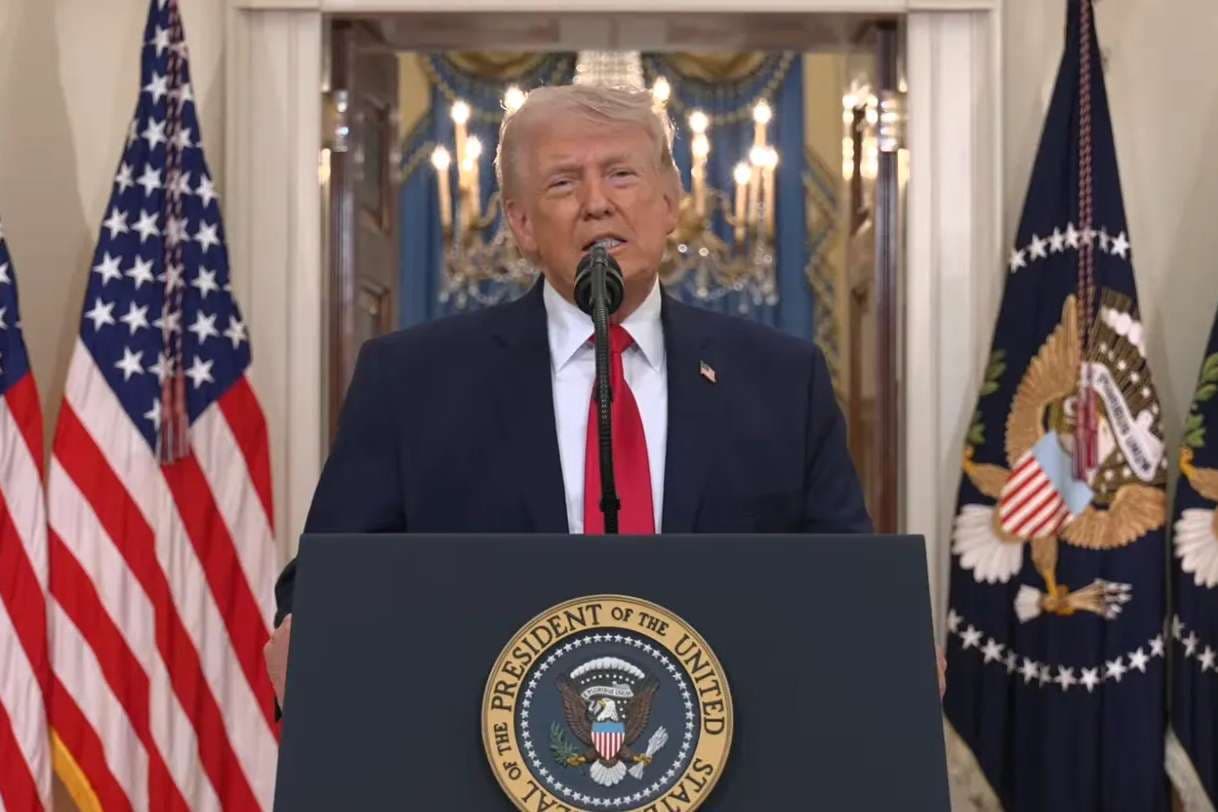
President Donald Trump and Iranian President Masoud Pezeshkian issued rival appeals to Americans April 1, as Trump defended the war effort and Pezeshkian questioned whether the war serves American interests. At the same time, several world leaders addressed their countries about the instability and economic tribulations much of the world now faces as a result of the war.
Trump delivers first national address since start of war
Trump told the nation April 1 that the U.S. military campaign against Iran has left the country's navy destroyed, its air force "in ruins," and most of its leadership dead. The President also vowed the operation would conclude within weeks.
Speaking from the White House in his first address since launching “Operation Epic Fury” one month ago, Trump said 32 days of strikes had achieved results "like few people have ever seen before" and that Iran's ability to threaten the U.S. or its allies was near collapse. "Tonight, Iran's navy is gone," he said. "Their air force is in ruins. Their leaders are now dead."
The President cast the campaign as long overdue and the culmination of decades of failed Iran policy. Iran’s theocratic regime “has been chanting, 'Death to America, Death to Israel' for 47 years," he said, citing the 1983 Marine barracks bombing in Beirut, roadside bomb attacks on U.S. troops in Iraq, and the October 7 attacks on Israel.
Trump said that Iran had been on the verge of a nuclear breakthrough and that allowing them to develop nuclear weapons would have facilitated "an intolerable threat.”
"They were right at the doorstep," he said, adding that the regime had been "rapidly building a vast stockpile of conventional ballistic missiles" that would soon have been capable of reaching the American homeland. In 2025, Operation Midnight Hammer destroyed Iran's key nuclear sites, Trump said, but the regime had immediately tried to reconstitute the program at a new location – proof, he said, that diplomacy had no chance of success.
Trump acknowledged that 13 American service members have been killed in the current operation and said he has visited Dover Air Force Base twice to receive their remains. "Every single one of their loved ones said, 'Please, sir, finish the job,'" he claimed. "And we are going to finish the job."
Trump went on to insist that the U.S. has no obligation to be in the region. "We don't need their oil. We don't need anything they have," he said. "But we're there to help our allies."
He singled out Israel, Saudi Arabia, Qatar, the UAE, Kuwait, and Bahrain for their support, while pointedly mentioning other countries that have stayed on the sidelines. "Many” nations “refused to get involved in the decapitation of Iran," he said. "We had to do it ourselves." He urged those nations to protect their own oil supply through the Strait of Hormuz, telling them to "build up some delayed courage."
He argued that regime change was never the stated goal of the war, but said a newer, "less radical and much more reasonable" regime is now in place in Iran.
Trump warned that if no deal is reached in the coming weeks, the U.S. would strike Iran's electrical generating plants. He said oil infrastructure had been deliberately spared to give Iran a path to rebuild, but added that destroying that infrastructure remains an option. "We have all the cards," he said. "They have none."
On the economy, Trump acknowledged a recent rise in gas prices but attributed it entirely to Iranian attacks on commercial oil tankers and said prices will fall once the conflict ends. He said U.S. oil production – which he said exceeds Saudi Arabia’s and Russia’s combined – has positioned the U.S. to weather the disruption.
He closed with a timeline. "Over the next two to three weeks," Trump said, "we are going to bring them back to the Stone Ages, where they belong."
Iran’s president directly addresses Americans in letter ahead of Trump’s address
Iranian President Masoud Pezeshkian published an open letter to the American people April 1, questioning whether the U.S. military campaign against Iran serves any genuine American interest and calling for dialogue over confrontation.
Opening with a defense of Iran's historical character, Pezeshkian claimed that his country has "never initiated a war" and insisted its military posture amounts to self-defense: "What Iran has done—and continues to do—is a measured response grounded in legitimate self-defense, and by no means an initiation of war or aggression."
He argued Israel “manufactured” the concept of Iran posing a threat. "If a threat does not exist, it is invented," he wrote, saying the portrayal of Iran as dangerous is "the product of political and economic whims of the powerful—the need to manufacture an enemy in order to justify pressure, maintain military dominance, sustain the arms industry, and control strategic markets."
Pezeshkian then challenged Americans directly on the cost: "Exactly which of the American people's interests are truly being served by this war? Does the massacre of innocent children, the destruction of cancer-treatment pharmaceutical facilities, or boasting about bombing a country 'back to the stone ages' serve any purpose other than further damaging the United States' global standing?"
He was most pointed on Israel, rhetorically asking “Is it not also the case that America has entered this aggression as a proxy for Israel, influenced and manipulated by that regime," and whether "Israel now aims to fight Iran to the last American soldier and the last American taxpayer dollar?" He added, "Is 'America First' truly among the priorities of the U.S. government today?"
The letter closed with a warning and an appeal: "Continuing along the path of confrontation is more costly and futile than ever before. The choice between confrontation and engagement is both real and consequential; its outcome will shape the future for generations to come.”
World leaders warn of economic hardship as war drives fuel surge
Trump’s address came on the heels of several other major announcements by world leaders, most of whom told the public to expect a period of economic hardship as a result of the war.
Australian Prime Minister Anthony Albanese delivered a rare televised national address to the nation on the fuel crisis triggered by the war. He warned of prolonged economic pain while urging conservation and calm.
“The war in the Middle East has caused the biggest spike in petrol and diesel prices in history,” he said. “The economic shocks caused by this war will be with us for months. The months ahead may not be easy.”
UK Prime Minister Keir Starmer gave a Downing Street press conference framed as an address to the nation, acknowledging the war's broad effects on the UK while stressing it was “not our war” and outlining mitigation steps such as forming closer ties with European Union partners.
“It is now clear that the impact of this war will affect the future of our country,” Starmer said.
“People turn on their TV, they look at their screens, they see explosions, infrastructure blown up, aggressive rhetoric – they worry that the UK will be dragged into this. We won’t,” he said. “But I also know that people have a deep sense this will affect their family and their household. They can see it at the petrol pumps, and they worry about their energy bills.”
French President Emmanuel Macron, while on an official visit to Japan, joined Japanese Prime Minister Sanae Takaichi in joint remarks calling for diplomatic de-escalation.
“We both advocate for a return to peace, a ceasefire, calm, and free passage through the Strait of Hormuz,” Macron said.



Comments