JD Vance recounts his journey ‘home’ to Catholicism in new memoir
After nearly a decade in the making, Vice President JD Vance's newly released memoir recounts how a search for meaning, stability, and faith ultimately led him to the Catholic Church.

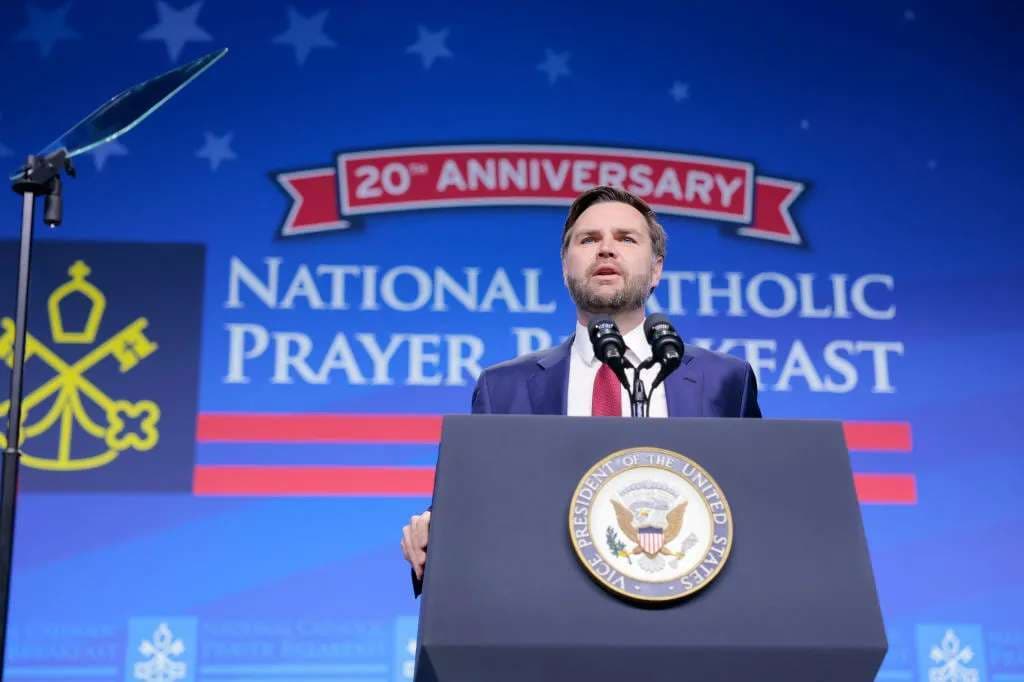
After nearly a decade in the making, Vice President JD Vance's newly released memoir recounts how a search for meaning, stability, and faith ultimately led him to the Catholic Church.
Published June 16 by HarperCollins, Communion: Finding My Way Back to Faith reflects on the experiences that shaped Vance's conversion to Catholicism in 2019 and his understanding of faith, family, and public service.
HarperCollins describes the book as “a spiritual exploration of what it means to be a Christian in all the seasons of life JD Vance has experienced — as a child, a young man, a husband, a father, and a leader.”
Vance said the book was driven by a question that had lingered in his mind for years.
“The story of how I regained my faith, of course, only happened because I had lost it to begin with,” he said in a statement reported by AP News. “The interesting question that hangs over this book, and over my mind, is why I ever strayed from the path. Why the Christian faith of my youth failed to properly take root.”
Speaking with CBS News in an interview published June 14, the vice president said he began working on the memoir years ago, following the publication of his bestselling memoir Hillbilly Elegy in 2016.
“I actually started writing the book back in 2017,” Vance said. “Hillbilly Elegy had come out, and I was talking with the publisher about what I was most interested in, and I kept coming back to this topic of religion because, as I write in the book, there was a sort of religious journey that was going on very personally at the time.”
He said the new memoir shares some similarities with his first book in its exploration of larger cultural and political themes, but ultimately became a deeply personal reflection on his own path back to faith. Vance said he hoped the book would be both a personal testimony and a contribution to broader conversations about Christianity in American public life.
“It took me almost 10 years to actually get all this out and get it to a place where I wanted to publish it,” he said. “But, you know, I thought, ‘Number one, this is one man's religious journey and maybe it will be helpful to some other people who are going through some similar things. And number two, maybe it'll say something interesting about the role of Christianity in American public life that people will pick up on.’”
A major theme of the book is Vance's journey from the evangelical Christianity of his youth to Catholicism. Reflecting on that path, Vance told CBS that he had deeply appreciated the generosity and hospitality he experienced in the Christian churches he attended growing up, but eventually drifted away from the faith.
“I started to see myself as, you know, too smart maybe, too high-minded,” he recalled. “I was going to make decisions based on rationality and science and not on this religious mumbo jumbo.”
Vance credited Catholic family members and friends with helping guide him toward the Church. In the interview, he said several influential people in his life — including some who are discussed in the book — introduced him to Catholic parishes, eventually leading to his conversion in 2019.
“God put a lot of people in my path who were very good Christians and ended up being Catholics, and that's where I found a home,” he said.
Craving stability in an increasingly fast-changing world, Vance said Catholicism “felt rooted.” He explained that he appreciated the Church's continuity, noting that attending Mass felt familiar even when visiting churches in other countries.
The book also explores Vance's dissatisfaction with what he describes as the “rat race of meritocracy.” As a young professional, he had achieved many traditional markers of success, including military service, a Yale education, and a prestigious career. Yet he said something still felt missing.
“I think that was the fundamental insight that led me to think, well, maybe Christianity has something going for it,” he said, later adding, “I [had] all these things that the culture tells me that I want, but I was not particularly happy. And more importantly, I was thinking, ‘I’m not a particularly good person right now.’”
As Vance's relationship with his future wife, Usha, grew more serious, he said questions about marriage, family, and virtue pushed him to reconsider Christianity.
“We were thinking about having a family together. And you start asking yourself, how do I be a good husband? How do I be a good provider? How do I be good at the things that actually matter?” he said. “And the more that I asked those questions, the more that I felt like Christianity had the best answers.”
The memoir also explores what it means to remain true to one's faith while serving in public office in a complex and often messy world.
“One of the fundamental challenges of my life is that I really do believe that Jesus is the son of God and that there are all of these moral truths that flow from it,” he told CBS. “Well, how do you apply those moral truths in a very messy world where there are a lot of trade-offs, there are a lot of competing factors?”
Vance said that challenge is “part of being a political leader in modern America.”
>> Usha Vance says Catholic faith brought stability to Vice President JD Vance <<


Comments