Jerusalem Patriarchate says concerns about Holy Week, Easter celebrations at Holy Sepulchre have been resolved
The Latin Patriarchate of Jerusalem and the Custody of the Holy Land said March 30 that an arrangement has been secured with the Israel police for the Churches’ representatives to celebrate Holy Week and Easter at the Church of the Holy Sepulchre.

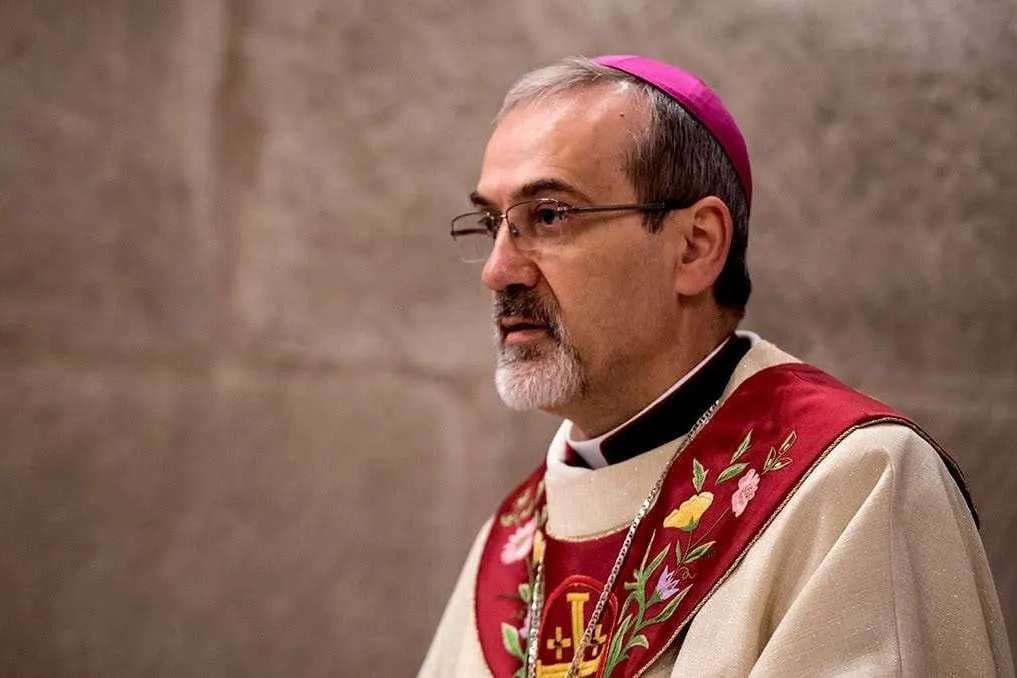
The Latin Patriarchate of Jerusalem and the Custody of the Holy Land said March 30 that an arrangement has been secured with the Israel police for the Churches’ representatives to celebrate Holy Week and Easter at the Church of the Holy Sepulchre. The statement comes after Cardinal Pierbattista Pizzaballa, the Latin Patriarch of Jerusalem, was stopped by Israeli national police from entering the church on Palm Sunday.
The joint statement confirms “that the matters concerning” the celebrations at the church “have been addressed and resolved in coordination with relevant authorities.”
“In agreement with the Israel Police, access for representatives of the Churches has been secured in order to conduct the liturgies and ceremonies and to preserve the ancient Easter traditions at the Church of the Holy Sepulchre,” they continued.
As Zeale News reported in the LOOP, the initial incident where Cardinal Pizzaballa was not allowed to enter the church — under the argument that it was for his safety — sparked condemnations from Catholic and secular leaders around the globe.
Israel Prime Minister Benjamin Netanyahu issued a statement later on March 29 that said he has instructed authorities to grant Cardinal Pizzaballa full access to the church. The prime minister noted that even though he understands the concern for the cardinal’s safety, as soon as he learned about the incident, he instructed the authorities to grant the permissions to Cardinal Pizzaballa.
The March 30 statement from the Patriarchate and Custody of the Holy Land also acknowledged the safety concern and that the forthcoming liturgies will be broadcast.
“Naturally, and in light of the current state of war, the existing restrictions on public gatherings remain in force for the time being,” they said.“Accordingly, the Churches will ensure that the liturgies and prayers are broadcast live to the faithful in the Holy Land and throughout the world.”
They also expressed “sincere gratitude” to Israel President Isaac Herzog “for his prompt attention and valued intervention” and “appreciation to the Heads of State and officials who acted swiftly to convey their firm positions, many of whom personally reached out to express their closeness and support.”
Cardinal Pietro Parolin, the Vatican Secretary of State, and Archbishop Paul Gallagher, Vatican Foreign Secretary, met with Israeli ambassador the Holy See Yaron Sideman after the incident occurred, according to Michael Haynes, the Vatican correspondent for Pelican Catholic.
Haynes reports that the Vatican stated that “during the conversation, regret was expressed over the incident, regarding which clarifications were provided, and note was taken of the agreement reached between the Latin Patriarchate of Jerusalem and the local authorities concerning participation in the liturgies of the Holy Triduum at the Basilica of the Holy Sepulchre in Jerusalem.”
White House Press Secretary Karoline Leavitt said the White House did “express our concerns with Israel” regarding the Christian sites in Jerusalem being shut down. She noted that safety is a top priority but that the sites should be accessible, adding that the White House is appreciative of Israel working on the security measures to reopen the sites.
The Patriarchate and Custody of the Holy Land also underscored in their statement that freedom of worship — for members of all religions — is a necessity.
“We wish to emphasize that religious faith constitutes a supreme human value, shared by all religions, Jews, Christians, Muslims, Druze, and others,” they said. “Especially in times of hardship and conflict, such as those presently endured, safeguarding the freedom of worship remains a fundamental and shared duty.”
“It is our hope that appropriate arrangements will continue to be found, enabling prayer to take place in places of worship,” they continued, “particularly in the Holy Places of all religions, in a manner that respects both legitimate safety needs and the religious observances and prayers that are of profound importance to hundreds of millions of believers.”
They concluded by noting that the Church’s dialogue with authorities including the Israel police is ongoing and by echoing the Pope’s call for peace in the region.
“We pray and hope for an end to the tragic war affecting the region, mindful of the heavy consequences it has on all,” they said. “The Latin Patriarchate of Jerusalem and the Custody of the Holy Land reaffirm their commitment to dialogue, mutual respect, and the preservation of the Status Quo.”
Cardinal Pizzaballa also offered a Palm Sunday meditation published by the Patriarchate, in which he noted that the war took away the ability to hold the traditional palm procession.
“It is the war that has interrupted our festive journey, making even the simple joy of following our King difficult,” he said. “Our brothers and sisters of the Holy Land cannot fill the streets this Sunday nor join their voices to the festive procession.” However, he offered a message of hope, saying that “faith does not falter when outward rites are stripped away.”
He said Christ once again weeps over Jerusalem, a city that “remains a sign of both hope and sorrow, of grace and suffering,” and the Lord weeps over the Holy Land “still unable to recognize the gift of peace.”
He later emphasized the hope of the resurrection amid grief saying that in the Holy Land the faithful “learn to look upon the city with the eyes of Christ,” learning “to mourn with him, but also to hope with him.”
“For the same Jerusalem that rejected the Prince of Peace has also witnessed the empty tomb. War will not erase the resurrection. Grief will not extinguish hope,” he said. “Today we do not carry palms in procession. Instead, we carry the cross – a cross that is not a useless burden, but the source of true peace.”
.jpg&w=3840&q=75)
Comments