Living every weekend in the Triduum’s rhythm: What I’ve learned from Liturgy of the Hours
By praying the Liturgy of the Hours’ daily Night Prayer, I have encountered, on a weekly basis, the sacred Triduum on a smaller but beautiful scale, in such a way that helps me build a rhythm of life centered around Christ’s Passion, death, and Resurrection.

The Church has once again celebrated the Passion, death, and Resurrection of Christ in the sacred three-day liturgical season called the Triduum. Now, the faithful will rejoice in the Easter season for many weeks, and then go on to celebrate Pentecost, Ordinary Time, and other feasts throughout the year, until the new liturgical year begins again at Advent.
To many, the Triduum can feel like a blip in the calendar, especially as it is marked by 40 days of intense preparation followed by many more of celebration. However, especially by praying the Liturgy of the Hours’ daily Night Prayer, I have encountered, on a weekly basis, the sacred Triduum on a smaller but beautiful scale, in such a way that helps me build a rhythm of life centered around Christ’s Passion, death, and Resurrection.
The Liturgy of the Hours is a set of prayers, primarily the Psalms, that religious and clergy pray at various times of every day, including the morning, midmorning, afternoon, evening, and night. This liturgy sanctifies all hours of the day and, like the Mass, is a public prayer of the Church, meaning that even when people pray it alone, they are still joining everyone else who is praying it around the world.
Laypeople are invited and encouraged to participate in the Liturgy of the Hours. I was introduced to the habit of praying Night Prayer by a group of my friends in college who gathered regularly to pray it in community.
A different friend would host the prayer in their dorm every night of the week, so I learned the rotating schedule and joined a group of about 20 Catholic Gen Zers gathered for a short but beautiful spiritual exercise. When it isn’t being chanted and is just read out loud, Night Prayer doesn’t take very long — between five and 10 minutes. We would always conclude by singing the Salve Regina, the Latin version of the Hail Holy Queen prayer; I cherish the memory of hearing my friends singing it with such love for Our Blessed Mother.
Post-graduation, I have retained a devotion to praying Night Prayer, having grown to love ending my day commending my life to the Lord. But it has also taught me something about the Triduum, a lesson that’s been reinforced by external habits I’ve cultivated as well. I have a love for “living liturgically” at home, especially thanks to my parents, who showed me how to observe and celebrate the Church’s liturgical calendar days at home.
My family has made an effort to tangibly set Sundays apart from the rest of the week, even through little things like adding extra decor at the dinner table, using the good china plates, or having a special dessert (or all three!). Several years ago, my family also began making an effort to penitentially acknowledge every Friday in a small way as the day Our Lord died, so we gave up having meat on Fridays year-round.
As each of these habits — meatless Fridays, feast-filled Sundays, and daily Night Prayer — became a part of my life, they became more interwoven, and began to reinforce my understanding of how deeply incarnational the Catholic faith is: In the spiritual life, and even through the material aspects of the world, God draws us closer to Him.
This became apparent to me as Night Prayer began to reinforce weekly meditation on the Triduum events, particularly through the closing prayers for Friday, Saturday, and Sunday.
For context, unless it is a special feast day, one prays with the same Psalm every Monday, and the same Psalm every Tuesday, and so on through each day of the week. Many of them are encouraging Psalms, as one speaks about taking refuge in the Lord, for example. But I remember one of the first times I really paid attention to the Friday Night Prayer Psalm, I was struck by how intense it is.
The antiphon prayed just before the Psalm is: Day and night I cry to you, my God. In it, a tone of reaching out to God is set, and Psalm 88 begins:
“Lord my God, I call for help by day; I cry at night before you. Let my prayer come into your presence. O turn your ear to my cry. For my soul is filled with evils; my life is on the brink of the grave. I am reckoned as one in the tomb: I have reached the end of my strength, like one alone among the dead; like the slain lying in their graves; like those you remember no more, cut off, as they are, from your hand.”
The rest of the Psalm continues to relate the Psalmist’s wrestling and struggle, reiterating his calling out to God amid trials. It concludes: “Friend and neighbor you have taken away: my one companion is darkness.”
When I first prayed with this Psalm, I didn’t understand why it was included as Friday’s weekly Psalm when so many of the other days’ Psalms were positive. But as I spent more time with it week after week, I came to see Christ and His suffering on the cross prefigured in this Psalm, thinking also of Christ’s cry from the Cross: “My God, My God, why have You abandoned Me?”
And sometimes when I returned to this Psalm, I came bearing sadness of my own. My life has had its ups and downs, and at the end of a particularly difficult week, I grew to appreciate the opportunity to pray through my own struggles — the crosses I have been asked to carry — especially with this Psalm.
But the prayer never concluded without hope, either. The closing prayer of Friday’s Night Prayer states: “All-powerful God, keep us united with your Son in His death and burial so that we may rise to new life with Him, Who lives and reigns for ever and ever.”
Every week I returned to Friday Night prayer, and every week it became more apparent to me that amid my life’s sufferings, I could unite them to the cross of Christ — and look forward to sharing in His Resurrection, as well.
Meanwhile, throughout these weeks, I was still “living liturgically.” Contemplating the hope mentioned in Night Prayer was reinforced when I enjoyed tangible reminders of Easter every Sunday.
Moreover, the Saturday and Sunday Night Prayers also offered space to continue reflecting on this hope. Saturday’s final prayer reminds the faithful to look forward to the next day, to the hope of the Resurrection. It sets a tone of expectation and joy, stating: “Lord, be with us throughout this night. When day comes may we rise from sleep to rejoice in the resurrection of your Christ, who lives and reigns for ever and ever.”
Then the light dawns on Sunday, the day of rest, and the day of rejoicing in Christ’s triumph over sin and death. I go to Mass, spend time with family and friends, enjoy special charcuterie or dessert, knowing it is a day worth celebrating, every week.
Having lived the day set aside from the rest, I look forward to concluding with Sunday Night Prayer that includes Psalm 91. It ends the weekend not with a prayerful cry of desolation, but a declaration of the Lord’s protection and love.
The Psalm concludes: “Since he clings to me in love, I will free him; protect him for he knows my name. When he calls I shall answer: ‘I am with you.’ I will save him in distress and give him glory. With length of life I will content him; I shall let him see my saving power.”
The hope of the Resurrection is then contemplated briefly again with a Scripture passage. The Sunday Night Prayer spotlights a reading from Revelation chapter 22, which underscores that the faithful in Heaven “shall see the Lord face to face” and that “the night shall be no more.”
As I prepare to go to sleep, the final line of the passage reminds me of the eternal life I hope to attain: “They will need no light from lamps or the sun, for the Lord God shall give them light, and they shall reign forever.”
This Scripture passage is one of my favorites to contemplate; it signals so much hope amid a world that often is so dark and reminds me that after the Cross on Good Friday is the triumph of Easter.
Sunday’s concluding prayer brings the day of celebration to an end, and points toward beginning a new week entrusted to God.
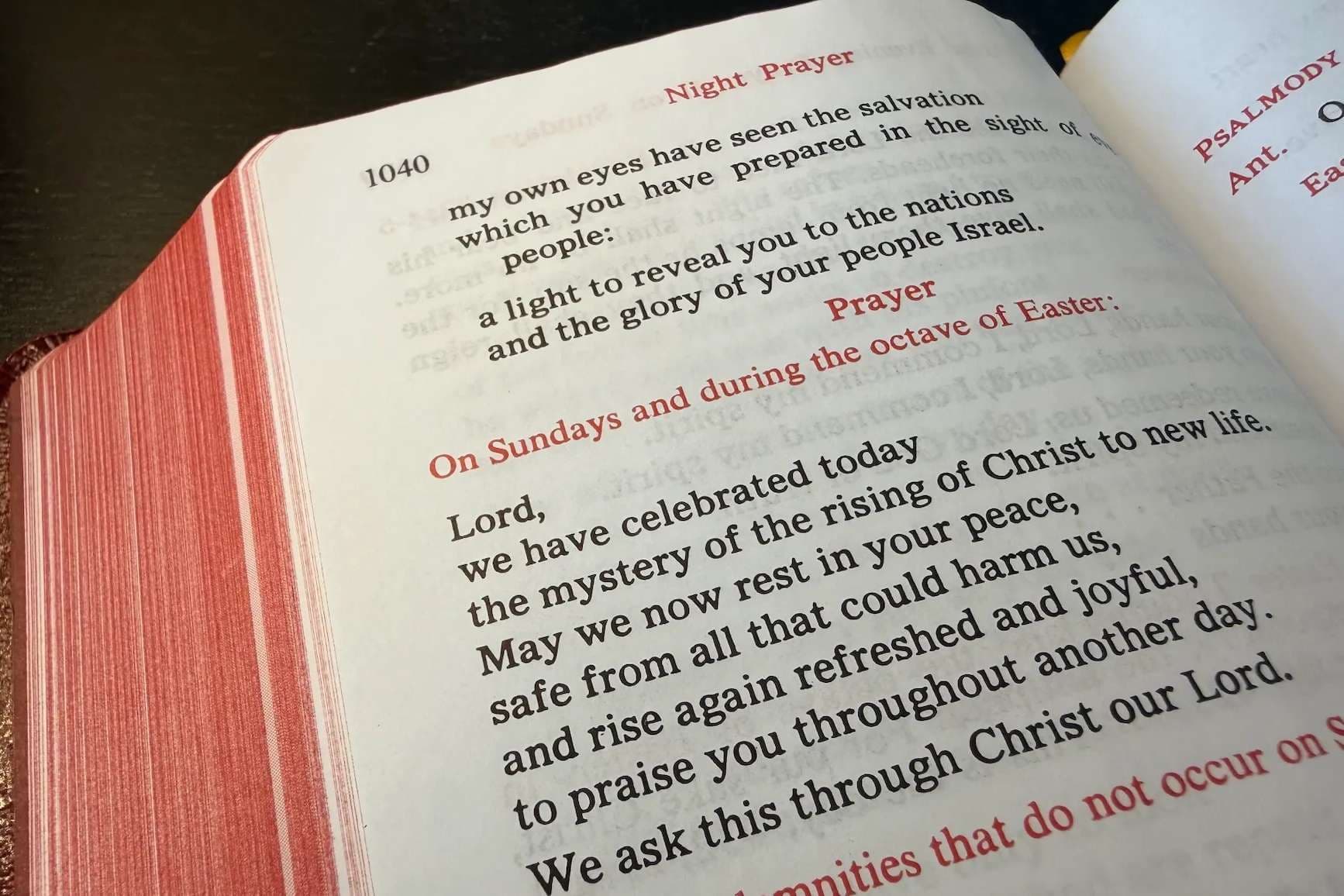
It states: “Lord, we have celebrated today the mystery of the rising of Christ to new life. May we now rest in your peace, safe from all that could harm us, and rise again refreshed and joyful, to praise you throughout another day. We ask this through Christ our Lord.”
I make the sign of the cross and conclude: “May the all-powerful Lord grant us a restful night and a peaceful death. Amen.”
Even as I pray this last part, I know death is not the end. There is reason to hope, and new life to come.


.jpg&w=3840&q=75)
Comments