Our Lady of La Vang stirs powerful reminder of her maternal care even amid persecution
According to long-held devotion, the Blessed Mother appeared multiple times to persecuted Vietnamese Catholics hiding in the forests of La Vang in the 18th century and later was declared Protectorate of the Catholics. Devotion to her has remained strong since and is deeply rooted in Vietnamese culture.


The feast of Our Lady of La Vang, widely celebrated on Nov. 22 by Vietnamese Catholics in the U.S., honors the maternal care and powerful intercession of the Blessed Mother, who, according to longstanding devotion, appeared to Catholics fleeing persecution in Vietnam in 1798.
The persecution sparked near the end of the 18th century, after Vietnam had been embattled in years of power struggles marked by uprisings and rebel forces, according to the Oklahoma-based Cathedral of Our Lady of Perpetual Help, which holds an annual celebration for Our Lady of La Vang. As her feast day is not on the universal liturgical calendar, occasions of celebrating Our Lady of La Vang vary. The principal celebrations at her shrine in Vietnam take place in August on the Solemnity of the Assumption, while many U.S. churches and diocesan bulletins highlight the feast on Nov. 22.
Near the close of the 18th century, an overthrown king from the southern realm of Vietnam sought to reclaim the throne and came in contact with a Catholic bishop and missionary who had advised him to seek help from France. The new king, Canh Thinh, feared that the usurped king would be supported by Catholics. In light of this, King Thinh launched a persecution against Catholicism in Vietnam, led by Tay Son authorities. On Aug. 17 of 1798, the king issued “an anti-Catholic edict and an order to destroy all Catholic churches and seminaries,” according to the Cathedral of Our Lady of Perpetual Help.
According to UCA News, in 1798, Catholics fleeing persecution under the Tay Son authorities sought refuge in the forests of La Vang. The name was said to have originated from the abundance of a type of tree called “Lá Vằng” in the forest in central Vietnam, according to the cathedral, which noted that it is also said La Vang translates into the Vietnamese phrase for “Crying Out,” representing the cries of the persecuted Catholics.
UCA News explains that the Catholics who had fled to the forest faced hunger, disease, and great fear, but gathered to pray the Rosary. According to tradition, the Blessed Mother appeared to them there, and was seen holding the infant Jesus. She comforted them and showed them local plans that could heal and treat disease.
According to the cathedral, “As the people recognized her as the Blessed Mother, she comforted them, offered solace and told them that whoever came to that same place to pray, they would get their prayers heard and answered. She continued to appear to the people throughout the period of persecution.”
Deacon Joseph Nguyen, who assists at Our Lady of Vietnam Church in Georgia, told the Georgia Bulletin that the Blessed Mother is also believed to have told the faithful in hiding: “My children, what you have asked of me, I have granted you, and henceforth whoever comes to this place to pray to me, I will listen to them.”
After the first apparition, local Catholics built a small chapel in her honor, and over the next few years, her name spread throughout the region, according to the cathedral. Though the apparition site was difficult to reach because it was high in the mountains, Catholics began journeying through the dangerous forests in pilgrimage to the site. They continued to do so annually despite the ongoing persecution, which lasted until 1886.
After the persecution ended, the local bishop ordered a church to be built in honor of Our Lady of La Vang. It was completed in 1901, and the bishop proclaimed Our Lady of La Vang as the Protectorate of the Catholics, according to the cathedral. A larger church was built in 1928 to accommodate more pilgrims, but it was destroyed in 1972 during the Vietnam War. A project to rebuild the church was carried out from 1995 to 2004.
According to the Wichita-based Cathedral of the Immaculate Conception, the Vatican has not officially and formally recognized this Marian apparition as authentic, though in 1998 Pope John Paul II publicly recognized the importance of Our Lady of La Vang and expressed support for rebuilding the church.
Marian devotion remains deeply rooted in Vietnamese culture. UCA News reported that according to Tran Trung Linh, a non-Catholic Vietnamese researcher, the Marian devotion in Vietnam is exceptional.
“I have visited many countries with long Catholic traditions, but I have rarely seen Mary receive such special affection as she does in Vietnam,” he said.
“Here, Mary seems to have gone beyond an ordinary religious devotion to become part of Vietnamese Catholic identity,” he added. “This may also have something to do with Vietnamese culture, where the mother is deeply associated with family, filial devotion, sacrifice and protection.”
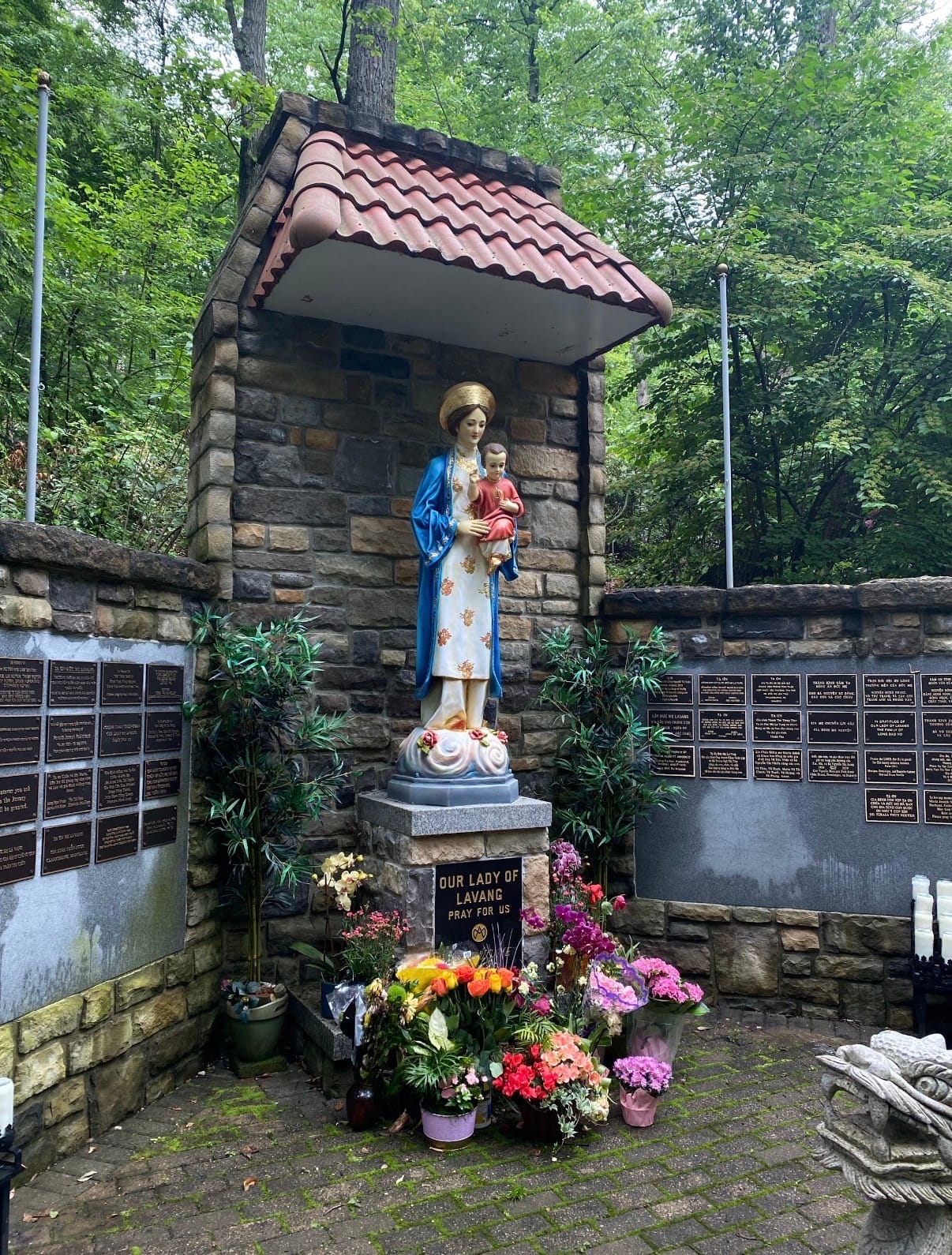
According to the outlet, the image of Our Lady of La Vang depicts her with Asian features and wearing the traditional Vietnamese ao dai and headdress. She is also holding baby Jesus, just as she was when she appeared to the persecuted Catholics in 1798.
In August, more than 90,000 Catholics celebrating the Solemnity of the Assumption of the Blessed Virgin Mary attended the annual pilgrimage at the Shrine of Our Lady of La Vang in central Vietnam, according to a Licas News article republished by Vatican News.
During the homily for the pilgrimage Mass, Archbishop Joseph Dang Duc Ngan of Hue outlined how important La Vang is for Vietnamese Catholics, saying it is where “Mary chose to accompany our Vietnamese people, amid wars, suspicion, and religious persecution.”
The archbishop said her apparition offered strength to the persecuted Catholics amid deep suffering. He also encouraged the faithful “to follow Mary’s example of obedience to God’s will, so that His plan may be fulfilled in each person.”


Comments