Pope Leo calls Christians to uphold human dignity in an increasingly virtual world
Drawing on Vatican II, the Holy Father said genuine relationships, respect for life, and social responsibility are essential to building a more humane world.

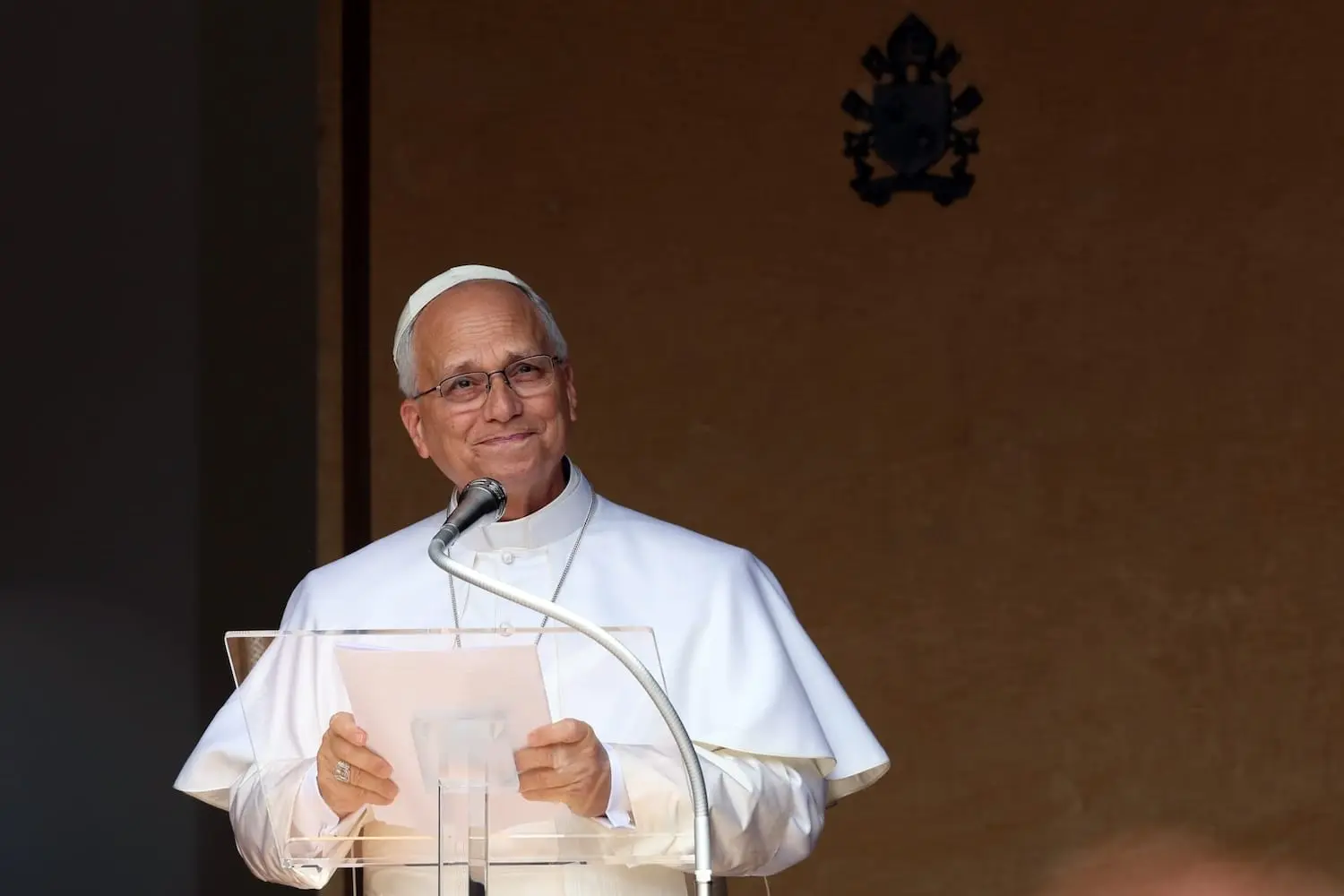
In his Sept. 16 Wednesday audience, Pope Leo XIV reflected on the dignity of the human person in an interconnected world, calling Christians to foster genuine connection as relationships become increasingly virtual.
The Holy Father continued his catechesis on the Second Vatican Council’s pastoral constitution Gaudium et Spes, focusing on the connection between human relationships and the dignity of every person.
“On the one hand, technological development, the spread of the mass media and social media, and the ever-increasing use of artificial intelligence are opening up new possibilities, breaking down barriers and bridging distances; on the other hand, relationships are tending to become less and less personal, more virtual, and there is a risk of becoming accustomed to delegating to algorithms decisions that are the sole preserve of the human conscience,” Pope Leo said.
Amid those changes, the Holy Father pointed to a particular role for the faithful.
“Ensuring that social relationships have real substance and personal depth is, in this regard, the contribution that the Christian community seeks to offer,” he said.
Pope Leo rooted that responsibility in God’s plan for humanity to live in harmony.
“The Council invites us to draw criteria and strength from God’s creative plan, in which He willed that ‘all men should constitute one family and treat one another in a spirit of brotherhood,’ which is why ‘love for God and neighbour is the first and greatest commandment,’ which found its full revelation and complete fulfilment in Christ,” he said.
That vision also places the human person at the center of social life, Pope Leo continued.
“The perfection of the human person and the development of society must be regarded as closely interdependent: to set them against one another or separate them would be to render them meaningless,” he said. “History, even recent history, clearly confirms this truth; we must therefore never tire of reiterating, in the words of the Fathers of the Second Vatican Council, that ‘the subject and goal of all social institutions is and must be the human person which for its part and by its very nature stands completely in need of social life.’”
Pope Leo said that broader vision of society also includes the diversity of people and nations.
“From this perspective, Gaudium et Spes affirms that the diversity of people and peoples in the world must not be considered as a danger or a threat, but rather as a resource for enrichment and growth,” he said.
The Pope said putting that teaching into practice begins with protecting human life and dignity.
“Whatever is opposed to life itself, such as any type of murder, genocide, abortion, euthanasia or wilful self-destruction, whatever violates the integrity of the human person, such as mutilation, torments inflicted on body or mind, attempts to coerce the will itself; whatever insults human dignity, such as subhuman living conditions, arbitrary imprisonment, deportation, slavery, prostitution, the selling of women and children; as well as disgraceful working conditions, where men are treated as mere tools for profit, rather than free and responsible persons; all these things and others of their like are infamies indeed,” Pope Leo said, quoting Gaudium et Spes.
That respect also extends to adversaries and those who think or act differently, the Holy Father continued.
“Every type of discrimination, whether social or cultural, whether based on sex, race, colour, social condition, language or religion, is to be overcome and eradicated as contrary to God’s intent,” Pope Leo said, quoting the council document.
The Pontiff concluded by returning to the responsibility each person bears.
“Dear brothers and sisters, this vision of humanity as a ‘community of people’ is a valuable legacy that the Second Vatican Council has left us,” he said. “It helps us all to engage in personal and communal discernment, so that we may responsibly evaluate today’s social and political projects, based on the criteria of the dignity of the human person, social justice and free participation in constructing the common good. For the future of humanity depends on each person’s commitment to collaborate with God and with their brothers and sisters in building a more humane world.”
_.jpg&w=3840&q=75)

Comments