Pope Leo says Solemnity of Peter and Paul draws us ‘into the mission of Jesus Himself’
The Pontiff encouraged Catholics to look to the example of the two saints and bear witness to Christ by courageously responding to the call to follow Him.

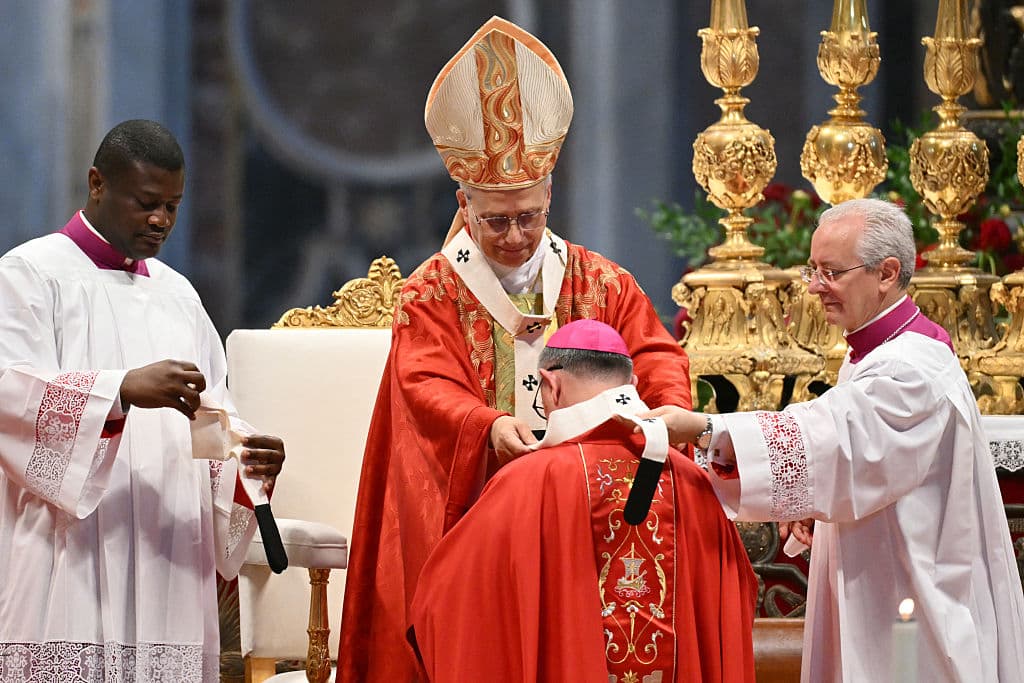
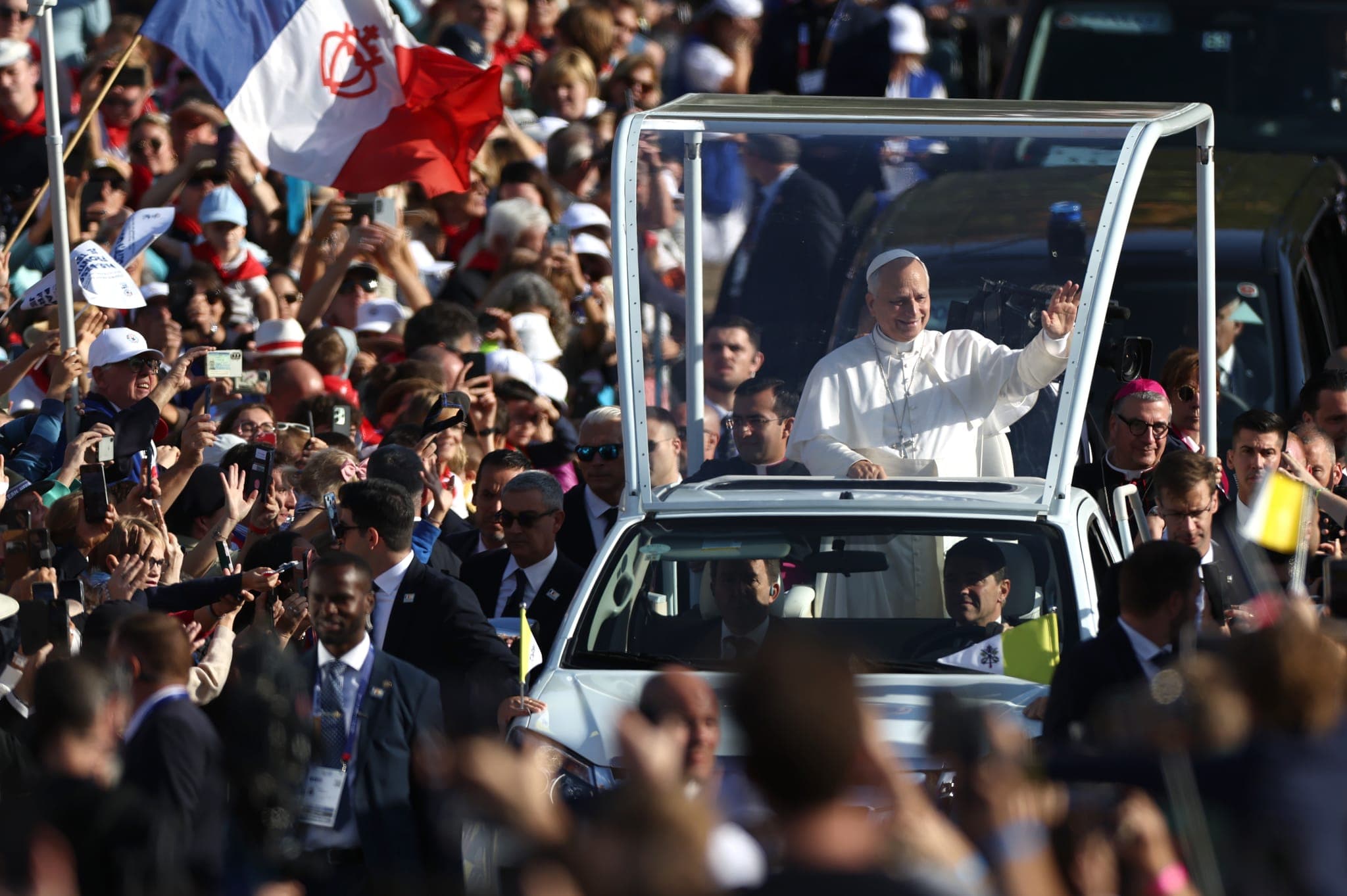
Pope Leo XIV celebrated Mass and gave a special Angelus address June 29 for the Solemnity of Sts. Peter and Paul, princes of the Church whom the Pontiff said were called proclaim the Gospel with their distinctive voices while exemplifying the unifying power of God.
The Pope gives an Angelus address every Sunday and on solemnities, which are the highest of feast days. Speaking to those gathered in St. Peter’s Square despite the summer heat, Pope Leo said today’s solemnity “recalls the original bond that unites the Church in Rome with all the other churches throughout the world in a communion of faith and charity.”
Both Peter and Paul were martyred in Rome. Pope Leo said their witness “is like a seal upon the New Testament,” adding that “the blood they shed in this city reveals the depth of God’s love that the Lord Jesus has given us.”
By their martyrdom and word, Christ’s Gospel took root in Rome and revealed in the heart of the empire its renewing power, inviting a deeper knowledge of God and of the dignity of the human person, as well as “a new understanding of power, not as dominion, but as service to human life,” according to the Pope.
He urged Catholics to witness to the faith, noting that God entrusts His mission to “imperfect but forgiven sinners” through which His grace may shine.
“Even today, the Lord, who died and rose again out of love, makes Himself present through His witnesses,” Pope Leo said, “reaching the centers and the peripheries, the capitols, and the most remote regions, through the voices, faces, and courageous choices of those who have responded to His call: ‘Follow me!’ Thus this day of celebration draws us into the mission of Peter and Paul, that is, into the mission of Jesus Himself.”
The Pontiff also observed that Peter and Paul, having varied backgrounds and character, were starkly different from one another even after being called to follow Christ because the Lord “did not make them the same.”
“Peter and Paul understood and proclaimed the Gospel each with his own distinctive voice, and the Holy Spirit, in inspiring the biblical authors, did not want their differences to be hidden,” he added. “Indeed, these differences are presented to us as good news.”
They were not adversaries among the apostles, but became a symbol of unity through the Holy Spirit, Pope Leo emphasized: “Their witnesses contributed decisively to ensuring that the Christian presence in history is directed not toward dominion but toward service, unity, and reconciliation.”
Pope Leo prayed that through their intercession the faithful may have the grace to ever more deeply appreciate the Church’s catholicity, persevere in ecumenism, and avoid any harmful challenges to communion. He concluded by asking the intercession of Mary, Queen of the Apostles, for her continued protection of the faithful in Rome and throughout the world.
Pope Leo celebrates solemnity Mass, blesses sacred wool cloth for new archbishops
The same day, Pope Leo celebrated Mass in St. Peter’s Basilica, where he blessed the sacred pallium — a white wool band of cloth with crosses on it — for new metropolitan archbishops, including four from the U.S.: Archbishop Mark Rivituso of Mobile, Alabama; Archbishop Ronald Hicks of New York; Archbishop James Golka of Denver; and Archbishop James Checchio of New Orleans.
Archbishop Golka, who was installed as Denver’s archbishop in March, said in a June 28 video message that the pallium symbolizes being a shepherd of the flock of one’s diocese. He said he also sees it as a sign of unity between the bishops and the Pope. Archbishop Golka emphasized that as his archdiocese’s new spiritual shepherd, he feels a strong responsibility to lead and protect those in his care.
“The shepherd is one who keeps the flock together, will do anything, including lay down his life for the salvation, security of the flock,” he said. “I would do that in spades for the people of the Archdiocese of Denver. I’ve come to love them in a short time. I would die for them. I would do anything to help get them to heaven.”
>> Denver archbishop reflects on vocation, appointment from Pope Leo <<
In his homily, Pope Leo reflected similarly on the theology of the pallium, saying it expresses “the commitment of every Shepherd — and also of every Christian — to take upon their shoulders the brothers and sisters entrusted to them, like so many lambs of the Lord’s flock, and to sacrifice their energy, time, effort and even their lives for them.”
“They do so in order that the Gospel may reach everyone, and the whole world may find in it harmony and concord,” he added, before conferring a pallium upon each of the new archbishops.
Pope Leo encouraged all the faithful to look to Peter and Paul as models to follow in striving to be apostles, servants of the truth, and cultivators of unity. He recalled that Peter is often seen in the New Testament as working to maintain communion among the brothers and professes one faith on behalf of the other Apostles in proclaiming that Christ is the Son of God. In the Acts of the Apostles, Peter strives to maintain unity when the question of whether uncircumcised Gentiles may be baptized; after gathering the brothers together and listening to them, Peter, “guided by the Holy Spirit, makes a decision that preserves communion and ushers in a new era for the entire People of God,” Pope Leo said.
Peter is not perfect, but he ‘knows how to to acknowledge his mistakes and repent,’ continuing his mission
The Pontiff also noted, however, that the first pope’s "magnanimity does not mean that Peter is perfect.” Peter denied Christ three times during the Passion, and then repents; additionally, in Galatians, Paul “rebukes him for the inconsistency of some of his actions.”
“Yet,” Pope Leo continued, “Peter knows how to acknowledge his mistakes and repent, without becoming discouraged and without failing in his mission to proclaim the Gospel and gather Christ’s flock, even unto martyrdom — a fate which he suffered here in Rome, not far from where we are gathered.”
He said that the symbol of keys associated with Peter reflects the first pope’s concern for unity, reflecting that keys open doors rather than break them down. This opening combines previously isolated rooms and turns them “into one welcoming home,” he reflected.
“In the same way, communion within the Church is not built by clinging rigidly to one’s own position, but by seeking, in all hearts, points of encounter in the Truth, in whose light alone each person becomes a means of growth for another,” Pope Leo continued. “In this light, we can interpret the mission entrusted by the Lord to Peter and his Successors for the benefit of the entire holy People of God.”
He said the mission involves listening to each person, discerning inspirations, and correcting errors, as well as encouraging, instructing, and guiding people on the path of salvation.
“Moreover, Peter’s example is an invitation to every Christian to become a builder of unity, placing God at the center of one’s life and drawing close to one’s brothers and sisters, attentive to their circumstances and needs,” Pope Leo said. “In this way, we learn to live with one another in charity, so that the message might be fully proclaimed.”
Paul teaches this as well, Pope Leo added, describing him as “the tireless herald of the Good News.” God called him to convert to the Gospel and then, in turn, proclaim it — and, like Peter, to witness to it, even to death, Pope Leo said.
“The apostle to the Gentiles allowed himself to be transformed by the power of God’s word,” the Pontiff said, “which rescued him from the way of violence and led him onto the path of love.”
Comments