Pope Leo speaks to young people about vocation: To choose ‘forever’ does not imprison us
In a rapidly changing world, the courage to make a lifelong commitment is perhaps the most revolutionary act one could choose, the Pontiff said in response to a 27-year-old man’s question.

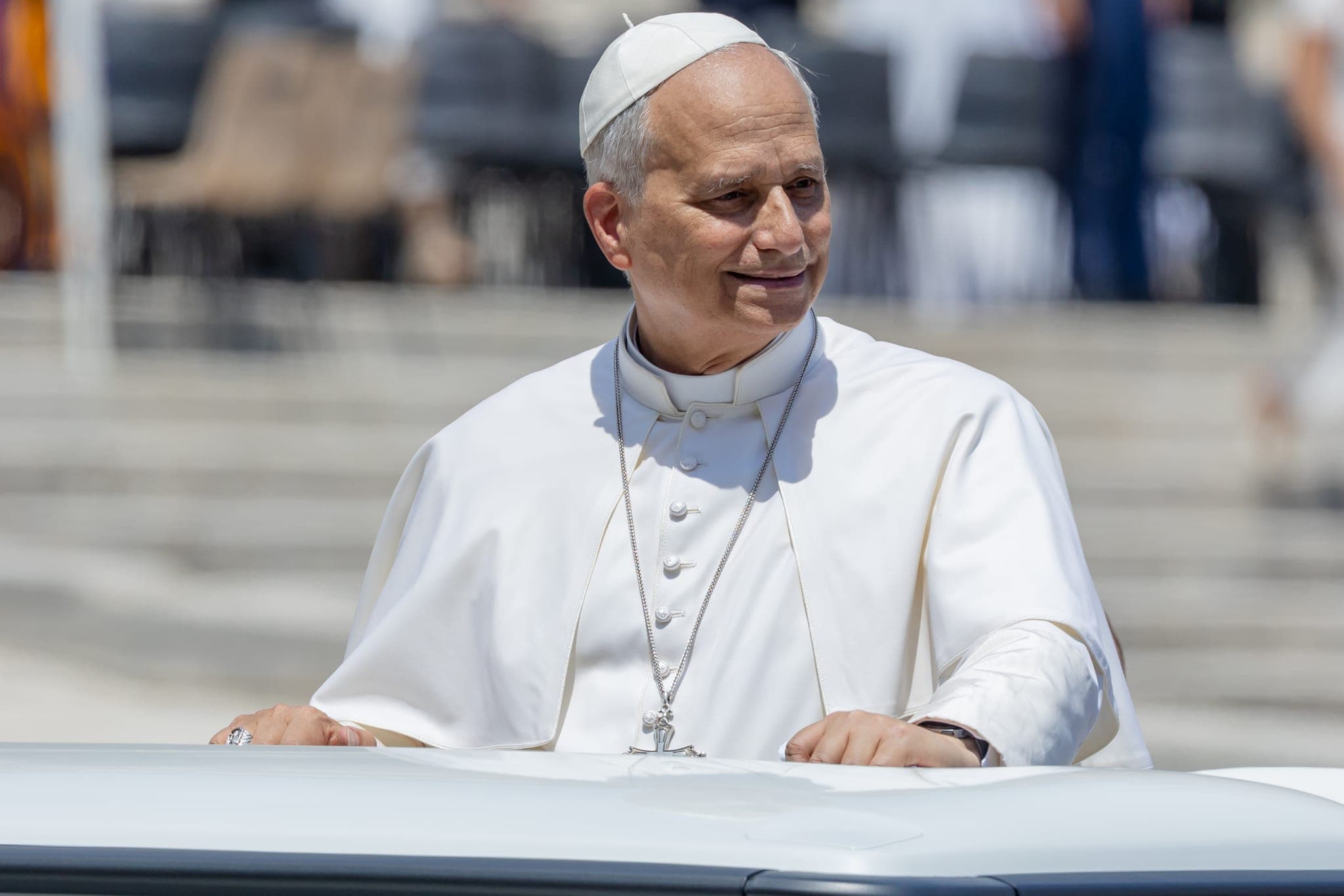
Speaking about his own vocational path and his advice for people living in a culture fearful of lifelong commitment, Pope Leo XIV told young people gathered in Assisi Aug. 6 that God has a unique plan prepared for each person and that the permanence of a vocation is liberating.
He shared this insight in response to a question posed by a 27-year-old man named Giovanni, one of several young adults who participated in a Q&A with the Holy Father at the Piazza Santa Maria degli Angeli. Along with answering several questions, the Holy Father also celebrated Mass in the Basilica of Santa Maria degli Angeli for the young people gathered the “GO! Franciscan Youth Meeting,” an international gathering for young people aimed at fostering a rediscovery of St. Francis of Assisi’s message.
Addressing the Holy Father, Giovanni explained, “We young people live in a culture dominated by the temporary, where the prospect of making a lifelong commitment fills us with fear. Yet God, in his unique and loving way, continually speaks to us and calls us to follow him, promising us life and joy, while gradually revealing our vocation.”
Giovanni asked, “How can we say a full and courageous ‘yes’ to him, without ‘putting our hand to the plough and looking back,’ by dwelling too much on the hardships and sacrifices that the journey may entail? What helped you most on your own vocational journey?”
Pope Leo began by commending Giovanni, saying that the question itself is a courageous inquiry and that “it expresses a longing for what endures.”
However, before outlining the value of commitment, the Pontiff first addressed that there is meaning and value in what is temporary, despite the fact that the world is passing away. Modern culture seems to have lost the sense of even the value of the temporary in its proper place, and Pope Leo indicated that in order to recover this one must take responsibility for the future and face the present, rather than simply longing for the past.
Continuing, Pope Leo acknowledged that new generations are grappling with a unique challenge against permanence in ordinary life. He said that nearly everywhere in the world, “the stability that once characterized traditional societies is disappearing.”
“Entire generations could once live their whole lives with very little change around them. Society was highly structured, and much of life seemed already mapped out,” he said. “In that context, the Church encouraged people not to settle for a destiny that appeared already written, but to discover the eternal significance of every action.”
“Today, by contrast, an often-confused understanding of freedom leads us to believe that nothing in life is ever truly decided, because the world around us changes so rapidly and we ourselves are constantly changing as well,” the Pope continued. “Yet this illusion only increases our fears and makes it easier to lose our way. In such a context, the courage to make a definitive choice may well be the most revolutionary act of all.”
Pope Leo emphasized that there is freedom and fullness of life found through vocation, which ultimately is a calling to communion with God.
“Choosing ‘for ever’ does not imprison us within a cage; rather, it opens us to a greater dynamism. To love is an exodus,” he said. “It is a path to be discovered, a journey that God himself walks with us. This is the meaning of every vocation. Sacred Scripture continually invites us to live in this way: like those who are called to rise, to set out on the journey of their own history, and to receive from the Lord both its direction and meaning, so as to love according to his plan.”
The Pontiff explained that faith, trust, and faithfulness are intertwined, saying that faith reveals that problems cannot be solved by shirking from them or traveling down “ever-changing roads without never truly arriving anywhere.” He pointed out that aimlessly journeying through life can have painful consequences on oneself and others.
“We may multiply our experiences, our acquaintances and our possessions, yet remain in exactly the same place,” he said. “The human cost is immense, and the inner emptiness that follows is profound. All too often, people end up using others and being used in turn. ‘For ever,’ then, is a grace which God himself enables us to respond to through our own fidelity, so that we may attain the fullness of life.”
As one grows up, it is important to know oneself, commit to decisions, and ultimately respond to the Lord’s call, the Pontiff said. In adulthood, one is called to be faithful in the commitments made. He described the journey as “an adventure” that no one should walk alone and that unfolds until the last day of one’s life.
“Looking back on my own life, I can say that the Lord has never left me alone,” Pope Leo said. “He has always accompanied me, often by placing people beside me with whom I could share the journey. As a priest, as a member of the Augustinian community and as a missionary, I found a light that has guided me to this very day, even to the moment when I had to say ‘yes’ to another and altogether unique calling: that of being Pope.”
Concluding, Pope Leo emphasized that every person is called, ultimately, to be in communion with God.
“In embracing the unique plan that God has prepared for each of us, we discover that the deepest vocation, written in every human heart, is a call to communion,” he said, adding that this call is a daily one.
“Sin obscures this truth by introducing mistrust, rivalry and suspicion into our most fundamental relationships,” he added. “Thanks to God, however, every vocation is also a journey of redemption and healing. Jesus’ invitation to follow him reveals our own dignity and teaches us to honor the dignity of others by placing our trust in them and proving ourselves worthy of their trust. This dynamic is so liberating that it deserves the wholehearted commitment of our lives.”




Comments