Pope Leo visits diplomatic corps, university members, psychiatric hospital patients in Equatorial Guinea

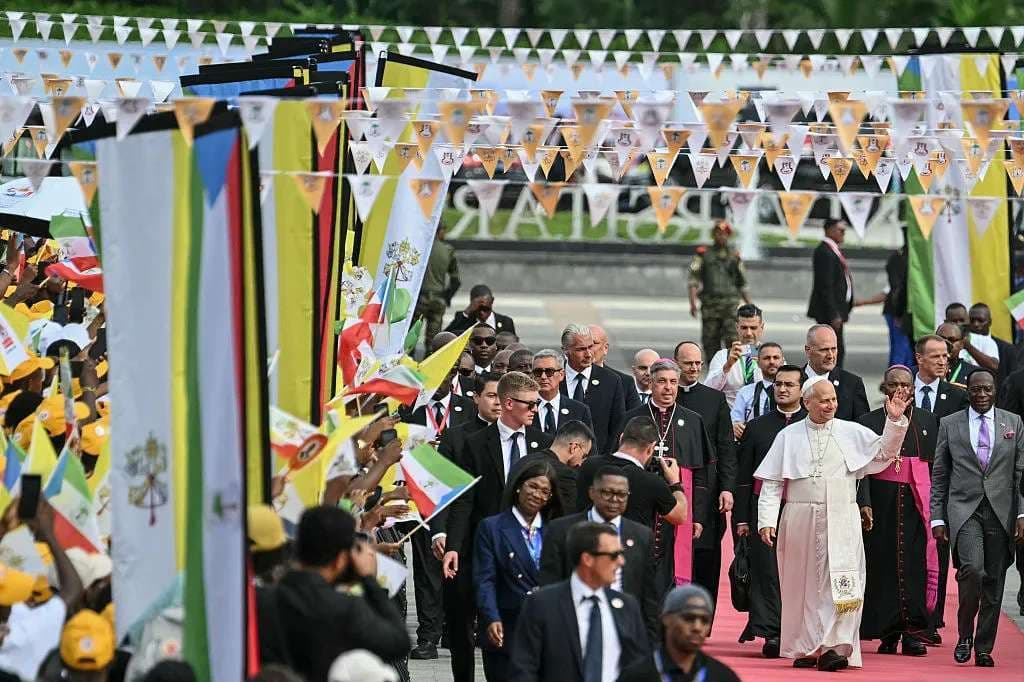
Pope Leo XIV arrived in Equatorial Guinea April 21, marking the final stretch of his 11-day apostolic journey visiting four countries in Africa.
According to Vatican News, his itinerary for the first of three days in Equatorial Guinea began with a courtesy visit with the president of the republic at the Presidential Palace, as well as meetings with civil society members and diplomatic corps.
He addressed the country’s political leaders during the latter meeting, encouraging them in their roles and calling on them to “dismantle the obstacles to integral human development. He also warned against misusing technology for military endeavors and said the name of God “must never be invoked to justify choices and actions of death.” He encouraged them to protect the rights of local communities, steward creation well, and uphold the dignity of labor.
The Holy Father also recalled Saint Augustine’s “The City of God,” contrasting it with the “earthly city.” He said the city of God is “characterized by God’s unconditional love” and the latter is marked by prideful self-love “and the lust for power and worldly glory that leads to destruction.” According to Vatican News, he invited the political leaders to reflect on this contrast and consider “which city they wish to serve.”
At the conclusion of the address, he reflected on the future of Equatorial Guinea, which he described as “a young country” that can cultivate “free and responsible consciences.” He encouraged the leaders to promote politics that advance the common good and to have “the courage of new visions and an educational pact that gives young people space and trust.”
He then met with representatives from the world of culture at the León XIV Campus of the National University, staff and patients at the Jean Pierre Olie Psychiatric Hospital, and privately with the country’s bishops, though Vatican News did not state where.
According to a separate Vatican News report, Pope Leo was given “a warm welcome of dance and song” at the hospital, where he also gave an address. He acknowledged that whenever he visits a hospital, he experiences “mixed feelings” of sorrow for the patients and loved ones and the burdens they carry and of comfort for the charitable work carried out there.
Overall, he said that at this hospital, “joy prevails,” noting that it comes from gathering in the Lord’s name and caring for those in need. He emphasized that God desires healing for every person and that the work of the hospital can be a sign of Christian love. According to Vatican News, he noted that God loves every person exactly as he or she is and said that Christ entered the world “to redeem and restore to full dignity those who suffer from the stigma of disability.” Likewise, Christ calls all people to love one another, according to the Pope.
“A hospital, especially one with a Christian mission, is a place where a person is welcomed as they are and respected in their frailty, so that they can be helped to get better according to a holistic vision,” he said.
The same day, he met with members of the World of Culture at the León XIV Campus, where he spoke about the intersection between intellectual pursuit and the Christian life of faith.
“Christ does not appear as a religious escape in the face of intellectual endeavors, as if faith began where reason ended,” he said, according to Vatican News. “On the contrary, in Him the profound harmony between truth, reason and freedom are manifested.”
According to the outlet, the campus is new and named after the Pontiff. Reflecting on the inaugural moment, Pope Leo expressed gratitude while noting that the naming “goes beyond the person being honored,” he said, “as it reflects the values that we all want to pass on to others.”
He described the university's role to form young people as noble, though demanding, and said that creating a new campus is an act of trust that affirms “it is worth the effort to continue wagering [both] on the formation of new generations” and on the role “of seeking the truth and putting knowledge at the service of the common good.”
He also reflected on the national tree of Equatorial Guinea, the ceiba, as a symbolic example of the university’s responsibility “to be well rooted” in the search for truth and academic rigor. He also pointed to the wood of the Cross as a sign of humanity’s redemption.
“If in Genesis we find the temptation to seek knowledge separated from truth and goodness,” Pope Leo said, “on the Cross we find a truth revealed, Jesus Christ, who far from imposing His own will, offers Himself through love and elevates us to the dignity with which we were conceived from the beginning.”
.jpg&w=3840&q=75)


Comments