Prescient prelate: Fulton Sheen’s words on patriotism ring true as US celebrates 250th anniversary
Throughout his ministry, Archbishop Fulton Sheen consistently taught that love of country is rooted in love of God.

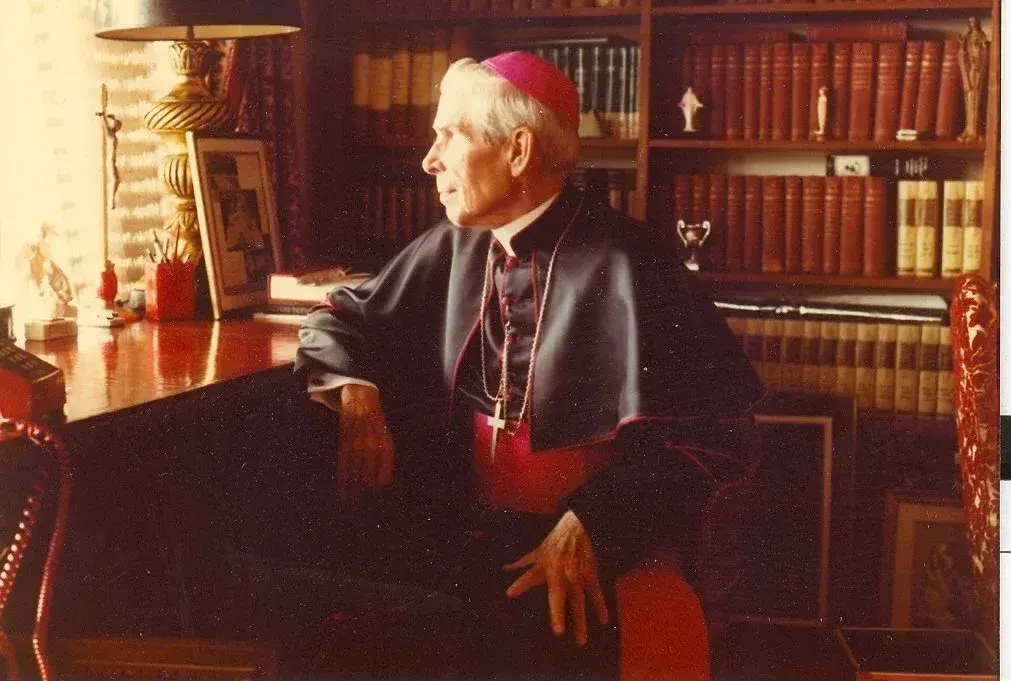
The timing seems providential. After years of delays, the expected beatification of the man known as "America's Bishop" and more recently as "America's Apostle" comes as the U.S. celebrates the 250th anniversary of its founding and while one of its native sons reigns as pontiff. Whether seen as a striking coincidence or divine intervention, the convergence offers a fitting opportunity to revisit Ven. Archbishop Fulton Sheen’s vision of patriotism.
Far from reducing love of country to politics or national pride, Archbishop Sheen — born, raised, and ordained in America’s Heartland — taught for decades that patriotism is a moral virtue rooted in piety, sustained by faith in God, and ordered toward the dignity and freedom of the human person.
The archbishop explained in accessible terms the essence of patriotism to the everyday American Catholic, and his prophetic words on democracy, communism, and the role of government continue to gain significance amid both the divisions of our time and this extraordinary milestone in the nation’s history. These select excerpts from radio, television, and the printed word offer much to meditate upon while celebrating the semiquincentennial.
Exploring the meaning of patriotism on ‘The Catholic Hour’ radio show
In a 1938 address then-Father Sheen delivered on The Catholic Hour radio program, he began by grounding patriotism in Catholic teaching, noting that St. Thomas Aquinas treated it under the virtue of piety.
"Once it is remembered that love of neighbor is inseparable from love of God, it is seen that love of our fellow citizens is a form of piety," he said.
He argued that the defining principle of America was not revolution but the God-given dignity of every human person.
"The essence of Americanism is not revolution,” he said, “but the recognition of the sacredness of human personality and the inherent inalienable rights which every man possesses independently of the State."
Father Sheen said the Founding Fathers deliberately sought a foundation for human rights that no earthly authority could revoke.
"They sought the foundations of man's rights and liberties in something so sacred and so inalienable that no State, no Parliament, no Dictator, no human power could ever take them away, and so they rooted them in God," he added.
Quoting the Declaration of Independence, he emphasized that all people "are endowed by their Creator with certain unalienable Rights," adding that those rights "are not the gift of the State or the Dictator" but come from God alone.
"Therefore no power on earth may take them away,” he added. “This is the essence of Americanism."
From that foundation, Sheen argued that religion is indispensable to a free society.
"If we wish to have the light we must keep the sun; if we wish to keep our forests we must keep our trees; if we wish to keep our perfumes we must keep our flowers — and if we wish to keep our rights, then we must keep our God," he said.
He summarized his argument by stating, "In conclusion, true Americanism is the belief in the freedom of man as a divine derivative. For that reason if we wish to keep pure Americanism we must keep our religion."
He closed with an appeal to Catholics to preserve both their faith and their country.
“It is our solemn duty as Catholics, therefore, to be conscious of our duty to America, and to preserve its freedom by preserving its faith in God.”
Exposing threats to patriotism in ‘Life Is Worth Living’ TV show, book
Ven. Sheen returned to the theme of patriotism throughout his Life Is Worth Living writings and television ministry, warning that America's greatest danger was not an external enemy but a loss of the moral and spiritual convictions that had sustained the nation from its founding.
Lamenting what he saw as a growing indifference, he wrote the following in the “Fatigue” chapter of 1953’s Life Is Worth Living: "Unfortunately, many have lost fire and enthusiasm. What has become of great patriots; of an intense devotion and love of country? A country is strong when it has faith in right; it is weak when it loses faith. Only a restoration of our firm belief in God will shake off indifference and apathy and a sense of opiate that makes us cold to international injustices."
For Ven. Sheen, the remedy was not found merely in politics but in a renewed confidence in God and the nation's providential mission.
“Communism is a ‘faith,’ a ‘philosophy of life’ based on hate and confiscation. Communism can be overcome only by another faith, a faith in God, a faith in His Moral Law, and a faith in the Providential destiny of our country,” he continued in the book.
That renewal, he believed, also required Catholics to speak openly and confidently about both their faith and their love of country.
“Our fires of patriotism, evangelization, and zeal are being reduced to embers. We are cold, dull, and apathetic. One tiny effect of that want of fire is the fact that in our Western world there are but few orators. Most men in public life are readers,” he wrote in the “Role of Communism and Role of America” chapter of Life Is Worth Living. “They are so little possessed of a love of great truths that their lips have no burning overflow. What young woman would ever take a man as a husband who wrote out a wedding proposal? Glory be to God, if He loves the woman, he ought to be able to talk about it! If we love God, we ought to be able to talk about Him. If we love our country, we ought to be able to talk about our country.”
Ven. Sheen carried the same message to millions of viewers during his television broadcasts. In his “Quo Vadis, America?” (Where Are You Going, America) telecast, he described patriotism as “a virtue that was allied to the old virtue of the Greeks and Latin called pietas, meaning love of God, love of neighbor, love of country. And when one goes out, all go out.”
Turning to the nation's founding during the telecast, Sheen argued that Thomas Jefferson best expressed the principles of the American Revolution because he recognized both “the dignity of man" and that "all rights and liberties come to us from God,” emphasizing that the rights of life, liberty and the pursuit of happiness are unalienable, meaning they cannot be taken away.
He closed by urging Americans to reject a spirit of destruction and instead pursue moral renewal: “Our nation is too full of those that are crying Down. Down with the universities. Down with schools. Down with the churches. Down with teachers. Down with government. Down with the police. Can you build anything down? You cannot! Certainly time in our nation to change our words! Let's begin now to use the word UP. Up from all of this filth! Up from this violence! Up from this indifference of courts. Up, up to the battlements of eternity. Up, Up, to God!”
Explaining the undergirding of American independence in ‘Declaration of Dependence’
In his 1941 book Declaration of Dependence: Trusting God Amidst Totalitarianism, Paganism, and War — written as the U.S. celebrated its last Independence Day before entering World War II — Ven. Sheen argued that our freedom is born from a reliance on God.
“In these days when everyone talks of rights and few of duties, it is important for us Americans to recall that the Declaration of Independence is also a Declaration of Dependence. The Declaration of Independence asserts a double dependence: dependence on God and dependence on law as derived from God.”
Ven. Sheen explained the ideas in the founding document: “Notice these words: The Creator has endowed men with rights and liberties; men got them from God! In other words, we are dependent on God, and that initial dependence is the foundation of our independence.”
He continued, “Each person has a value because God made him, not because the State recognizes him. The day we adopt in our democracy the already widespread ideas of some American jurists that right and justice depend on convention and the spirit of the times, we shall write the death warrant of our independence.”
In the book, he discussed attitudes among Americans he considered harmful to the country.
“It is unfortunately the spirit of many in our own land who would sabotage our national life,” Ven. Sheen wrote. “There is irrationality in America, for countless are our fellow citizens who are guided by emotion rather than by reason, who go on repeating catchwords and slogans that they never analyze, and who deny there are any basic truths of reason, much less of revelation, by which man can chart the course of his life and discover the goal of his destiny.”
He also warned that the U.S. is not immune to the threat of totalitarian ideology, particularly communism, which seeks to stamp out religion and thus patriotism.
“Mark these words: The enemy of the world in the near future is going to be Communism, which is using peace when it can and war when it must, and which is preparing, when Europe is exhausted from war, to sweep over it like a vulture to tear its flesh. When Russia falls, America will be the new seat of Communism.”
The issue persists decades after World War II. Bishop Robert Barron of the Diocese of Winona-Rochester, Minnesota, whom some consider to be today’s Fulton Sheen, warned Americans in the days leading up to the nation’s semiquincentennial about growing socialism and communism in the U.S., pointing to the political success of politicians who identify as “extreme socialists or communists,” arguing that communism is fundamentally hostile to religion and to America’s founding principles.
Similar to Sheen’s observations, Bishop Barron said his opposition to communism is rooted partly in the ideology’s hostility to religion. Citing Karl Marx’s claim that “the first critique is the critique of religion,” Bishop Barron said Marx believed that religion had to be “taken down” before society could be remade politically and economically.
In Declaration of Dependence, Ven. Sheen wrote, “The greatest defenders of America are not necessarily those who talk most about freedom and democracy; it is the sick who talk most about health. For that reason, there should be less loose talk about democracy and freedom; instead of judging religion by its attitude toward democracy, we should begin to judge democracy by its attitude toward religion.
“For in a crisis such as this, America will save her Stars and Stripes by grounding them on other stars and stripes than those that are on the flag: namely, the stars and stripes of Christ, by whose stars we have been illumined and by whose stripes we have been healed.”
As the archbishop would often conclude, “God love you.” JMJ.


Comments