The history of Tenebrae: How the Liturgy of the Hours changes during the Triduum
Latin for "shadow" or "darkness," Tenebrae is a unique liturgical celebration that only takes place during Holy Week.

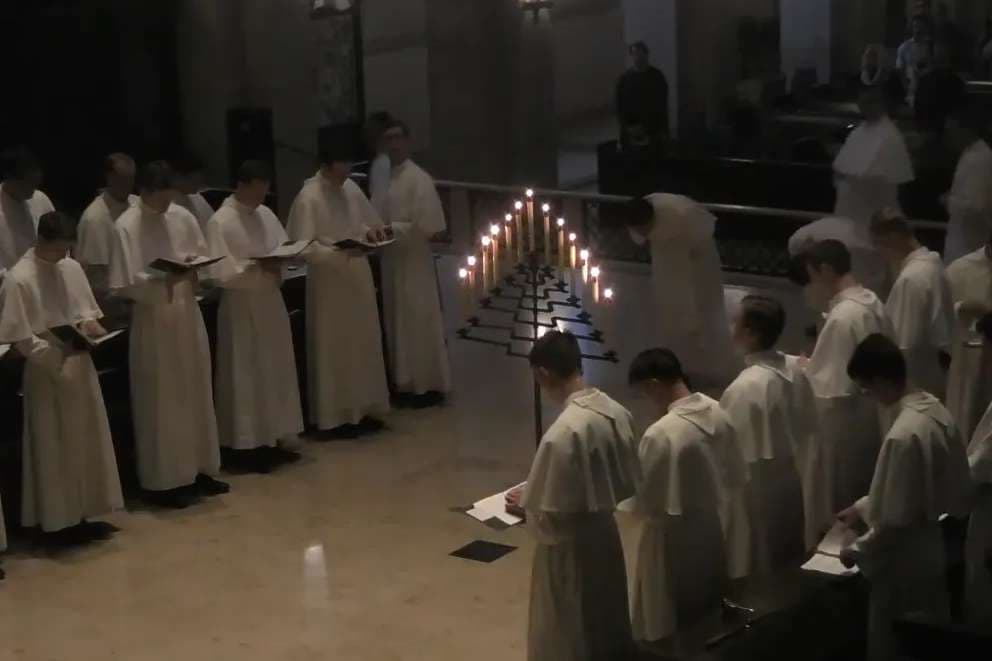
The Liturgy of the Hours is the universal Church’s prayer for priests, monks, nuns, and religious, a cycle of psalms and prayers said at different hours throughout the day. In the three days leading up to Easter, Matins and Lauds are combined in the unique liturgical celebration of Tenebrae.
Latin for “shadow” or “darkness,” Tenebrae was traditionally at night, often ending around midnight in total darkness, according to Angelus Press. Following Pope Pius XII’s 1955 liturgical reforms of the Holy Week liturgies, Tenebrae began to be prayed in the early morning.
Dom Prosper Gueranger explains in his book The Liturgical Year that the liturgy echoes that of a funeral:
“All is sad and mournful, as though it were a funeral-service,” the priest wrote, “nothing could more emphatically express the grief that now weighs down the heart of our holy mother the Church. Throughout all the Office of Thursday, Friday, and Saturday, she forbids herself the use of those formulas of joy and hope, wherewith, on all other days, she begins her praise of God.”
In Tenebrae, the prayers omit the traditional invocation of “Lord, thou shalt open my lips,” and “Incline unto mine aid,” the priest added, as well as the “Glory be” usually prayed at the end of each Psalm.
“So likewise are those soul-stirring additions, which have been gradually made, in the different ages,” Dom Prosper wrote, “and nothing is left, but what is essential to the form of the Divine Office, Psalms, Lessons, and Chants expressive of grief. Each Canonical Hour ends with the Psalm Miserere, and with a commemoration of the Death and Cross of our Redeemer.”
He then explains what unfolds in the Tenebrae liturgy.
In the sanctuary near the altar, a large triangular candelabra holds 15 candles. Six additional candles sit on the altar. The candles are made of yellow wax and are also used in Requiem Masses and other services for the deceased. After each psalm and each canticle, one of the 15 candles is extinguished, leaving only the top candle still burning. During the Benedictus at Lauds, the six altar candles are put out.
The master of ceremonies then takes the remaining lit candle from the triangle and places it on the altar while the choir repeats the antiphon. Afterward, during the recitation of Psalm 51 and the concluding prayer, he hides the candle behind the altar. When the prayer ends, a loud noise is made by striking the choir stalls.
Angelus Press explains the symbolism of the service: The candle hidden behind the altar signifies the burial of Christ, and the loud noise symbolizes the earthquake that occurred at the time of the crucifixion. The gradual extinguishing of the candles “provides a stark visual that Our Lord is slowly but surely left alone in the darkness of the world, fraught with sin.”
The service also ends abruptly, without a blessing or a concluding hymn. The article argues that while even the liturgies of Holy Thursday and Good Friday have some consolation, Tenebrae is sorrowful and mournful.
“On Holy Thursday, the altar of repose is decorated, and we can keep company with Our Lord. On Good Friday, the crucifixes are finally unveiled, and we can kiss the feet of Our Lord, and receive Him in the Eucharist. But Tenebrae is sorrowful, from beginning to end, complete with darkness, earthquake, and Our Lord symbolically hidden from our view,” the article states. “Truly a contrast, and an important reminder of this most sacred of weeks.”








Comments