‘The world needs you’: Ambassador Brian Burch urges Thomas Aquinas graduates to seek true peace through rightly ordered love
U.S. Ambassador to the Holy See Brian Burch urged Thomas Aquinas College graduates to pursue a vision of peace rooted in truth, justice, and the dignity of the human person during a commencement address that connected the nation’s 250th anniversary to Catholic teaching on ordered love and public life.

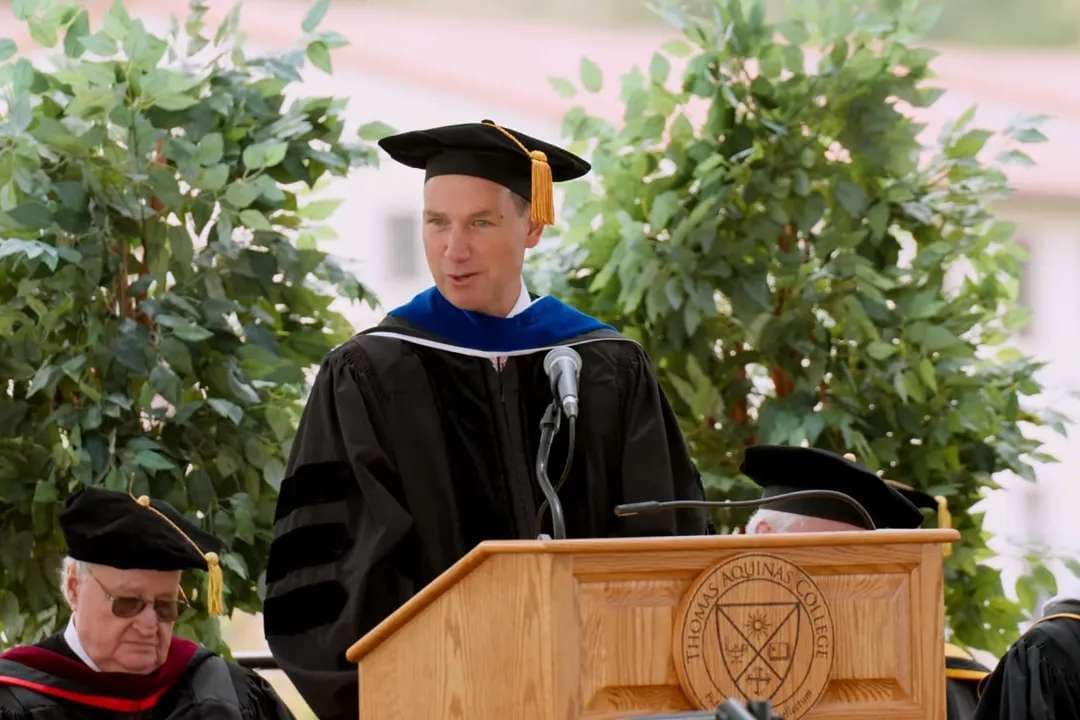
U.S. Ambassador to the Holy See Brian Burch urged Thomas Aquinas College graduates to pursue a vision of peace rooted in truth, justice, and the dignity of the human person during a commencement address that connected the nation’s 250th anniversary to Catholic teaching on ordered love and public life.
Speaking to the Class of 2026 during his first visit back to the U.S. since assuming his diplomatic post in Rome in August 2025, Burch said the college’s Great Books formation had prepared graduates for a world “that desperately needs” minds shaped by truth, beauty, and goodness.
Drawing on the thought of St. Thomas Aquinas, Burch said intellectual life begins in wonder — a vision he said the founders of the college clearly embraced. He contrasted that approach with that of many modern higher education institutions, which he said prioritize credentials and specialization over the formation of the whole person.
“The modern university promises students three things: credentials, specialization, and the lure of a productive career,” Burch said. “This institution proudly offers something older and far more demanding: truth, intellectual curiosity, and the formation of the soul.”
America’s founding ideals
The ambassador framed much of his address around America’s semiquincentennial celebration in July 2026, arguing that the nation’s founding cannot be understood apart from natural law, divine providence, and rights endowed by the Creator.
“Two-hundred-and-fifty years ago this summer, 56 courageous signers placed their names on a piece of parchment, risking their lives, their homes, their wealth, and their sacred honor,” Burch said, referring to the Declaration of Independence.
He said the anniversary offers Americans an opportunity to celebrate more than “a birthday or an abstract theory written on a piece of paper.” Rather, he said, Americans can celebrate “the endurance of our American way of life — a particular people with a unique shared history, tradition, land, and culture.”
Burch emphasized that the Declaration of Independence does not appeal to human reason alone; it also invokes “the Laws of Nature and of Nature’s God,” the rights granted by a Creator, and “a firm reliance on the protection of divine Providence.’”
He explained that the word “providence” is derived from the Latin pro videre meaning “to see ahead.”
“God sees ahead of us,” he said. “The tradition of the Church understands this as God’s eternal nature seeing all of time and all things as present — including the smallest details of the universe — and, by way of nature and grace, He orders all things accordingly.”
Burch told graduates that just as God, in His providence, saw each of them come into the world and grow to adulthood, He will continue to guide them as they begin their “pilgrimage into a world that desperately needs what your education here has formed in you: minds sharpened by truth, hearts enlarged by beauty, and souls anchored in the good.”
The meaning of true peace
Burch centered much of his address on peace, drawing from St. Augustine’s teaching that peace is tranquillitas ordinis, or “the tranquility of order.”
“Peace, for Augustine, is not the silencing of all discord,” Burch said. “It is the harmonious arrangement of creation — within the human heart, within families and communities, within nations, and ultimately within the cosmos — according to the wise design of the Creator.”
He warned graduates against confusing peace with withdrawal or the mere absence of conflict. Instead, he said, peace requires “moral clarity” and rightly ordered love.
“Evil does not prevail merely because of violent people. It prevails when good people become distracted, indifferent, or lack courage,” Burch said. “A society loses peace when people stop defending truth, stop protecting the vulnerable, or stop believing that evil and injustice must be restrained.”
Burch also connected St. Augustine’s vision of peace to the American constitutional order, noting that the Preamble of the Constitution identifies justice, common defense, general welfare, and domestic tranquility as aims of government. A well-ordered society, he said, depends on citizens formed by faith, virtue, strong families, dignified work, and public service.
The pursuit of peace
In one of the speech’s most memorable passages, Burch recounted the story of Pope Leo XIV’s father, Robert Prevost, who served as a U.S. Navy lieutenant during World War II. Burch said Robert took part in the D-Day invasion on June 6, 1944, and later witnessed Victory in Europe Day in Rome on May 8, 1945. Exactly 80 years later, Burch said, Robert’s son, an Augustinian, became the first American pope and appeared on the balcony of St. Peter’s Basilica with the words, “Peace be with you.”
Burch then traced several modern popes’ teachings on peace. He said Pope St. John XXIII, in Pacem in Terris, taught that “true peace flows from justice, rooted in the dignity of the human person.” Pope St. John Paul II echoed Augustine with the teaching, “No peace without justice,” while Pope Benedict XVI emphasized that peace is not merely political but a fruit of conversion, Burch recalled.
The ambassador also argued that the U.S. and the Holy See play complementary roles in peacebuilding. America, he said, holds “unmatched military, economic, and diplomatic power,” while the Holy See exercises moral and spiritual authority through its defense of human dignity, reconciliation, and dialogue.
“Both are necessary, representing complementary forces — one grounded in geopolitical power, the other in ethical and moral persuasion,” he said. “Both are needed to achieve tranquillitas ordinis.”
Still, he cautioned that peace “cannot be sustained by institutions alone;” especially citing the limitations of multilateral institutions; and why such limitations call for moral clarity and moral courage from nations capable of defending a true conception of peace.
A “society that forgets God inevitably disorders itself,” he remarked.
Turning directly to graduates, Burch urged them to become peacemakers in their homes, workplaces, and public lives, especially in a world that often markets counterfeit forms of peace through consumerism, social media, careerism, and shallow politics.
He encouraged them to begin by developing a rightly ordered heart. Such a heart will radiate peace into families, communities, and workplaces..
Second, he challenged them to use their critical thinking and moral formation to promote a justice rooted in human dignity rather than ideology.
“Advocate for policies, practices, and political leadership that protect the common good rather than ideology or sentimentality,” he said. “But do so with the realism of Augustine: Expect imperfect results in the earthly city, and never despair.”.
Finally, Burch urged them to take ordinary steps to heal a culture that suffers from disordered love.
“Get married. Have children. Build a home,” he said. “Do acts of charity, especially among those closest to you. Create and celebrate good art and music. Continue to read good books. Perhaps even write one. Join the foreign service. Build cathedrals.”
Burch closed by reminding graduates that the peace they seek is ultimately not achieved but received – a gift from God.
“As you leave this campus, carry with you the wisdom of Augustine and the formation you have received in virtue, faith, and reason. The world needs you,” he said. “It needs young men and women who know that true peace is not the absence of struggle, but the hard work, discipline, and courage of rightly ordered love.”





Comments