Warner questions shifting objectives behind U.S. strikes on Iran
Sen. Mark Warner, a member of the bipartisan “Gang of Eight” (a group of top lawmakers granted access to classified intelligence), said there was no imminent threat to the U.S.when the Trump administration launched strikes against Iran, and questioned what he described as shifting explanations for the war.

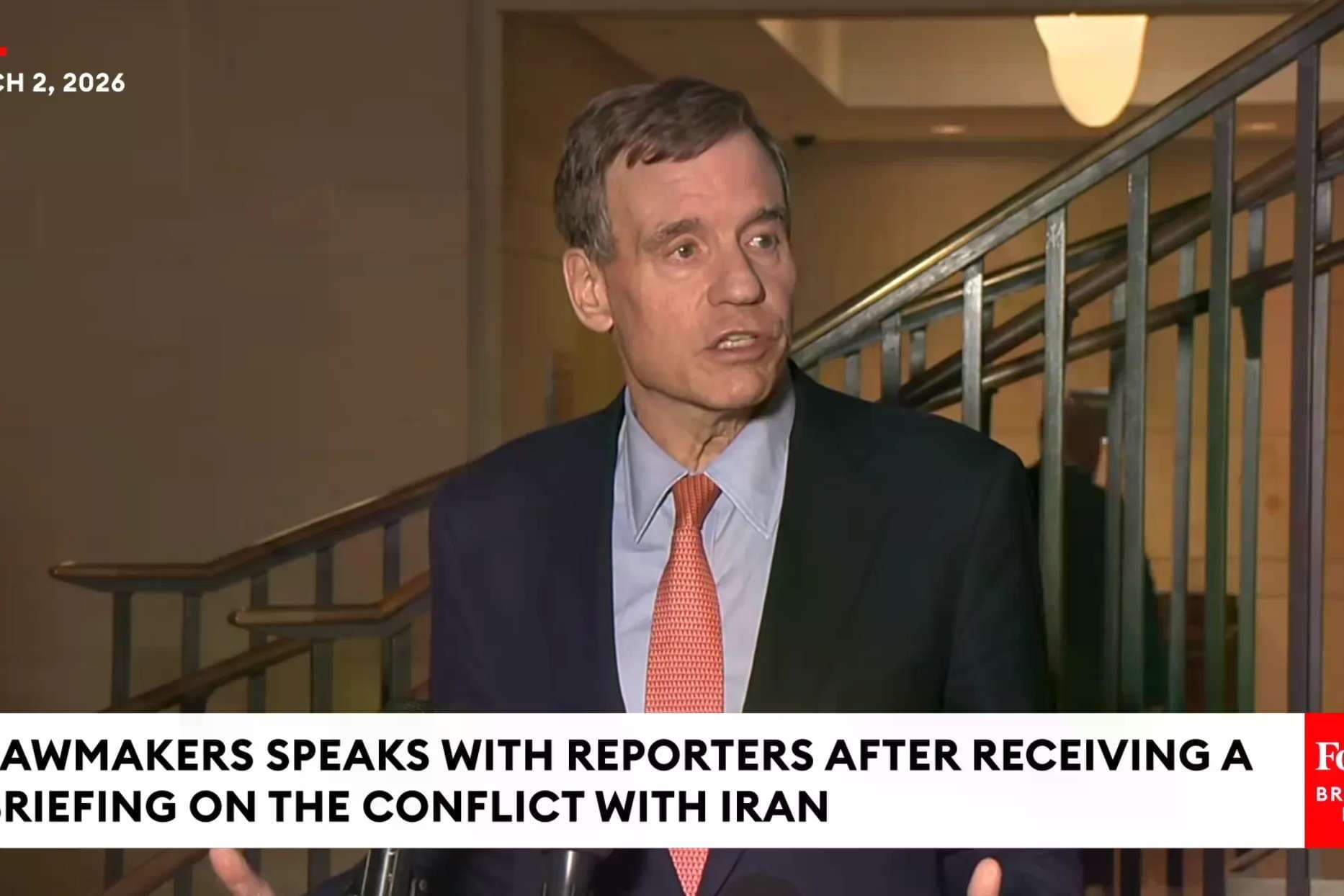
Sen. Mark Warner, a member of the bipartisan “Gang of Eight,” a group of top lawmakers granted access to classified intelligence, said there was no imminent threat to the U.S. when the Trump administration launched strikes against Iran and questioned what he described as shifting explanations for the war.
Speaking to reporters on March 2, Warner, a Virginia Democrat, said, “We have seen the goals for this operation changed now, I believe, four or five times.”
“There was no imminent threat to the United States of America by the Iranians,” he stated. “There was a threat to Israel. If we equate a threat to Israel as the equivalent of an imminent threat to the United States, then we are in uncharted territory.”
Admin’s initial focus on Iran’s nuclear program
“A week ago it was about the Iranian nuclear capacity,” Warner said, pointing to the administration’s initial emphasis on stopping Tehran from obtaining a nuclear weapon.
Oman, which has served as a mediator in the negotiations, said hours before the strikes that the sides had agreed Iran would never develop nuclear weapons. Omani Foreign Minister Badr Albusaidi described the new understanding as a “major breakthrough” and said it included zero stockpiling of enriched uranium.
“A peace deal is within reach,” Albusaidi said.
Neither Israeli nor U.S. officials acknowledged the mediator’s statement, and when President Donald Trump announced the strikes hours later in the early morning of Feb. 28, he said the operation was necessary to ensure “this terrorist regime can never have a nuclear weapon. I’ll say it again. They can never have a nuclear weapon.”
Defense Secretary Pete Hegseth echoed the nuclear justification during a March 2 Pentagon briefing, saying Iran’s missiles and drones served as a “conventional shield for their nuclear blackmail ambitions.”
Emphasis shift to missiles
Warner said that after the initial focus on preventing Iran from obtaining a nuclear weapon, the administration’s public messaging increasingly centered on ballistic missiles.
In remarks to journalists March 2, Trump said Iran’s conventional ballistic missile program posed “a very clear, colossal threat to America and our forces stationed overseas” and warned Tehran would “soon” have missiles capable of reaching the U.S.
Hegseth, during the March 2 Pentagon briefing, described the mission as “laser-focused” on “destroying Iranian offensive missiles” and “destroying the missile threat.”
Later that same day at the White House, Trump listed missile destruction first when outlining the campaign’s objectives.
“First, we’re destroying Iran’s missile capabilities,” he said, before citing naval targets, preventing a nuclear weapon, and stopping Iran from arming proxy forces as motives.
Warner pointed to the ordering and emphasis of those objectives as evidence that the administration’s stated rationale has shifted from its initial focus on nuclear prevention.
Regime change rhetoric and clarification
Warner also pointed to Trump’s call for regime change as part of what the lawmaker described as inconsistent messaging.
In his Feb. 28 announcement on Truth Social, Trump urged Iranians to “take over your government,” calling it “probably your only chance for generations.” In a phone interview that day with The Washington Post, he added, “All I want is freedom for the people” of Iran, saying he wanted “a safe nation.”
But when Trump later outlined the campaign’s objectives at the White House, regime change was not among them.
Administration officials subsequently said it was not the formal aim of the operation at the March 2 Pentagon briefing.
Hegseth said, “This is not a so-called regime change war,” though he added that “the regime sure did change.”
‘A war of choice’
Warner said the evolving rationale fails to demonstrate an imminent threat to the U.S.
“This is still a war of choice that, as [has] been acknowledged by others, was dictated by Israel’s goals and timelines,” he said. “Israel is a great ally of America. I stand firmly with Israel. But I believe at the end of the day, when we are talking about putting American soldiers in harm’s way, when we have American casualties and expectations of more, there needs to be the proof of an imminent threat to American interests.”
Israel’s role in timing of strikes
Several senior Republican officials have acknowledged that Israel’s readiness to act alone factored into the timing of the U.S. strikes.
Secretary of State Marco Rubio, speaking to reporters on Capitol Hill after briefing congressional leaders, said the administration anticipated Israeli military action and expected Iran would retaliate against American forces. According to Rubio, Iran would likely respond to any attack from Israel or the U.S. by targeting both nations.
“We knew that there was going to be an Israeli action," Rubio said, "we knew that that would precipitate an attack against American forces, and we knew that if we didn’t preemptively go after them before they launched those attacks, we would suffer higher casualties."
Sen. Tom Cotton, R-Ark., said Israel “faced an existential risk and they were prepared to strike Iran alone. If that happened, Iran was very likely to target our troops.”
House Speaker Mike Johnson, R-La., also called the strikes “a defensive measure,” saying that if Israel had acted independently, Iran “would have immediately retaliated against U.S. personnel and assets.”
Hegseth described Israel as acting “out of self-defense” and as a “capable partner,” saying the U.S. “didn’t start this war.”
Warner and other critics argue these explanations of the administration’s decision to enter a war raise questions about whether the U.S. acted in response to an imminent threat to its own security or to preempt fallout from expected Israeli action.







Comments