What the Divine Mercy image can teach us about John the Beloved’s belief
The image of Divine Mercy offers insight into the burial veil of Jesus and John the Beloved’s belief in the Risen Lord, Bishop Slawomir Szkredka wrote.

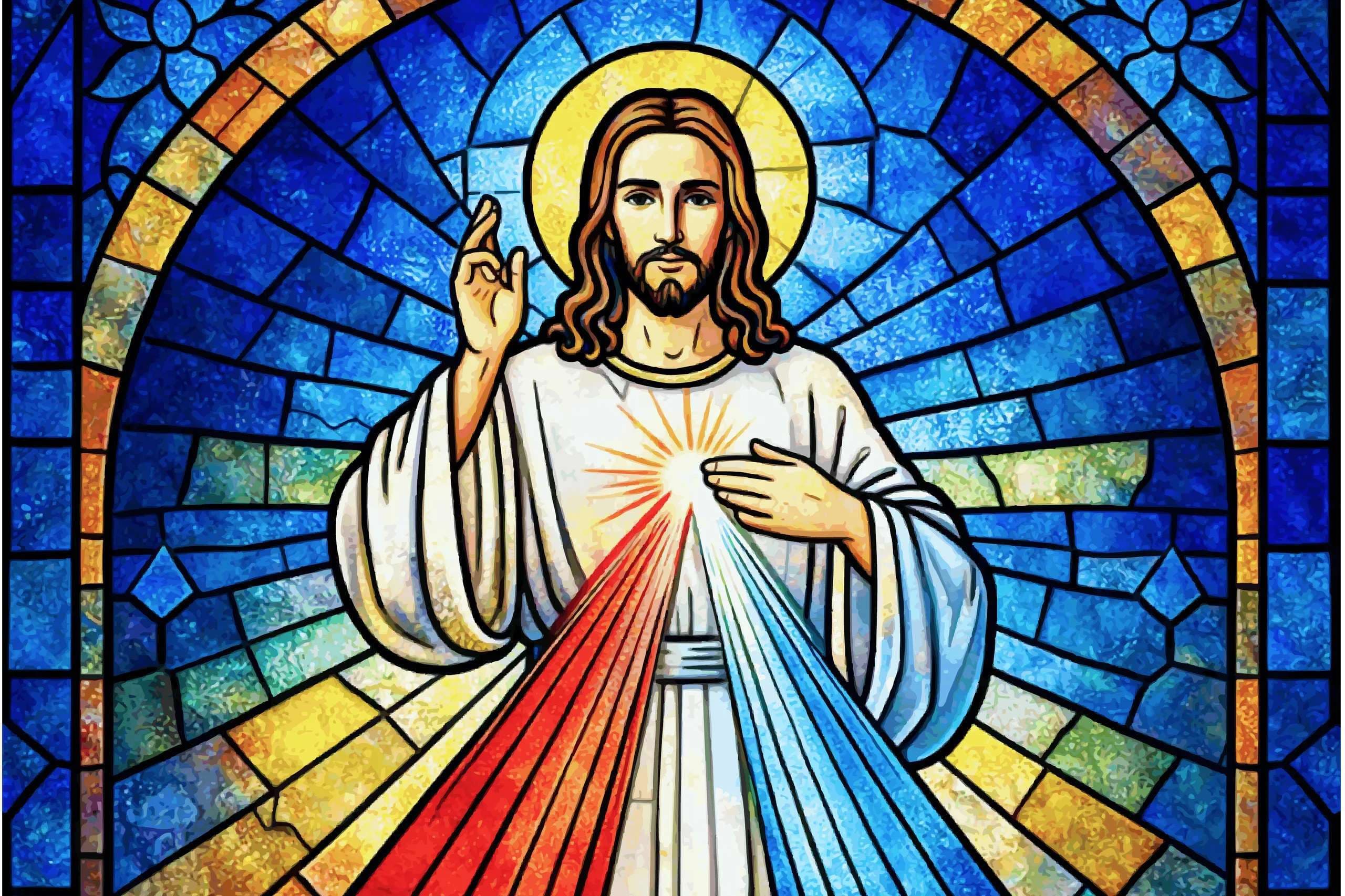
The image of Divine Mercy offers insight into the burial veil of Jesus and John the Beloved’s belief in the Risen Lord, Archdiocese of Los Angeles Auxiliary Bishop Slawomir Szkredka wrote in an article for Angelus News.
In the Gospel of John’s account (John 20:1–10) of Saint John and Saint Peter run together to the empty tomb.
“The Beloved Disciple — whom our tradition recognizes as John the Evangelist — arrives first, bends down, looks in, sees the linen wrappings but does not enter,” the bishop wrote. “Then Peter arrives and enters. He sees the wrappings and the ‘napkin’ (soudarion) that covered Jesus’ head, rolled up and placed separately. When John finally enters, we are told, he ‘sees and believes.’”
St. John only believes after he enters the tomb, the bishop notes, and asks, “What prompted him to believe?” The orderliness of the tomb is one clue, many commentators state, since a tomb robber would not bother unwrapping the body, and certainly not neatly folding the linens. But the face cloth, or soudarion, carries a deeper meaning, the bishop argues.
Soudarion, a borrowed word from Aramaic, mirrors the word used for Moses’ veil.
“In fact, the famous veil worn by Moses (except when he speaks with God) in the book of Exodus is called a sudara,” Bishop Szkredka wrote. “Scripture says that Moses’ face was shining because he had been speaking with God, and this supernatural radiance made the Israelites afraid to approach Moses. Therefore, after relating the words of God to them, Moses would put a veil over his face, and would remove it while entering the presence of God.”
The removal of Christ’s veil, then, implies that He is now in the presence of God — and St. John, perhaps because of this hint — knew that Christ had risen from the dead.
But the image of Divine Mercy, revealed in an apparition to Saint Faustina Kowalska in 1931, reveals even more about St. John. The painting commissioned by St. Faustina, based on her visions, shows Christ entering the Upper Room, where his disciples were gathered. He gazes downward, and He told St. Faustina, “My gaze from this image is like My gaze from the cross” (Divine Mercy in my Soul 326).
“A spiritual possibility is intimated here,” the bishop noted. “At the hour of mercy, that is, at the hour of Jesus’ death, John the Beloved Disciple saw Jesus’ gaze.”
St. John was the only apostle present at the foot of the Cross, and so he was the only apostle who had seen that merciful gaze, he continued.
“When John enters the tomb, which in Greek is called mnēmeion, a place of remembrance, he remembers that merciful gaze,” Bishop Szkredka wrote. “But now he also sees that this gaze is no longer veiled by death. Death covered it only for a time. With the veil of death removed, mercy triumphs. John saw it and believed.”
The bishop added that the Old Testament tells us that “no one can see the face of God and live,” (Exodus 33:30), but Jesus lifts the veil of death from the face of humanity, allowing man to see God.
“When we look at the image of Divine Mercy, Jesus’ eyes gaze downward. We do not see them. We see his face, but he has not looked at us yet,” the bishop concluded. “When he does, our gazes will meet. We will be enveloped in God’s mercy. We will believe in the Resurrection.”




Comments