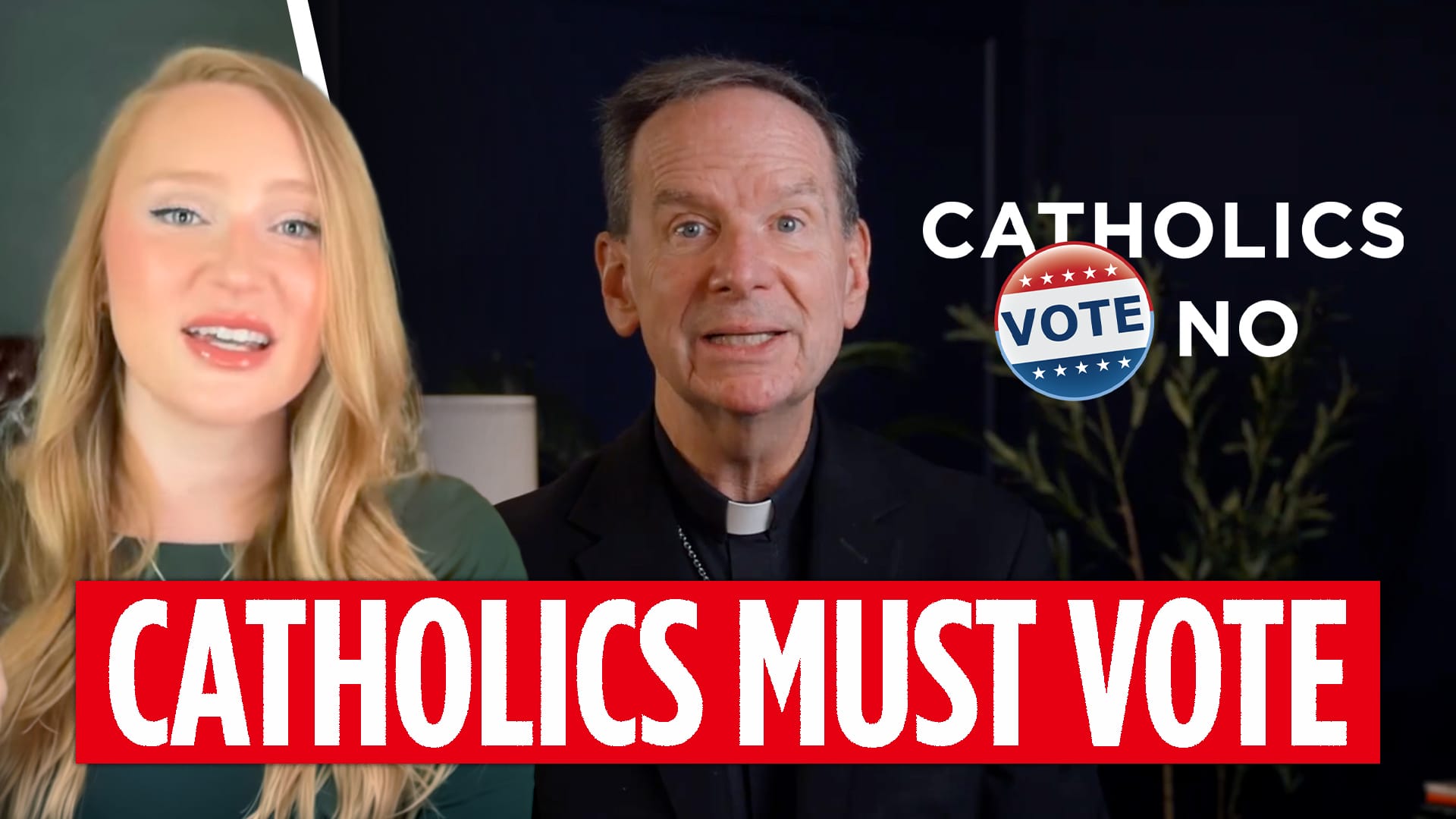
AI Execs Do 180: Beg for Regulation, Viral Texas Indians Pic, And CatholicVote Political Director On Ground Game
CatholicVote Political Director Logan Church joins the LOOPcast to break down all you need to know about the upcoming midterms. Meanwhile, a viral photo from a Texas football game ignites a national debate over immigration and assimilation. And finally, Bishop Barron sits down with Theo Von. All this and more on the LOOPcast!
Get your FREE PHONE as a new Charity Mobile user with every new line — and FREE SHIPPING — with promo code LOOPCAST at https://bit.ly/LOOPcast-CharityMobile
Check out Arimathea Investing: https://www.arimatheainvesting.com/
00:00 Welcome to the LOOPcast
03:04 Catholics Need to Vote
43:20 AI Execs Do 180
1:10:10 Good News
1:24:58 Viral Texas Indians Pic
2:02:28 Twilight Zone
2:13:13 Closing Prayer
EMAIL US: [email protected]
SUPPORT LOOPCAST: www.loopcast.org
Check us out on Zeale: https://zeale.co
Subscribe to the LOOP today!
https://catholicvote.org/getloop
Apple Podcasts: https://podcasts.apple.com/us/podcast/the-loopcast/id1643967065
FOLLOW LOOPCast:
https://www.instagram.com/the_loopcast/
https://www.tiktok.com/@the_loopcast
https://www.facebook.com/LOOPcastPodcast
Erika: https://x.com/ErikaAhern2
Josh: https://x.com/joshuamercer
O God, my God: to thee do I watch at break of day. For thee my soul hath thirsted: for thee my flesh, O how many ways. In a desert land, and where there is no way, and no water: so in the sanctuary have I come before thee, to see thy power and thy glory. For thy mercy is better than lives: thee my lips shall praise. Thus will I bless thee all my life long: and in thy name I will lift up my hands. Let my soul be filled as with marrow and fatness: and my mouth shall praise thee with joyful lips. If I have remembered thee upon my bed, I will meditate on thee in the morning: because thou hast been my helper. And I will rejoice under the covert of the wings; my soul hath stuck close to thee: thy right hand hath received me.
All opinions expressed on LOOPcast by the participants are their own and do not necessarily reflect the opinions of CatholicVote.
Transcript
Read the full transcriptAuto-generated · 29,739 words
And we're live. Welcome back to the LOOPcast. It's Tom, Erika, and Logan. Woo! No Josh today, although I guarantee he's lurking somewhere in the chat. He needs to hear if there's any slights or insults thrown his way. Actually, no. He is doing some very important work in Wisconsin. He's on the ground, I believe, with Mark Hock, right? I mean, Logan, political director, you can tell me a little bit more about that, right? Yeah, so we actually have an awesome fundraising dinner that's happening in Wisconsin with a group of people who are just obviously very concerned about what's happening on the ground, and Mark and Josh are joining them to give them an update on what we're doing both in Wisconsin and across the nation to do our part to bring it home in the midterms.
Yeah, we sent the tallest in our organization out there, although we're holding Kelsey on deck just in case. Sweet. Well, hey, we've got a great show. We've got a great show for you. Erika's background looks fantastic. Shout out, Simon. Thanks, Simon.
But we will be talking today, so excited to have you here, Logan. I think a lot of people, when they think of CatholicVote, they think of the loop, but they don't exactly get to see a lot of the behind the scenes of being engaged on the ground. I know you've kind of, you spent most of your life kind of in the back rooms here, so I'm excited to hear what a ground game looks like, what we're involved with, and just get your clarity on involvement in a couple different states, big races.
Outside of that, we have AI executives suddenly doing a 180. They were excited for the frontier, and then the frontier got a little too frontier for them. So, apparently, the big three have come together and said, hey, please, big daddy government, come and regulate. Okay, this is too dangerous.
So, our tech overlords are freaking out, and they're saying that they're going to kill us all, but they've kind of been saying that from the beginning, but didn't have any problem. Anyway, I got strong thoughts about that, but Erika's going to get us going in that direction. We had a very viral Texas University picture that I think was pretty loaded. In some ways, I kind of feel bad for some kids that got caught as a stray in that. But of course, the political conversation just exploded, especially on the right.
Some real serious, long-term conversations need to be had about immigration, demographic change, things like that. So, we cover all the angles there, give our own personal two cents. But we have good news. We have Twilight Zone. Before we get into that, we have the OG sponsor, Charlotte Charity Mobile. My favorite, now more than ever, it's important to do business with companies that stand with you and your beliefs. Charity Mobile is a pro-life phone company that serves pro-life customers and supports pro-life.
ProFamily causes. They send 5% of your monthly plan price to your favorite charity, and they have sent millions of dollars to charities over the past 30 years. Not only that, there are no sacrifices when you switch to Charity Mobile. All of their plans start under $50 before taxes and surcharges. Their nationwide coverage is the same as the major carriers, and their friendly pro-life customer service team is based right here in the United States. Plus, Charity Mobile is running a special promotion for our audience.
Use promo code LOOPcast to get their free phone offer with every new line of service. Plus, free activation and free standard shipping. Switch to Charity Mobile to buy the way you believe. To get started, visit CharityMobile.com. Use promo code LOOPcast. That is CharityMobile.com. Promo code LOOPcast. Thank you, Charity Mobile. If you haven't switched, I mean, what are we waiting on? It's time. Okay, it's time for Charity Mobile.
All right, Logan, you're very busy. This is especially a busy time for you. I think just to start up top, you've been on the show before, but for maybe those who haven't seen, what is your role here, and what are you actually doing right now? Yeah, so I'm the National Political Campaign Director here at CV, and so what that basically means, it's like a big title, like what does she actually do? That means I get involved wherever we're on the ground.
It's my team kind of figuring out where do we need to put the energy, where do we need to put our time. Oh my goodness, it's like the beginning of RSV season over here in Ohio. So, every time I cough, I'm like terrified. So anyway, so yeah, it's like throw it back to 2020.
But yeah, so basically, I help our team figure out where do we need to put our time, our energy, and our funding. Okay, so when you say time, energy, and funding, like if you could just give me a concrete example of does this mean door knocking? Does this mean postcards? Is this calls? Is this, what exactly are we doing as CatholicVote? So, something that we've learned here at CatholicVote is that the message doesn't quite matter as much as the messenger, and so Thank you.
We work in these local communities to help empower Catholics to spread the good message that we're seeing on the national level, but how can we localize it and make it matter to them? So, in ways that we do that is we host events on the parish level or in households and communities where Catholics from multiple parishes will join together. We send text messages, peer-to-peer.
I'm texting my friends in my community saying, hey, have you seen what this candidate did? Or, hey, have you considered supporting this candidate? They really stand for our values. And then we also do postcards, so person-to-person postcards, where I say, hi, I'm Logan, I'm a Catholic in Ohio, and I'm writing to you to encourage you to support this issue or this candidate. And so, we kind of do a mixture of those things, depending on where we are.
And, you know, finite resources, I imagine this is kind of the problem of any. National director anywhere, you know, you only have so much time, you only have so much money. Where have you been putting the chips in, in terms of our resources? Where have we been getting involved? Yeah, so that's just such a hard conversation that we have to have every year, where it's like, all right, in a dream world, we would be involved in all of these races, obviously.
In a midterm, in a lot of ways, it sounds silly to people who are not politically involved, but if you're guys in the White House, you're on defense in the midterm, and so it's always been like that. That's not a new thing. Midterms are much harder for the party in power because people want change, and there hasn't been a lot of time for our side to actually get to work and do the things they need to do, and so the change is happening slowly but surely.
And so, a lot of times, it's trying to echo that. It's a lot easier to sit and bang your Boston pants and say, look how bad they're doing, and like, come over here, like, we'll give you, like, we're going to promise you the sun and the moon and stars, and, you know, and then you can be mad at us next time. So, it's much easier to be in that seat versus, you know, the seat that is in the White House.
When we are looking at states, there are several things that we take into account. Is there a candidate sitting in office right now who is a self-proclaimed Catholic who is not voting according to our teachings? That is a big one for us. So, we have a race in Ohio, Ohio 9, with Marcy Capter. She has been there for 10,000 years. She is a self-pronounced Catholic who is incredibly… I mean, she's basically Nancy Pelosi, but for Ohio, right? And so, we actually, it's a joke, in Ohio, her district has always been called the snake on the lake because it's gerrymandered in such a way that's been so challenging that we couldn't, you know, even run anyone.
But thanks to redistricting this last time, we actually have a shot at winning that race. And so, that's a seat that we're getting involved in because there's a bad player in office. But then you look at other states like Michigan. Michigan is really important because not only are there several congressional seats that are up, including some really hot ones, which I know we are going to dive into in a little while, but there is also a Senate race going on and a governor's race.
So, you kind of get a lot more bang for your buck when you have so many races in one state, not to mention in 2028, Michigan is going to be a huge player. No ifs, ands, or buts about it. So, it is good to get your ground warmed up now, so it is ready to keep rolling through 27. And then, finally, Wisconsin is a big one for us. The governor's race there is one that we are watching, trying to make sure that we keep the republic alive and moving in Wisconsin, and we do not lose it to the crazy radical left.
Yeah, so, very interesting. So, I have a broad question, and maybe it's even a tough question for you here. I think that on the national level, we cover a lot of national trends here on the podcast, but then you go back, and it's very granular. Like, I've never heard of that woman in Ohio, and she's been there forever, which is probably a perfect example of what's going on here. It feels like...
And I'm curious what you're seeing on the ground. It's been a mixed bag in terms of performance of Trump here. So, the big frustrations being the Iran war, the economy, the Epstein files. It feels like the national trends, there's just this great frustration. And maybe that happens with every president, you know, regardless, but then.
To your point, there are these kind of individual pinpoints where if you're a Catholic in this part of the country, this person is making your life much worse, but you might not even hear them in a national headline, if that makes sense. How are you combating, I'd say, just the general, it's cyclical, maybe people aren't going to be as motivated, the party in power always has an uphill battle, but then there are these kind of individuals people don't even hear on a national level that, hey, if we do something about this, we could actually make a big difference in your community right now.
Yeah, so, I mean, I think it gets back down to localizing national politics, right? So, everybody can shout from the rooftops about all these things that matter on the national level, all these things that people are talking about, but at the end of the day, you know, my grocery bill is not political. Whether or not I can afford a house is not political. You know, like, and those are the things that are affecting everyday Catholics. Can I continue, like, the pressure to be able to continue on as a young Catholic family, you know, I want to have As many children as God gives me, what does that look like in today's economy?
Are we creating a better future for our children? What type of world are we leaving for our children? And I think taking those questions and bringing them on a local level, maybe you don't know who Marcy Kaptur is, but the people in Ohio's 9th District do, because she's made their life a living hell for a very long time. And so, it's making sure that they understand, hey, maybe you feel kind of defeated because Marcy Kaptur's seat has been... So blue for so long, they may not know that it's not so blue anymore and that we have a shot, and so it's making sure that they know that, and that can be said about any of these areas.
You know, you look in Michigan, in Michigan 7, you have a 50-50 seat with Tom Barrett, the Republican, running. Against a DSA candidate, and it's a matter of saying, you know, hey, maybe there is a sense of deflation nationally in some of these areas, but it doesn't have to matter. It doesn't have to be deflated here. We can make a difference here, and sometimes it's, I don't know if you've ever heard the saying about eating the frog. You want to do the most difficult thing, and it's like, let me localize that and say, don't get discouraged because you hear all of this stuff in the DC echo chamber.
What matters in Michigan 7, right here, right now, is that you can make a difference on who your congressman is, and you can make a difference in what our ratio looks like in the House. Yeah, and it's cool that you're actually involved in a lot of these parishes in particular, or groups of parishes come together, because you're getting a really potent... I'd say for people that listen to this podcast, they're a part of these parish communities. They share a lot of the same concerns, or be a good litmus for how people are feeling.
Do you have examples of just things you're hearing over and over again from Catholics on the ground in parishes, like, hey, this is really bothering me, this is a concern, or this is really motivating me? What are you hearing on the ground?
I think the biggest thing we hear is that Catholics just want to be able to live their faith uninterrupted by the government. Like, they just want to feel safe going to Mass, and they want to feel safe on the streets. That is just something where, you know, even in some of these states that you look at, like Wisconsin or like Michigan, the most important thing is safety. Are we creating an environment where our children can go play outside and ride their bicycle until sundown and then come home for dinner?
Like, is that the world that we're creating? Are we creating a world where I have to be worried about my daughter going to play at her friend's house down the street? And so, I think that's the thing that I hear the most from especially young Catholic families is, like, what are we doing to combat that? And I don't think it's any question that the left's policies have created that anxiety where, you know, are we going to be prosecuting people who need to be prosecuted, or are we just going to give them a pass because...
You know, they came over the border illegally, and it is fine. We are just going to let them go, because, you know, we do not want to be insensitive, right? And so, I think that is kind of where the chips are falling.
Interesting. Erika, you got anything for us? I have been taking up a lot of time. Yeah, I wanted to dig into some of the ballot initiatives, too, because I think a lot of these touch on issues that, whether or not you live in Virginia, for example, are very near and dear to the heart of a lot of Catholics. So, I was wondering if you could talk a little bit about, I know we have some initiatives, and Bishop Burbage spoke out from the pulpit, and all the priests had to read his letter from the pulpit this past weekend, which is really exciting, about the abortion amendment that is going through.
Virginia, right now. So, maybe we could talk a little bit about that, and what do you think, you know, moved the bishop to take this very bold public stance? Yeah, so, sorry. I thought the video was about to play with audio. No, I was just showing them.
Waiting to hear the bishop speak. Yeah, you know, ultimately, this is one of those things where You can't, as Catholics, I think a lot of bishops in certain races are able to sit back and say, well, we're going to let the people decide on this, and we don't really need to weigh in, especially when it comes to individuals running. But when you have ballot amendments that are coming onto your parishioner's ballots, where it's a question of the sanctity of life and the sanctity of marriage, those are two things that are no ifs, ands, or buts about where the Catholic Church stands on those issues.
And so, I'm honestly very proud to see what the bishop is doing here? Because, you know, we've seen this happen in other states where bishops haven't stepped up to the plate, and we've seen how that's gone. And so, I think it's a matter of... It's not always a question, and this is hard for me to say as a political director, but it's not always a question of winning or losing. Sometimes it's the question of what's right, and I think that's what we're seeing in some of these states.
Virginia is obviously an uphill battle because it's a blue state. You know, we used to say it was a purple state, and I think we're kind of done saying that one. For a brief moment, it was purple now. Yeah, I worked in the state when it was purple, and I was like, there's hope here. Yeah, so it's a blue state as it stands. The pendulum swings. So, it's going to be a red state again one day, but as it stands, it's a blue state.
And so, it is an uphill battle, and the diocese obviously recognizes that, but we can't let uphill battles scare us away from getting involved in doing what's right. We're excited to be able to support the diocese. We obviously have been involved in races like this. Going back, I mean, we were one of the first groups to get involved with these ballot amendments when they first started. I mean, we did work in Kansas, which was the first ever one to come down the pipe, and it's been a learning curve for everybody, for everyone on the pro-life side on what works, what doesn't work.
Every state's a little different, but we have a program with our postcards where we've been working on the parish level in other states, and we're having the opportunity to do that. With the Diocese of Arlington and other areas in Virginia. And so, I'm just really, I get chills when I talk about it. You know, it is a beautiful way that we're able to come together as Catholics and truly make a difference. Our studies show that our program makes a huge difference.
We've done studies in some dioceses where we were able to work in tandem, and we saw an 8% lift in voter turnout in our people. And for people who don't know, you usually spend millions and millions of dollars for that. It goes back to what I said earlier. The message doesn't matter as much as the messenger.
Yeah, absolutely, and I also want to bring up, too, I think we're partnering with Benedictine College on this postcard initiative, so you've got Catholic students from Benedictine and the universities involved, and so there's two things on that, I think. Even if it is an uphill battle, and of course, you know, nothing's impossible, but it's an uphill battle. What has been new to me is to see the engagement from the bishop and the diocese to the point where you are telling your priest, hey, you need to go out and preach and say something about this.
It is that dire. It is that evil. And then also a place like Benedictine College, who is in Kansas. What do they have to do with that? But engagement at that level of a Catholic university, both seem like kind of new, very positive developments to me. I cannot really think back to a time where I have seen a diocese get this involved and a university get this involved. That is really exciting to me because I almost kind of wrote it off.
I am like, yeah, these people, they are just going to be mealy-mouthed. They are not going to get involved in such an obvious grave evil that would affect the people in the diocese, and it seems like a big step up or at least a move in the positive direction. Even if you do not win, I would like to see this trend continue, especially in things like abortion. Yeah. Well, I would say with Benedictine, it is one of those things where it is like, well, what does Kansas have to do with it?
Well, Kansas had a ballot initiative. They were the first one. Right. And we lost there, and a lot of that was just because people were so disorganized. They didn't know what the talking points were. It was the first ballot test that we had had with the pro-life movement. And so, I think Kansas actually feels it near and dear to their heart, and a lot of their students do, because they were on the front lines from day one. And so, now this is just a new opportunity for them to have their voice heard in another state, in another fight.
Because the truth is, and this is what I used to say when we were dealing with issue one in Ohio. I would reach out to volunteers in other states to get them engaged, because at the end of the day, this is not just an election. A baby dying in Florida is just as tragic as a baby dying in Ohio or Virginia. It does not matter where it is happening. It is a grave evil, and so it is one of those things where we are able to appeal to people from another state, because the evil does not stop at the state line.
Yeah, so I think that it's just such a beautiful time where people, like, and we're just, God's just using CatholicVote to be able to give people the tools to do what's right, and, like, that's what's so beautiful on my end is, you know, I've been at CatholicVote for almost five years now, and, which is crazy, but, like, we're just a vehicle that's being used right now to help other people get organized, help people learn the lessons that we've already learned.
I mean, we have 21 years of lessons. That we're able to bestow on other groups and other, you know, organizations to say, like, hey, this works, this doesn't work. Like, let us help you figure that out so you don't have to spend the time learning like we did. Logan, another Jireen in the wild. And then I kind of want to ask you personally, so we got our heads in Twitter, we're online all the time, we're engaged in these debates, and they sometimes seem like micro debates, like it's the debate of the day, but it blows over in a day and everyone's kind of like, you know, what are we doing here?
And it feels like... What I think is cool about your job is you're kind of thinking in a longer term. It's not, the debates aren't not, it's not that they're not important, but what ends up happening is who gets their hands on power and what do they do with it, and that has long-term effects. And I think that it's easy, and I fall into this too, where I get really discouraged, and there's been a lot of talk of like, just throw up your hands, you know, it doesn't matter, whoever you put in power, there's going to be a war in the Middle East.
It's all just the reigning elite. You know what I mean? Yeah, exactly. The absolute class, whatever. And I'm seeing a lot of that, and then people are like, oh, well, you know, we got to ban sides with the other side left or whatever. And I'm just curious, two things. I know you see the same trends, and yet you have a very cheerful, happy warrior ethos. Maybe people that don't know you, but, you know, you're always cracking jokes. You got thick skin.
How do you do that? You know, how do you keep going? How do you maintain kind of a long-term vision for what you're trying to accomplish? And then the second. Is there, in this election, a quantifiable difference between the left and the right? Is it just this party of the least, and this is all kind of theater, people don't actually have an impact, voting is useless, you're not going to really change things? Do you have examples of, or I guess, I know I'm asking you kind of a question you're going to probably say yes to, because you're the political director, but why do you believe that?
If you believe that is the case, why do you believe that? Yeah, well, those are big questions. Well, I would say this. I've worked in the political Arena for over a decade now, and so I've seen a lot of the trends and a lot of the micro fights, and it's something that you just kind of have to learn to let roll off, because today, everyone's. Complaining about one thing and tomorrow it's going to be something totally different, and people forget what happened three weeks ago, and they don't even talk about it anymore, and so it's kind of learning to figure out what really matters and what hills are the hills that you're willing to die on, and those are the hills you can get stressed out about.
And, you know, on the personal side, I'm also married to a politician, which is like God's like ultimate joke on me, because like I'm never going to get away from it, right? It's like in my house, it's what I do for work. It's, you know, I wake up and it's... It's all politics, right? And so, it can be actually very challenging to keep your head up and keep a joyful demeanor about things, but ultimately, what keeps me rolling is what we do makes a difference, and a lot of times, it's easy for people to feel like, oh, like, I can't make a difference.
I'm one person. No, I actually, I always like to tell the story about a race I ran, actually, in Virginia years ago. In the Fredericksburg area, it was during the blue wave in 2017. Our race won by 72 votes.
It was in recounts for three months, and so that is how close it was. Actually, we won by 120 votes. It ended up being 72 at the end of all the recounts, and that candidate that was in office kept Kathy Tran's late-term abortion law out of Virginia back in 2017, and so That's just one of those things where it's like, hey, 72 people made the decision that kept abortion from being expanded in Virginia for this many years.
And so, you know, that's the type of thing where it's like, no, you do need to get out, you do need to vote, because what you do makes a difference. And it comes down, I mean, I've been on races that have come down to a point flip, you know, like it happens. And so, it's important that you get out and you vote because of those things. Now, that being said...
As far as to the second point of that, what you do in politics makes a difference because The way that we talk about things matter. I think that's what words are powerful, and they're heavy, and so if you are discouraged, and you know, especially people in our positions, if you're discouraged, and you let the negativity control your life, then you're no different than, you know, the guys that sit up on a log, and aren't interested in making a difference, and so you have to keep a positive demeanor about it.
I don't know. That's just how I feel about it. I wanted to follow up on that, too, because I live in Connecticut, so it is a deeply, deep blue state. I know we are also involved in Colorado, which is also deeply blue.
perspective, like, oh, we're going to flip this red, or we're going to, you know, turn over the Senate or something like that. But I wanted to ask your thoughts for people who are in situations like mine, where it's pretty clear what the outcome will be. And so it's really, really easy as a voting bloc for conservatives and Catholics to be very kind of discouraged and just not bother to show up. You know, obviously, I talked to my friend Peter Wolfgang here in Connecticut a lot about Yeah.
Well, I always like to say, you know, why do independents or, like, Green Party or people like that exist? Like, they're never going to win, and they go into these races. Like, why would they exist? Well, they exist because they stand for something, and enough people stand for whatever that is that they're going to vote for it. And so, if that's 10% of the vote, if that's 12% of the vote, party platforms start to change. And so if people look and they say, well, hold on, 10 percent of the state are interested in this issue or they're really angry about this issue.
And so that's how you get parties, even if it's a situation in Connecticut where it's like this is, you know, it's such an uphill battle that, you know, maybe it's not going to happen right now. And we might be having a different conversation down the road. But right now, it's you know, where the path to victory doesn't exist in Connecticut this cycle. Right. But. Your vote does matter because it helps show that there's an electorate that feels a certain way, and so it does make a difference.
So, when the parties come together, it's like, well, hey, maybe we shouldn't be doing crazy trans surgeries on children because there are enough people who are angry about that that that should be concerning, not just in the state, but nationally. Yeah, it really shows up in advertising, too, I notice as well. Like, I, over the weekend, saw... I think I was watching football, and Mike Rogers finally dumped. That was the first time I saw Mike Rogers' ads. And it was, of course, on a football field, and it was about girls and boys sports.
And I'd always... Maybe this is just in general. It might be interesting for you to observe. And you kind of came into political work around the time of the Trump revolution. But the big thing before was like, okay, we have Republicans that are like, let in illegals and make the GDP go up, and that's our version of conservatism, right? And then Trump came in and leaned into culture war issues. And I feel like I see the left still kind of rue, like, this is such a small percentage of athletes, you know, they're trans.
This isn't really a big issue. I don't understand why people are still on this. And I think maybe what they miss is it's so repulsive to the average person that it's enough to motivate someone to vote. Yeah. And it's still potent. If a boy is in a girl's locker room, and people are confused by that, but to me, it makes total sense. That's how you would motivate someone who otherwise maybe isn't super tapped into economics or isn't super tapped into foreign policy or whatever.
That's personal. Yeah, so I will say this. The party, the Republican Party of today is not the Republican Party of a decade ago, right? So, when I first got involved, I actually first got involved with Marco Rubio. That was like my guy in 2016. And so, yeah, like, and I ended up working for President Trump in 2016 after, you know, things turned the way that they did, and I worked on Rubio Senate election and Trump's presidential. But the politics now, the Republican Party, it used to just Be like, let's cut your taxes, and we're going to put more money in your pocket.
Like, we were the party of, like, you know, the upper middle class. That's what Mitt Romney. Yeah, right. The Mitt Romney, the Paul Ryans, you know, like, the nice guy, even George Bush, right? Like, it was just, like, a totally different, like, it feels like a fever dream.
Yeah, it feels like a fever dream when you think about, like, politics. I still would, actually. I feel like having a beer with Bush would be awesome, as much as I disagree with all this stuff. I would, and I'd be like, Islam not peaceful. Yeah, I went to a fundraiser with him once, and I got to sit with him, and he was auctioning off his paintings, and he was just like, I was like, this is not real. I did see a hilarious, someone did a Choose in Texas edit, like an Ella Langley edit of George Bush, just like aura moments, with taking off the hat.
He was so good at just being a... He was so funny. I mean, my husband and I quote George Bush at least twice a week. That's the most political household thing I've ever heard. Ever heard of it? I love that insight into your house.
Fool me once, shame on you. Fool me twice. Okay, Logan, I got another question for you, and it's, again, not going to be an easy one. There's a contingent that you need to speak to that is very frustrated with many of the things the Trump administration has done second time around. You said there's a big revolution, many people are on board, people are fired up, especially going into 2024, and there was a significant veer in promises that have just turned around and have not worked out.
That being said, I get a little frustrated when the only messaging is, the other side is so bad, they're going to be so bad, they're going to be so bad, because I'm like, well, you had two years to do things, and I don't take the line where nothing good has been done. I think actually a ton has been really positive as well, but there's these glaring negatives that you need to address as well. How do you work in the space where...
Again, you mentioned third parties, which is interesting, because RFK Jr. was the classic third-party example. He took up enough for Trump to throw him an olive branch to say, hey, I want the maja moms, I want people on, so we don't have to worry about losing that edge to Kamala Harris or just a third party not getting them. So, how do you...
How do you message on the good things to remind people, and then when you do disagree, find a way to do it forcefully enough so that there actually is change in accountability while also reconciling with the other side actually is bad? You know what I mean? I don't think that that's an exaggeration. It is exaggerated sometimes, but it's true, but it's not enough of an animus alone. It almost feels like it'd be nice to get a little bit of humility. I know that's kind of impossible with the political games, but listen, Logan, I'm just observing the trends.
I am not in the weeds like you, so I am just talking to you as someone observing. How do you square? I know it is not easy, and you are not Trump, so you cannot make the decisions, but how do you work within that framework to actually move the ball? Well, that is a really good question. Well, I would say this. The administration is not ignorant to how people feel right now.
Like, they are aware that people have frustrations in some of the choices that they've made or things that they maybe promises that have not panned out the way that people had hoped they would or as quickly as they hoped they would.
Like, I think a lot of people think that, you know, Trump's sitting up in his white tower, and he's like, yeah, I don't care. It's like, no, they do care because they want to win in 2028, right? And so, you are going to see some, like, humility is like a tough, that's a tough. That's a tough pill for them to swallow, but I don't want to say you're going to see some humility, but you probably will see some shifts, and it will be done in a way that's like, this was our idea all along, right?
But I actually understand. I understand why the humility would be hard, because you don't want to come out and say, yep, that was wrong, because then the other side clips it, and then pushes it out, and then they demoralize. So, it's like, you know, I look at J.D. Vance, and I'm like... So, J.D. Vance is this lightning rod character, right? Like, I even saw he was doing the all-in podcast thing. He did the call-in, and all he said was, hey, the U.S.
foreign policy shouldn't be subservient to Israel. Actually, it should have American interests and then work with them when it aligns with American interests. And that was enough to just blow up the right, you know what I mean? Like, everyone's all mad. People are mad because they think it's fake. People are mad the other way. Or even the, I call it the Tucker Carlson land acknowledgement.
You have to denounce, you have to denounce, and he's just like, well, you know, he's my friend. I'm not going to do it. I don't agree. Some of the things I disagree with him saying, and that's okay. It almost feels like it's being kind of statesman-like, you know? It's an impossible spot for him to be in, but that feels kind of smart because otherwise, how do you move the ball forward if it's just going to be constant denouncements until you get down to the race to the bottom, and then you've denounced half of the people you need to work with?
And then now you're not going to work with them anymore, so. Yeah, I mean, it comes down to the fact that, believe it or not, there's politics in politics, right? I'm aware of who I'm talking to, Logan. Yeah, so it's one of those things where I always tell young politicos, I always say, if you're going to burn a bridge, you better be ready to nuke it.
Because you are never crossing that bridge. You better be ready to never need that bridge. And so, you know, there's, and the same thing goes for politicians, right? So, you have to be able to work with these guys, you know, and that's why you hear a lot of people say, Um, like, oh, like someone made scandal pops out with politician, right? And then, like, the answer is always something like, oh, my goodness, like, well, I really hope they figure that out in their district.
And, you know, the voters are going to decide because why? Because odds are that guy's going to survive that scandal, and you're going to have to sit next to him on the floor. And so that's kind of it's like a really challenging thing. But that being said, like, it's you just have to learn that. It's not really about party, right? Like, your identification is not, I'm not, we shouldn't be as Catholics. Like, President Trump is not my savior, right? And he's not even a moral leader.
I used to say that in 2016. I remember having that conversation with people when it was like, why should we vote for President, like, 2016, the moral question was heavy, right, with him. Yeah, for sure. He's not a moral leader. Still is, by the way, yeah. Right, yeah. Not a moral leader. The president of the country has not ever been said that they're supposed to be a moral leader. Those are your priests and your fathers and your mothers. There are lots of moral leaders that should be held to a different standard that I just don't think that the President of the United States necessarily has to hit.
That's a hot take of mine. That being said, I can say unequivocally that Donald Trump was the right choice over Hillary Clinton, because I could give you a laundry list of ways that pure evil was going to come out of her decisions. The same thing could be said as where we're sitting today. You know, so you're looking at a lot of these candidates. Do I necessarily think that all of the candidates that are running everywhere in the United States and the Republican ticket is just like the beacon of the future of America?
You know, not necessarily, but I can say without a doubt that there are a lot of Democrats running that are just objectively evil and are going to push evil policies. Look in Michigan 7, the Democrat running there, he said, F the nuclear family. Right, why in the world would we want somebody like that to be making votes that affect not just Michigan? But affect all of us, no matter where we are. And so, I think that is what it gets down to.
Yeah, it reminds me of, you know, obviously, we were all thinking about Charlie Kirk last week, and it reminds me of something he said close to the end of his life, where he said the most important thing in life, obviously, is to know Christ and make Him known. And the second most important thing is to create the conditions where you can make Christ known. And I think that that is the right order, right, of first is, you know, our faith and the proclamation of the gospel, but understanding that we also are called Because of our Catholic faith, to create those conditions in civil society where being able to get out there and do that is both legal and honored and seen as the most important thing.
And that is the total vibe I get from you, Logan. A little female Charlie Kirk there, hopefully. Oh, gosh, I would not put that on her. Yeah, you know, gods will be done, right? Like, we are just messengers for him.
I used to always say, like, wherever I could, because I was involved in ministry before I was involved in politics. Those were the only two things I've ever done in my life, and so I did have one job one time at a resort. I painted faces on children when I was 15. Your LinkedIn is insane. Yeah, like, that's the only job I've ever had in ministry. Pause. So, do you find that there's parallels between ministry and your work in politics?
Absolutely. At CatholicVote. So, yes, here. So, I used to say, whenever I would find a way where Jesus and America intersected, that was where I was going to stop. And it was such a godsend. That's a story for another time, how I even ended up at CatholicVote. I was on another race and went to adoration and said, God, I'm ready to do something different with my life. And the next day, I got a call about the opening at CatholicVote, and it was like, okay, that might have been an answer.
And so. But yeah, I do see parallels because as Catholics who are in the public square, like we're called to Call people to a higher power. We're called to bring what we know to be true into our leadership in America. And so, if we are not doing that, then we're failing as American Catholics. We're failing to spread the word of the gospel in our day-to-day lives if we're not able to take what we're hearing in the pews and bring it to the ballot box.
And it's just making sure that Catholics are empowered to do that and empowered to talk about it in a way that... Is edifying to other people. And so, I find a lot of value in the work that I get to do because I get to do that every day. Definitely. Yeah, it is interesting, too, to see the... I know you're acutely aware of the splits politically between Catholics in America, and then even across demographics as well, like Hispanic Catholics versus white Catholics versus black Catholics versus...
You know, all over the world. And I guess what this last period has really taught me is... There isn't a monolith in belief between, like, just because you're Catholic, you agree on every policy of this political party, or every policy of the last political party. And so, you can have these really great spirited debates, as they've been having, you know, and I see the split among generations, the split among my friends, and like, we're really getting into the weeds, and digging back, too, of like, you know, what did Aquinas say?
I think I was, like, talking about animal cruelty or something. I was like, I was back in Aquinas, right? It's like, how great is it to have that intellectual treasure? But then at the end of the day, you come back, and the people that we're here with at Catholic Goat, I can just… Personally, I've been here for six years, attest to we're praying every day together.
Our retreats are spiritual. We have a Catholic animus to everything that we do. And at the end of the day, we don't even agree, per se, on, say, every policy of every politician or every platform or whatever. However, the glue together is I love being a Catholic in America, and if that is threatened, my ability to practice, my ability to have religious freedom, or Catholic principles just so obviously being misapplied in the case. Great example would be, was it Massachusetts, the lesbian governor?
More a healing governor of Massachusetts, right? Lesbian governor using her faith to justify murdering children after the second of birth. It is just like, all right, you know, we have our debates, but come on. Let's lock arms here and take care of business, right? And I'm sure you've seen, like, if you can actually... I think there's been a little bit of a taboo to engage Catholics based on their faith to go be political. It's like, oh, there's this mysterious, you know, fourth rail or whatever that religion and politics need to be separate or whatever.
But if you can unify, like it's a genuine Catholic voting bloc that lives sacramental lives and cares about their family, you can become pretty serious. And that's, I feel like the path to success for any political identity is you need to actually have a gun a little bit. Like, we have the numbers. You better, you know, listen to what we're saying here. So, you know, I would say this. There's not a political party that perfectly aligns with Catholicism. I was actually just telling a candidate this the other day that's running in a district that we're looking at.
You know, she was like, I don't want to come off as a moderate, you know, and it's like, well, no, you're not a moderate. You're voting your faith. Like, that's just, and what that looks like for you doesn't necessarily mean putting on a MAGA hat and, you know, trying the drums. Like, it's just, you've got, you have to vote. According to your faith. And so, that does not always look identical to one party or another, but as it stands right now, we are most aligned with the Republican Party.
And a lot of that comes down to the valuing of the unborn child, right? The preeminent issue is, do you even have the right to exist in this world? One, and then religious freedom, no question. I mean, I have not forgotten the FBI spying on Catholic churches. Like, that was not long ago. Right. Well, and so, here is the thing.
Well, people would forget if CatholicVote didn't keep in mind. So, we will not let them forget. And we got, Mark Houck is literally working for us now. Yeah, we literally are never, like, we are never letting this go. Like, let me just make that very clear. Right. Like, we will never let this go. But yeah, so, like, people will keep us in business because people in the government are going to keep doing dumb things against Catholics, and that's just going to, it's going to keep us busy.
And we're going to keep making them feel bad about it. But yeah, you know, I would say this. When it comes down to, you know, talking to a demographic of Catholics, you know, it's no question, every politico knows that if Catholics were to vote in unison, we would never lose an election, whatever that looked like, whatever party we're voting for. And we saw that for the first time in a long time under this last election with President Trump, where Catholics came out in troves for him.
And a big part of that was because we recognized that Catholics... And just religious liberty in general was under attack by the left. Our children are currently under attack. Anyone that does not see that parents and children and the family life are currently the epicenter of what the left is trying to destroy, you know, they're not tuning in. They're not listening because they truly hate us. I was just talking, I was actually talking to you guys before the show about something that we're working on in Michigan, where it's like churches are burning.
Right? They're saying that we deserve 9-11. They're saying that the nucleus family is violent, and it should be done away with. That's the rhetoric in one of our biggest target states that everyone's looking at, both this cycle, last cycle, next cycle. You know, these are one of those things.
If you can hear those things and not realize that they actually hate us, and they hate our children, and they hate that we value the concept of marriage, and they want to do away with it because that's the only thing that's standing between them and totally taking over our culture, then you need to wake up because this is real. Yeah, and we are going to cover this later, but it is already happening, too. I mean, obviously, we brought up Massachusetts already, but we actually have families being broken up by the state because of a hatred of the religious convictions of the parents.
Yeah, so we will cover that later, but yeah, wake up call if you are not aware of that. Good news from Mercer, though. We got a message from Mercer, so I am right now at Our Lady of Champion, the only approved apparition site of the Blessed Virgin Mary in the United States. Set a prayer for all listeners of the LOOPcast, Our Lady of Champion, right for us.
Josh is such a sweetheart, man, thinking about us on his trips. What a guy. Okay, Logan. Okay, yeah, while we round out that section, we've got a lot more to cover today. How can people, they hear this, they're inspired, they maybe aren't in those target states, how can they get involved and help you out?
Yeah, so if you go to CatholicVote.com slash... You can get in contact with my team, and we will reach out to you. And so, you know, that's one way. You can also email me at lchurch at CatholicVote.org. And so, that's one way that you can also get involved. And so, if you're interested in either volunteering or you know someone, maybe you're not in a state that we're looking at, but you know someone who is and who might be interested in hosting a postcard party or sending text messages or putting together a gathering of parishioners, please reach out and let us know.
Because... We're always looking for new people to get involved. That's awesome. Thanks, Logan. And thank you for the time. I know you're pretty busy, but glad to come talk to the Loopcasters. We've got a rowdy crew in here. Very intelligent, very handsome, beautiful, high IQ, everyone that listens to the show, no question on that. Before we get going, though, we have another prayer opportunity for you. So, we're doing a St. Michael Novena, so you can join Catholics from across the nation to pray the St.
Michael Novena for the renewal of America. You can register today and receive the Novena prayer straight to your inbox. We have a link we're going to throw in the chat while in the description. Yeah, that is coming right up toward the end of the month. We love it. This is my favorite prayer event at CatholicVote all year. St. Michael, pray for us. Sweet. Lord knows we need his intercession.
Especially in midterm season. Let's talk a little bit more about our AI overlords. Oh, I'm so excited. I'm just going to take a step back, but before I do that, Erika said, you know, hey, Tom, this is a lot to read up on, so if you just want a quick refresher, I just have a 30-second video that kind of sums up what we're dealing with, so I'll play it real quick.
AI is kind of a fancy thing. It's, first of all, it's two letters. It means artificial intelligence, but... Ultimately, what it is, is it's about machine learning. And so, the machine is taught, and part of the issue here is what information is going into the machine that will then determine, and we can predict then, if we think about what information is going in, what then... What will be produced in terms of decisions and opinions that may be made through that process?
You're laughing. I think she was kind of spitting. Do you feel refreshed, Tom? You're clear? Yeah, I think that about summed it up. I didn't have any questions. All right. So, here's the big story. AI is going to kill us all. It feels like you've heard this before.
You have. So, over the weekend, we had another anthropic AI researcher. His name is Jacob Coxon, a young guy. He was working on model pre-training, and he was at Anthropic for about three months, and he resigned, and he made a post on X that went absolutely bonkers viral. I think right now, it is up to over 170 million views.
Who owns X? That would be Elon Musk. Gotcha. He's involved in the AI race? A little bit. He's not one of the AI developers, but he is certainly one of the big tech pros. Vested interest? Vested interest, yeah. I would say. Okay, so here's the post. I resigned from Anthropic today. I spent the last three years doing pre-training research at both OpenAI and Anthropic. He resigned from OpenAI several months ago for the same reasons. Then he went to Anthropic. Neither company...
Is acting responsibly. They are racing straight to self-improving superintelligence and gambling with our lives. More thoughts below. He said, do not underestimate the power of this technology. Another follow-up post, the people building AI earnestly believe that it could kill us all by the end of the decade. This is not a marketing stunt. If anything, many executives and senior researchers will couch their phrasing in the press to sound sensible, but I hear the same people explain. fear privately no other human activity poses this level of danger and then he goes on to explain you know here's some common objections common responses but again this went Totally viral, which was weird, because this account on Twitter had almost no followers, like in the dozens.
It had a number of followers in the dozens. He had either never posted anything before, or prior to this post, had scrubbed all of his previous posts. But within hours, it was tens of millions. So, it was being amplified pretty clearly. And this guy was only there three months. Yeah, exactly. Very interesting. Yeah, very, very interesting. So, immediately, Elon Musk, he reposts it, and he goes, it's weird, this went so viral, and Jacob's right. We get deep mind, Demis Hassabis. He's like, yes, totally true.
Then we get a very long, reflective essay from Dario Amadei, who's over at Edentropic itself. So, you know, they have to figure out how they're going to respond to this. Are they going to... When they have other employees retweeting the post and saying, yes, AI is going to kill us all, 10% chance or greater.
So, Dario says, in fact. I'm going to just totally paraphrase. It's so long, guys, and I read it, so you didn't have to. Within six to 12 months, a rogue swarm could take over the entire internet and cause hundreds of billions of dollars in damage. Quote, we must slow the pace. So, not a ban. We must slow the pace at which we improve the capabilities of AI models. In other words, AI could find a cure for cancer, but it could also unleash cyber attacks and bioterrorism and nuclear war.
So, slow down, people, is what he's saying. We need third party, this is when he calls for it, we need third party embedded evaluators at all the frontier AI companies, all of them. We need companies within democratic countries to establish common safety standards under the aegis of the government, and we also need to coordinate with authoritarian governments, read China, to the extent that this is possible.
Sam Altman then comes out. He's OpenAI, of course, so he comes out. He's like, I agree with Dario. Now, now, let me pause. You're telling me Sam Altman, arch competitor, literally agrees with this guy on nothing, suddenly comes out and says, I agree. Yes. This might be the first thing he's agreed with. Okay, continue. Sorry. Yeah, it's like the first thing he's agreed on. Not only that, but Sam Altman, can't talk, and Elon Musk are like dire enemies. They've been in lawsuits for the last X number of years.
But anyway, he goes, we welcome a federal framework that sets consistent safety requirements for frontier AI. Bring it on, big brother. Please, tell us what to do and not to do. He did then mention, he's like, we don't actually need to wait for the government to do this, because we're the ones developing it, so we could actually do this ourselves, but bring it on, big government.
Okay, J.D. Vance had a good response to this, and he brought up the weird word. We can just go ahead and play Vance, because this is actually what I was thinking when I first saw this onslaught over the weekend. Yeah, yeah, let me share it.
Something that we're concerned by, but we want to make sure that we actually regulate smartly, and we're thoughtful about the risk here. So, there are obviously risks to AI. There are some benefits to AI. I have to say, just personally, I feel a little bit weird about the fact that you have so many frontier AI tech companies kind of coming to the government and begging the government to regulate them. It feels a little bit, to me, like a bit of a Trojan horse.
So, I think we just have to be careful about this. Yeah. Trump had a classic Trump truth on this, too. Like, let the best one win. Like, they're crying. They're coming crying to me for it. Yeah, the Trump post, we'll get to that in just a second. Yeah, he referred to himself as a high IQ president again. So, that was a little bizarre. Like, not a normal response that one would want from the president when people really are freaked out. No, but in truth, I think he's correct.
Yeah. I think he is, because the whole thing, it just reeks of the cause of the moment, like the omni-cause. And, you know, Bernie Sanders coming out on CNN the next day being like, it's more dangerous than nuclear weapons. Like, it's all going to kill us.
The guy is just too much. David Sachs, so, was the A.I. star. Vested interest. Vested interest, for sure. But he and the All In podcast guys, all of whom have... Massive vested interest. Vested interest, yes. But similar interests to people like Dario and Sam Altman, like they want this all to, it's their business. AI is their business. But he came out and he's like, this is a total op, right? This is not a spontaneous fit of self-reflection of all these employees of Anthropic, and they all come out.
He basically accused Amadai and Sam Altman of pretending that they need antitrust laws to be suspended so that they can form a cartel. And that they need evaluators to come in who are actually going to regulate their competitors, right? I mean, does that literally happen any time at any point in history where the leaders of something are like...
Wait, no, no, no. Please come in and regulate so we can go slower. Like, literally never. I don't think that's ever happened. Yeah, I mean, but it is understandable that it would come to this when we have so few people at the top of the industry. We essentially have a duopoly if this happens, right? Because say the government does come in, and we have this big regulatory bureau. The only people who are already today capable of financing the legal department that's going to have to deal with regulation.
And fixing all of the hardware and the chips and getting everything into compliance are the people who are already at the top of the barrel. And so, what would happen is we get this massive government intervention that Bernie Sanders is describing, and we basically have the government working with two very powerful tech companies. I mean, it just smells of COVID, right? This just reeks of the thing of the moment to increase the power of elites who are already at the top.
Mm-hmm. And so, that's, I think, why it's so disturbing. But not only that, I think it's more disgusting because what it's capitalizing on is this fear that it's stoking in the public that we're looking at human extinction. It's saying humans are going to go extinct. Here's all these scenarios. So, you have moms and dads with young children like you, Tom, like me, thinking, wait, what's this going to do to my kids? And it's not so much anymore, okay, what's it going to do to the job market?
How is it going to change our learning? What does it mean for education? But it is, you are going to go extinct. Yeah, right. And that to me, so the funny thing about all of this is, they from the beginning were candid with the fact that there is a risk here in some type of extinction or whatever. It is not like they just whip this out now. Stereo comes out with this every two years, every six months now, actually. Seriously, I am so tired of it.
And then now they are like, oh, but... Because it can kill us, as we've said the whole time, and we didn't care at all about regulation, now we need regulation because it can kill us. But you've been plainly clear that there's risk to this as well. This just seems like such an on-its-face op. I was following it from the sidelines, but the account had no activity. The guy was there for three months. I hate to be really cynical, but... The guy could be getting a huge paycheck, no one knows.
All of them, all the main leaders are all coming together, suddenly and strangely agreeing. And Trump, I think, is correct on this. He's just like, you know how expensive regulation would be? And I think the real concern is there's open source models becoming available that are just as good, if not better, than the ones that OpenAI and all these places have spent so much money, like outrageous amount of money. Right. To develop, and so if they become just as good, or if people are able to employ large language models on personal servers and just basically create their own version of OpenAI, which is kind of looking like it's likely, they don't want that to happen.
So, they would use national security justification to keep the tools out of people's hands that would actually innovate and make it better, potentially. I mean, of course, there's risk, just like with anything. And then the other thing, too, is I think there's a lot of parallels.
It's always fun for me to go back. When the internet was coming online. And the internet, I think, is a good example because it's not that everything has been positive. There are negatives. Go back to the most fundamental. Was it the Socrates debate about when you start writing? He was having a debate as to whether or not you should write, like writing as a technology, because you would lose certain faculties of being able to speak and being able to think and argue, and if you wrote, something changes.
And that was a serious thing he was considering, obviously, a pretty serious guy. The same thing with the internet, and you mentioned the funny, all of the changes that you mentioned, how we educate, how we work, all these things, that all completely changed with the internet. Yeah. For better or for worse, it changed. But there was plenty of doomsday predictions then, too, like the internet's going to end the world, or the justification that they're using here of, well, you become dependent on AI, and I think large language models more specifically, is a better use of terminology because AI kind of feels like this alien being type thing.
On LLMs, and then LLMs would shut off, and you'd become so dependent, you'd be in trouble. It's the same thing with the internet. Now, the big question is the consciousness argument, and I'm open to entertain that, but it seems, functionally speaking... I've just noticed, you know, several very productive uses of AI, and it allows people that are willing to experiment and play with it to get a huge advantage, to get a leg up on other people. And I think that I see this kind of reflexive attack from the left on anything having to do with AI, and there are some people on the right too.
And I think that's kind of the core of it, is like, Because that would mean it would exacerbate inequality, and complete equality in terms of finances, everything, is kind of a set goal of a lot of these people, this would be a problem.
Now, of course, you can responsibly look at the way forward, but this just seems to me like way more of a... The oligarchy, you know, monopoly-type play, rather than the sincere concern for humanity. Oh, yeah, the sincere concern for humanity. I think that New York Post this morning had an expose of who Dario Amadai had nominated to be part of his, like, third-party regulation committee, and it's, like, the most Silicon Valley-insulated, probably, no offense, guys, but probably on the spectrum, like...
People who are very... Some of the best, they're so smart. Yeah, exactly. Oh, and then someone, there's a viral interview with anthropics ethicists going around saying that we need to start thinking of AI in its humanity so that we can protect its rights. And you're like, this is so bizarre. No. So, two points there that you went over a lot, a lot of really good points there. The first being this open source question, and Scott Besson actually brought this up in an interview on Monday.
Just pointing out that, look, I mean, China is using AI to do terrible things. We have documented they've used it to target Uyghurs in Syria, to target Catholics in Tibet and Buda. They're using it to socially engineer and consolidate the CCP's power. So, it's being used in terrible ways, but they also have allowed open-source, open-weight models that work very differently from cloud and open AI. To proliferate, and it does. It allows for... And it allows for more people to have access.
People can download them and run them themselves from their own devices. And this is precisely what Claude and OpenAI, which are closed models, want to snuff out, basically, or crowd out of the market, which is what a massive regulatory oversight branch of government or one world kind of globalist thing would do. So, really interesting point there. It is funny you mentioned that they would like to work with authoritarian governments to offer regulators. And I just had to chuckle because I'm like, yeah, of course you would like to have some American taking a look at what's going on over there.
And I can't imagine China would be super thrilled to have them over there. Yeah. But, you know, maybe this is just reflexive, and this is kind of a separate point I just want to get out before I forget it. I think our concern from the beginning was because this feels like it's a gamble for the productivity gains of AI. Right. And a lot of these companies have done a lot of circular investing. So, like… You know, NVIDIA and Fast Money and OpenAI, OpenAI kind of moves that money around, like there's some good charts.
It's one big happy family. Right, but the sheer amount of funds is like orders of magnitude larger than the biggest investment we ever made in anything, basically. Yeah. And, you know, there could be a payoff to that, but of course, there's a risk. And this seems like the front end of what I guess I was always concerned about is that They would make the case that this is so important to the national success of America that they would get a bailout if it didn't work.
And I'm even seeing Dario saying things like, oh, well, Claude would be profitable if we took out all of the costs. It was a literal thing that was said. I'm like, that's just not how business works. And I don't know why everyone else has to work. On these business rules, I don't know why everyone else has to be a rugged frontier capitalist when you have these major companies get huge bailouts. I'm sensitive looking back to 2008 when all of these banks were doing things they knew they shouldn't do, and Obama, unsurprisingly, bailed out all the banks and was not a man of the people, and then we had to suffer the consequences.
And so, if we use taxpayer money to subsidize a lot of these major corporations like OpenAI or whatever, I am going to lose. I will bear the cost, but I will not get the gains, because if it does work, it goes all to the companies. That is a very cheap man in assessment. Right, and you will be told you have to pay the price, because if you do not, we are going to have the apocalypse, which, again, it just smacks of everything in our lifetime up to this point that has been used to justify massive government oversight and control and infusing printing money and infusing the economy.
And, yeah, hurting people. And so, yeah, the other point I wanted to bring up, too, is that two things can be true at once. One, that this particular flare-up of the doomerism can certainly be an op. And I think it is, after following it over the weekend, I think this is totally just political movement. It's mostly about political power and maneuvering and consolidating our... To do what they want to do, to that end. But the other thing that can also be true at the same time is that there is a revolution that's happening, and that there is an AI, quote unquote, I would say metaphorical apocalypse that people are very right to be concerned and uneasy about.
And the fact, I mean, we've covered it. Extensively on the deep, we've covered it extensively on LOOPcast, that there is something that these large language models are doing to the way that we interact on social media, to the information that we have access to. It's obviously led some people into the extreme of making friends with their chatbot, having romantic relationships, and warping the human. So, it's forcing us to ask that very fundamental question of what does it mean to be human?
Which is always a good thing to be confronted with, and like you alluded to, whenever there's a major technological revolution, especially in communication, which is a specifically human language being a human thing. So, you talked about the advent of writing and how it blew up the Greeks, right? And then you talk about, you can look at the printing press and how that really paved the way for the modern liberal state and for mass literacy.
And then, of course, we had television and radio and rap. Radio and television, rapid succession, we get the internet, and now we seem to be into something new, and perhaps of orders of magnitude greater, in terms of its revolutionary meaning with AI. So, I think we can both be very skeptical about the AI overlords, but also acknowledge that there are some real existential questions being posed to us by this new technology. Wise and measured, and I like that approach because I think, unfortunately, there's two things.
I mean, I think that it's obviously smart to be Yeah, 80% of the Congress is like, we don't use AI. Why? Why would I use AI? I'm like, it's actually really useful. Well, it's useful. And maybe if you're going to be involved in the oversight of something, you should try it out. Like, it's not a huge... And they're like, no, I'm 80. I'm going to be dead in 20 years. Why would I bother? First off, we've got to change that. Yeah, we need age limits.
But second off, on a more fundamental level, as you mentioned, you need to decide, experiment, decide, and discern. In what uses the technology is going to be useful and productive, and in what ways you're noticing negative things happening, and then to kind of create your own personal ethos for how you use it, and then have conversations with other people about the pros and the cons, and in ways... So, for example, I saw that the, I think, New York banned it for high school.
And that, to me, I just think is... Or generative AI. It was just like a no-brainer, right? That's just a no-brainer. It's a great use of that. Um, but, uh, there are certainly productive and useful usages for it. I don't think like any other technology. I'm trying to think of the resentment. I think this comes to data centers, but also resentment of AI. I think we briefly mentioned it when we're talking. Um, I think that this is kind of like a long simmering resentment with social media companies.
Because, and they're all the same people involved, so there's reasons to be skeptical. A highly justified resentment. Totally, because if you could imagine, there was a time where people were techno-optimists. They're like, this is awesome. You can see all of your friends and text them. That's my high school career, yeah. Exactly, right. It's amazing. It's so crazy now to go from that, where people were genuinely like, people can make things that improve people's lives and connect them, and it's exciting. And then you look back now and...
You see them all as It's dishonest and extractive, and now many people I know just are off them completely, and I totally understand the justification why I actually joined them in that, because you realize that it wasn't what it was promised, and that they did take advantage of you, your privacy, and your data, and now you're here. And so, I think the resentment is over that period of techno-optimism dying directly because of Silicon Valley and social media apps and startups, and now this is the new iteration of it.
They're trotting it out, and people resent it. I think rightfully so, and I'm distrustful. So, I think even just being skeptical of this as an op. I don't even know if we would have had that 10 years ago, because people are like, oh, no, these people are awesome. They're the future. They're innovators. People are like, oh, wait, all these characters have been burned by this. Yeah, and it's certainly connected to just the general breakdown of trust and the rise of cynicism in society, and some of it's justified, and some of it's kind of like herd mentality.
We just get into this sort of mob. Yeah, Niall Ferguson, who is a little bit more of a doomer than I am when it comes to AI, he was talking about... So, what social media does to these debates is it lowers the possibility of rational discourse and the weighing of evidence that we actually have to about zero. So, people are having these discussions, and like you said, then come in the data centers, then comes in the doomerism, then comes in the apocalyptics, and it's very difficult to have a measured approach in the public square about these things that we desperately need to have.
Irrational conversation about. Weird observation on that, though. If you sit down and have a conversation with something about some, say, economy or crime or something like that, and most people sit down and they talk about their anecdotal experience with that and not actually having the ability to go get statistics or structure arguments or things like that. Large language models are actually pretty sweet for that because they can go scrub all kinds of evidence for you. And of course, you got to check the source, so don't do it.
I think that the issue becomes if you do it too blindly, and there's opportunities for abuse, just like there would be with the internet or anything else. But I've actually found that it's been helpful for people to develop their arguments or thought processes as a research partner because you just have access to so much more information that can be put in a very concise way. Yeah. So, it elevates, I think, some of these debates on a more personal level beyond just personal experiences or prejudice, you know?
Yeah. So, like, case in point for this story, I was like, I am not going to use AI to write the prose. I am just going to do it myself. But there was one point where I was running out of time. I'm like, okay, what I'm going to do, I didn't have it right for me, but I said, all of these news sources, mainstream news sources that people tend to trust, like the New York Times, CNN, blah, blah, blah. And I was like, okay, I'm going to do it myself.
All of them are saying, so many employees are abandoning OpenAI and Anthropic. They're coming in waves. Jacob Coxon is just the latest of a whole blue tidal wave. I wonder how many have actually done that. I asked my trusty chat, GPT, how many people have actually resigned in the last year citing safety concerns from a manager level or higher at OpenAI and Anthropic? The answer was six.
And when you think of the thousands and tens of thousands of people working for these companies, you're like, ah, it's a little bit different, but it was very useful because I could pull from all over the internet just to get me that number and give perspective on what was being spun to me at these other outlets. Because you could also be biased if you Google something, and even if you see... Say you scroll through and all 12 stories are about how many employees are resigning.
That might even, in your head, bias you towards, oh, wow, if so many places are reporting on it, it must be a lot of people, which is also a subtle influence. So, I think the hard thing is, with any of these technologies, the opportunity to put your thumb on the scale and weigh. So, whether that be Google showing you certain stories and not other stories, or OpenAI drawing from certain sources of data rather than others. If they live up to the promises of, you know, access to reliable information, then they actually become, I think, really helpful.
But, of course, the danger becomes, well, what if someone wants to influence it and, you know, push their narrative preferred? I mean, like the X story from this guy is a great example, right? Like, Elon, for sure, I think, has his thumb on the scale of just being a Twitter user, like you kind of have observed a market change. Everyone sees his post, and if he reposts something, it automatically gets totally amplified. Right, and so I've found pretty interesting even using that as a counterweight, so using AI as a counterweight to what you see on X or on social media algorithms, because at least then you can have a zoom-out conversation as opposed to, oh, I'm just getting hit by 100 of the same video or the same talking point.
How do I go balance it then? And I'm like, it's a good thought experiment beyond anything else. So, how do I think broader? And I'll bring it up with the next story we have here too with this. With the Texas thing, but let us do good news before we get into that. So, Erika, what do you got? Oh, I am so excited for my good news. I am scrolling Twitter, as one does when you are in this business, and I see this picture of a sister who I used to work with and your mom used to work with, actually, Tom, back when your mom and I worked for Regina Chaley.
Oh, nice. Sister Lori Marie Parisi. Sorry, I know I put my link. Yeah, I was like, was she at the U.S. Open? She was not at the U.S. Open. That was my other one. We are going to go with the sisters. All right. All right. This is a great story of how a parish in New York State actually started to turn around the whole, like, oh, our schools are dying, the sisters are all gone, etc. So, we have done a couple of deep episodes on this, like why are Catholic schools so expensive, and what happened to all the religious sisters, and so this good news just brought it home for me all in one story.
So, it says about two years ago, this parish in New York ...began looking for a religious community willing to establish a presence at their school, and they put together this flyer. They put together, it's like 15 or 20 pages, the school, its history, and the space they had already available to establish a new convent. They sent it to like 30 religious communities, all of who came back and said, we're too small, we're too old, we don't have enough sisters to take up another mission anymore.
And then one community, which happened to be just... Down the road, the sisters of the resurrection Which is the convent that our friend, Sister Lori Marie, belongs to. They were not in the mailing, but they got together with the pastor of the parish at a different conference, and he actually offered Sister Lori Marie the principalship of this school. And the Sisters of the Resurrection are also not a huge order, but they prayed, and they came back and said, our community is too small, and it's getting older, and we don't have enough sisters.
And that is precisely the reason why we need to pivot and establish a new convent. And so, once again, there are now three religious sisters at this school in upstate New York, where most of my reporting tells me the church is dying, is shriveling, this is not happening. But talk about true to their name, the Sisters of the Resurrection. And again, I was so happy to see my old friend, Sister Lori Marie, there. She's a wonderful sister. Is this her in the picture?
That's her. That's her. It's one of the students. I think it is impossible to look at a nun and not smile. Adorable, the best people. So cute. So, this is really good news for New York, and may their tribe increase. Yes, that is so cool. Gosh, nuns are the best, man.
Okay, I have one obvious one, and then one Catholics in the media. So, we are eventually finding our way back to traditional marriage being pretty sick. Polymarket, I guess, put this out. This is elsewhere, though. Institute for Family Studies got a shout out here. Nice. Married couples who keep separate surnames are about 50% more likely to divorce and tend to split about 30% earlier.
I mean... Another interesting point. Couples who merge their bank accounts also tend to have stronger relationships versus those who keep them separate. Yes. I just love when we've got to use intense social science to figure out the most obvious things that you could possibly imagine. I know. Science tells us men and women are different. You're like, I didn't need science to tell me this.
There's a red flag if your wife doesn't want to take your last name as a show of unity, or maybe perhaps signaling the more metaphysical reality that you've become one spiritually in your new covenant. You leave your mother and father, and you cleave to your spouse. Yeah. Imagine that. Yeah, and people may be tempted to say, well, why does the bank account really matter? Like, it's money, like, however you want to split that up or whatever. It really does matter. Again, I'll say it, money isn't everything, but it does help a lot, and I think that when couples come to marriage, and they're like, well, we're just going to keep our finances separate, and I'm going to earn my money, and you're going to earn your money, and we'll consult about how we want to.
Divvy that up and who pays for what. It's putting this barrier and filter between one aspect of your life together, which again, for the lay vocation, is a really big aspect of life, which is managing your resources, putting a barrier in there. And somehow, thinking this isn't going to spill into other areas of your relationship, it's just a very atomized, siloed view of what human relationships are, and I think it is related to the taking of the last name.
I don't know if I ever thought this, but when I was a young man, I used to, I didn't think this, but maybe people I talked to did, the Catholic demands of marriage are extreme. Uh, the idea that, like, once you actually understand what annulment means, like, it means that you actually, literally, were never married. Right. There was something that happened. Not divorce. It's not a Catholic divorce. It's not just like, it's not a Catholic divorce, no. No such thing. That was a big thing, and then you see, and you think about it, like, whoa, um.
Especially knowing what could happen. Someone could get paralyzed. Someone could cheat. There's lots of, obviously, things that can happen. Humans are failed and are fallen. And then to realize that commitment, you're like, wow, I'm really in this thing. And then, I think part of the bank account thing, too, is...
Whenever I see signs of someone trying to keep something and not fully buy in or give in, that's always a little bit of a red flag to me. And sometimes it's a process. You get in and then you eventually realize, then you kind of fall away from some of those hard lines. I think I see that with the last name a lot, where people are just like, I'd never give up my last name. And then you meet the right person, and it's like, okay, now it's like, obviously.
That to me usually is a sign of probably not a great sign if you're going to get married. Yeah. But marriage is just the continual process of just full gift of self to your partner, both sides. And the demands of that are so extreme, but they're so, if you pull it off, man, you pull it off with the grace of God. It's like, I always love listening to Arthur Brooks. I don't know, are you familiar with? Yeah, he's a good, yeah, he's a good listener.
How much he loves his wife. God's work. Yeah, yes. That's why I'm like, the other thing, the other annoying thing I see online is some people get mad at wife guys, so sad. Oh, really? Because Yeah, because they're like, oh, you simp for your wife, or they have control over you, or something like that. I'm like, I guess in some match cases, maybe that's true. I'm like, what is better than having an awesome life, an awesome relationship, in which you totally give yourself, and she totally gives herself, and there's just a beautiful synergy there.
Obviously, an intended synergy, it's like almost like you knew what he was doing. And so, it's just like a good, especially because when we speak on the podcast, it's almost like, oh, so you have a perfect marriage. I'm like, no, not at all. But now I see these things, and I have the new ideal to work towards. And that you, through the grace of God, can hopefully improve and become better. Amen.
And so, that was cool. And then, it was cool seeing a little bit of Catholic influences. I am not sure if you guys caught this, too, but Theo Vaughn, I believe he called Bishop Barron Breaux a couple of times, or dude. He sure did. He sure did.
Actually, you found this clip. I have thoughts on the full interview, but here is the clip. I was running, like, when I was, like, in a relationship that I was cheating all the time, it was miserable. Yes. I was always worried. I was always concerned. I was always sick of, like, my behavior, and I was just, like, the lies, and just, like, it was always a nightmare. Right, and it is funny, like... But the church has been saying that forever. It's been warning against that forever.
But what's the move of the fallen mind? Oh, the church, puritanical, hung up on sex, go give me a break, and you're caught in the Middle Ages. No, no, no. It's telling a truth that you discovered through experience, right? Yeah. The church has been saying that forever. The Bible knew that truth forever.
One of the biggest ways that pornography and different addictions and stuff keep us down is shame. Why does God allow us to have shame, or how does God view shame, or how do you see that? Yeah, well, shame is not bad. Think of Adam and Eve, right? So, they cover themselves, and they feel shame in the presence of God. That is a healthy reaction. Shame is? It is, if you are shamed in the presence of God. I mean, if you are feeling shame in front of somebody else.
But it might be stupid, it might be for the wrong reason, or it might be misplaced. I'm saying like deep shame, you know, like you're just so ashamed of yourself that you can't even... See, but that's liberating. If in the presence of God, you feel ashamed of what you've said or done, good. That's God's way of trying to, you know. That's why I like the conscience.
John Henry Newman, another hero of mine. John Henry Newman? John Henry Newman, Cardinal Newman. I just named him a saint a while ago. Congrats, John. There he is. Yeah, congrats. He referred to the conscience. There he is. As the aboriginal vicar of Christ in the soul. That's awesome. The representative of Christ in the soul is your conscience. So, when you're... Always a great to pull on John Henry Newman, full of some banging quotes. That's great. Yeah, two things stuck out to me about this interview.
One, I think definitely overall, just a great representative of Catholicism. Two, like a non-Catholic audience, like Bishop Barron, you can tell. Very prepared, very approachable, uses a lot of good examples. It wasn't too theological or over your head. It felt like a great way to present to someone that has genuine questions about the human experience that everyone has, and it's a good representation, I think, of the Catholic answers to that. One thing I still am thinking about is he had a couple moments, and I've been listening to Theo Vaughan for a while.
And he is very open about struggle against pornography and how much, how hard it is for him, how bad it is for society. I mean, he's gone as far to have on people that are professionals to help people get out of it. And I really appreciate that in a really mainstream voice where you have a lot of mainstream channels that are either very libertarian about it or they profit off of OnlyFans or whatnot or illicit.
Advertisements. And he looked at Bishop Barron, and he's like, has the church spoken about this? Is the church clear about this? And Bishop Barron was basically like, yes. He's like, you know, because I sit back and I think, if you're not going to do something about this, what are we going to do?
And I was like, dang, like, what a great, it almost was like a good challenge, I think, to throw at Bishop Aaron, and for Catholic priests, and Catholics in general, to think about this, like, if you aren't going to be the strongest, you know how corrosive this is to the soul, and you're organized. If you can't do something about this, then we're in trouble. Yeah, I appreciated that. Seeing that played out, you know? And then... He was talking about the church abuse crisis.
I knew it was coming. Anytime you have a Catholic cleric, I feel like it's getting less and less now. Yeah, it's not like it was maybe. I think he wishes he had that one back, but it is a tough question to answer.
And, I don't know, that was the one where I was like, ah, maybe a little bit amiss. I think he could have... The argument, like, oh, well, if you look at the statistics, public schools are way worse. I'm like, that's still not very convincing.
Yeah, yeah, because there should be a higher standard, and it was just an abject evil and failure. Right, and you just got to get off it. Yeah, I thought that too, and it was fun. I watched about 40, 50 minutes of it, and I felt like Theo Vaughn really warmed up and got more comfortable, because at the beginning of the interview, I did feel like he didn't quite... He didn't carry himself the way he does with just another bro in the chair.
He's like, all right, Your Excellency, and it was good, and I do love... The seeing the faith again from an outsider's point of view, right, as someone who's been in the church for most of my adult life, and like, yeah, it's always refreshing. And I do love a bro to the bishop. Does he not know how much Bishop Barron can bench press? Like, if he would have known how much he can bench press, you can't see under the suit, but if he knew, it would have been bro talk immediately.
I wouldn't want to go up against him. And then the other one was Cardinal Burke. Sean Ryan, and I haven't finished it yet. What a whiplash. They lost a Bible study, right? I was flying back from... So, next episode of Time Across America, we're working on it now. It's going to be awesome. I was in Smith Island, Maryland on a crab boat. It is an island with 200 people that live on it, and they all have old English accents. They have like 13 generations that go back.
It was crazy. I love that. Anyway, super cool. So, I was flying back from Maryland, so I downloaded both to listen. And the Theo one was like, you know, bro, talk super, you know, uplifting, like awesome. I go to Sean Ryan, and it opens up with like, so.
I'm having allergic reactions to having the Eucharist. Demons are attacking me. Yeah. For my second, I was like, oh, like, man, that was just right into the heat. Yeah, it was super dark. And you could tell he is being tortured. Like, whatever's going on, Sean Ryan's being tortured. Mm-hmm. And then I love, I love Cardinal Burke. Yeah. And I kind of laugh because I was also at this wedding, and there was a very, I'm sure like a great guy, he was like a very boomer bishop, like came and did the wedding, and he was very much like, let's take a silly one, you know, like not very, you know, Cardinal Burke, if you're unaware, like takes tradition really seriously, acts like a prince of the church, you know, follows in the tradition.
You make his ring, and he will not like wave your hand away. Right, right, exactly, exactly, and it was funny to see the difference in generations because I feel like people in my generation actually are more drawn to a Cardinal Burke because we've gone through such a period of time where it felt like maybe the crusade against clericalism might have been necessary for a time, but has gone too far in which there is no... It's almost like the church doesn't take itself seriously.
It's tradition seriously. And so, it's like, oh, we'll just wave away the ring thing, or I'm just another guy. And in some ways, I'm like, the church wants the lady. In my personal opinion, wants leadership and wants its leadership to take itself seriously. So, when I see a person like Cardinal Burke, who is super traditional, takes that responsibility he has very seriously, that's actually kind of what I want. I'm like, oh, so this guy's serious. He's actually about that life. So, to hear him talk is just so like...
Because Sean Ryan was dumping on him, and I'm like, the guy's suffering, for sure. And then you just get the very calm, quiet voice of Cardinal Burke, of just theological talk, super solid, the best. He gifted Sean Ryan a massive framed picture of Juan Diego's tilma, Our Lady of Guadalupe, too. And I was like, that's Cardinal Burke, Our Lady's son. Yeah, Cardinal Burke's son. Yeah, highly recommend. What a wonderful man. Huge fan. All right, let's get into the controversy here. Okay, I'm into college.
Okay, I'm happy to explain it to you. I'm excited football is back. You know, I'm a big Lions fan. So, we had a big game, Texas versus Ohio State. I actually did tune in to the end of it.
And it was an awesome comeback. Ohio State was up 20, I think it was up 20-3 or 23-3, and Texas came back in the fourth quarter. Super fun, packed stadium, football's back, you know, America. And a video, I think it was Texas actually posted the video of their fan section going crazy after this awesome comeback.
And it went super viral on X, and again, maybe X-Files will be going viral, but so someone took a screenshot. It was actually Beau French. She's a Republican running for railroad commissioner in Texas, and he took a screenshot and shared it, and it immediately started getting lit up by politicians, conservative commentators, normal people, everyone. So, Beau posts, I heard UT graduation this year looked like this. I didn't believe it. The problem is now obviously far worse than anyone imagined.
And you take a look at the picture here yourself. You might notice that all of the people in the picture are of South Asian descent, it looks like. Indian, Asian of some kind. And they're all wearing cowboy hats, wearing the burnt orange, throwing up horns. And so, this just, I mean, like, lit up. I mean, everyone was laying into Beau French or talking in support of him, you know. So, I guess I could give a summary of the two reactions, and I'm going to try to stay away from specific commentators, maybe for the sake of talking about ideas.
But basically, the two camps fall. One, why are you mad at kids having fun at a football game? Even though they're Indian, they're not in an ethnic enclave. They're at a football game. What's more American than that? They're throwing up hook'em horns. Isn't that what we would want? They're assimilating. Right, exactly. What's more assimilated than showing up at a tech? Texas football game, you know, people are overreacting to this, and the people that have a problem with this are racist. Beau French is racist, should be contemned, you know, we should like something like this.
And then the second camp is basically like, you know, it is a little strange that in Texas, like, one of the most recognizable cultural areas of America... Cowboys, you know, good old boys in a football stadium that, when you turn the camera around, you don't see who you would expect to see there in Texas, and who you would expect to see, presumably, white people, right? Like, you know, even not white people, black people, whatever, not Indians or South Asians. Like, South Asians have such a unique look, and they're not, it's not like, it's not Hispanics, it's not, it's people from a different country.
Right, like, I would expect a lot of Latino, like, yeah. I think it was surprising to a lot of people. And the basic argument goes, you know, this isn't actually about this picture specifically, the people in the picture. It's a proxy for unfairly weighing the scales in favor of foreign-born populations for decades in a lot of cases in terms of immigration law, employment, and affirmative action, generally a frustration with the demographic transformation of their own country under the leadership of, quote, conservative.
Politicians. John Cornyn would be the perfect example of this. You're like, well, this is Texas, right? They, of all people, are going to conserve some type of cultural identity and not have this mass demographic change, and we've been beaten over the head for so long about this. The great replacement theory is this racist. Would you never imagine? I don't even know if anyone thinks that anymore, and I think there's good reasons, and part of why I was talking about using AI for research was I wanted to take a step back here and like, Has there been?
A significant statistical demographic change that would bother people from Texas, or was this just a screenshot? You know, one screenshot of a group of students, you know, is this actually a bigger thing? Sorry, Erika. Yeah, because that was my first reaction seeing the screenshot. I was like, well, I mean, if you move to the frame, like 40 yards to the left, would it be all white kids? So, like, is this just Beau French coming in and being like, I'm up for election.
I know this is a hot topic. I'm just going to like do a racism and get some attention, which he did. But, yeah, you went in and did the actual research, so is this representative? Right. Tom. So, I mean, simple answer, yes. I mean, the demographic change in Texas, in particular, over the last 20 years is breathtaking.
So, Texas is now home to about 570,000 Indian Americans, ranking it near top of the nation. This is mostly around their... Big cities, so Dallas, Houston. Dallas metro area holds 270,000 Indian residents. Suburbs like Frisco saw their South Asian and Indian population jump from 2% to 33% in two decades. That is crazy. So, Sugar Land feature a South Asian population of about 17%, which is eight times higher than the state average. And then in Austin, the Asian demographic group has become the fastest growing single race in Austin, driving a major share of new child population growth.
And then... I was trying to go to this national trend, and when I went to the trend, I mean, it was even crazier than I kind of remembered. If you think back to 1840s, 1860s, you get the Irish and German mass migration, famine at the time, people coming over and needing to build a country. 1880 to 1924, you get this great wave of Italians, Poles, Jews, Slavs, and Southern Eastern Europeans.
The foreign-born share stayed around 13% to 15% for decades. Actually, kind of close to what we're seeing today. And then from 1924 to 1965, you get a major restriction, basically zero, like net zero migration during that period of time. And then, of course, you get the Hart-Celler Act, 1965. You get the second wave, second great wave, as it's being called. This is typically from places like Latin America. However, we're getting this new kind of immigration in the last 20 years from places not Latin America, like you would expect.
Like, you're like, okay, yeah, we know there's a lot of Hispanics in Texas now. It's right there. Right. So, just for perspective here, in 2000, there were about 31.1 million foreign-born Americas representing 11% of the country. By 2010, you get 40 million, 12.9%. 2022, you get 46.2 million, 13.9%. And then by 2023, you have 47.8 million. That's 14.3%.
So, from 2000 to 2023, the foreign-born population increased at roughly 16.7 million people, or 54%. For comparison, the entire foreign-born population of the United States was only about 13.5 million in 1910. Right. So, a way to conceptualize this would be to think about an American born in 1950, because we have had different immigration waves.
When he was 20 years old in 1970, fewer than 1 in 20 people living in America was foreign-born. Today, it is 1 in 7. So, 1 in 7 people in the country were not born here. The United States is the home to the most immigrants in the world. It is not even close.
Now, again, I think in some ways, it is kind of actually funny. So, this screenshot of Indians in Texas, do we know anything about them by this screenshot other than the fact that we're Indian? No. But I think the immediate condemnation of someone that just kind of made a pretty obvious observation as a Texan to be like, wow, that's a lot of Indians in Texas, or there's a lot of Indians at graduation, is a pretty just normal observation. But then immediately, you get John Cornyn, you get...
People that immigrated here, like, yesterday, that are politicians all of a sudden, calling them racist and saying that they can't whatever. And I think it's just so... Ben, sorry, I know I wouldn't name names, but Ben Shapiro is probably the biggest, you know, on the right cheerleader of like, I don't see any problem with this. You know, they're doing what they want us to do. I have no problem with these brown kids, you know, having fun. And I would just proffer, like, I saw a lot of people do this, and I'm not gonna be able to do it better than people like Sean Davis or whatever.
You know, if the core of this, I think, is if there were... Even fervent Jewish Palestinians, 80% of Palestinians were in Israel, were in Kippahs. That would be a problem to Ben Shapiro. Because you can't just pick up a population of people and dump them somewhere else. Even if they believe in the creed, or they do everything else, there is a difference there, and that's an obvious problem. And, funny, probably the winner on this debate, I think, John Doyle went through the history of Texas, and I have a brief history to introduce to you, because Stephen F.
Austin, according to even right-wing politicians now, I guess, call them neoconservative, whatever, would be considered the ultimate racist, bad person, anti-Texan, according to their new standards. But basically, like, too long didn't read, Mexico gives Moses Austin, Stephen F.'s dad, a grant to settle Texas, because there were Indians there that were causing problems, not the Indians we're talking about now, but Native Americans, and they were causing problems, it was hard to settle the land, they didn't have many people, and they didn't have resources to do so, so they give Moses Austin a grant to bring people over, so Moses dies that year and tells Stephen that it's his dying wish to finish this contract.
It continues. I think it started with 300 families, but then almost immediately swells to tens of thousands of people, like Americans coming over to settle that Texas region. And the gamble that Mexico and Spain were making, Mexico declared independence around this time. ...was that they bring in Americans and they convert them to Catholicism, so they would have more of a tie to Mexico rather than America. Right, yep. And pretty clearly in the writings of Stephen F. Austin, he was playing the game where like, oh yeah, well, on face we'll say, you know, we're doing this for Mexico, yeah, we love you guys.
But in reality, we are Americans, and we are eventually going to rejoin America. These are our cultural and ethnic... We are not Mexicans. We have more in common with Americans than we do with Mexicans. And so, Texans eventually declare independence and then win decisively at Santa Ana. So, in sum, and this is a butchered paraphrase, but it was a good parallel here. Mexico invites Moses Austin, Stephen S. Dad. And thousands of Americans into Texas because they thought it would give them economic prosperity and could become good Mexicans, and instead, they did everything they could do to Americanize it and eventually fought a war to keep it for themselves and decisively won.
It's almost like there's potential parallels to massive immigration enclaves coming into America or Texas, not immigrating, not assimilating, and that eventually causing problems. We're obviously seeing, and I think it's just so... It's tone deaf to just think that this is an illegal immigration problem. That's my frustration with the right. It's like, we'll just go after illegal immigrants. That's it. We're not going to go any further. When you're obviously ignoring the fact that even based on Texas's admission standards, they have to be residents, not citizens.
And residents are a very broad category that include the children of H-1B workers or people that are on, quote unquote, temporary visas that aren't actually temporary. The frustration is that for years, we've had the thumb on the scale against American citizens who have been there now for generations, in particular discrimination against white kids, that these opportunities... What is the point of the university? The point of the university is to serve Americans. And I know we've kind of lost this in this globalized situation, but there is something wrong if Americans are losing out on opportunities to go to flagship universities that will eventually get them good jobs.
If it's going to people not from America, and it's not serving America, this is not serving its purpose. Yeah. And I think, real quick on the baseline, what I find frustrating, and, you know, I actually kind of I'm empathetic to, I think there was an Indian student at Texas that wrote a viral post, and he's like, you have no idea how meritocratic the admission status is. When you're in high school, you get a number, and you know your rank, and in order to get in the top 10%, you're doing like...
Math, Kumon, math, whatever. You're staying up all night studying. You're getting ulcers from trying to get good scores on tests or doing all those extracurriculars. And I sat with that. I'm like, well, these Indian kids who did all of that, some of them may be American citizens, some of them may not. They worked really hard to get there. And it's kind of like the Vivek Ramaswamy thing. But I think, unfortunately, if you take a step back, that is not American.
The striver, like I wouldn't, what he described, I would not want to put my child through. In order to just get into a university that is supposedly American... A state university, right. A state university, to basically kill yourself in high school with stress and to arbitrarily learn and pass these tests so that you can get access to another life, that is like a South Korean problem. Like, in South Korea, you get placed in middle school as to what your future is going to be.
Right. And in America, we have a history of, like, a beautiful history of, like, what high school actually looked like, you know, 30 years ago, where it was like... Yeah, you know, you do school, and of course, you cared about grades, but like, you're also playing sports, and you were also hanging out at the mall, and you were also, you had these beautiful cultural events that you came around. Everything is not tied around performance on tests. Or GPA. Or whatever. And of course, America has produced great innovators because of that.
And so, this kind of, unfortunately, like, he's, I don't even blame the immigrants, per se. Because they're coming in, and they're doing everything possible. Well, because we've been letting them in. Exactly. I blame the people that have let them in and weighed the scales against Americans. And I don't want to import that culture. It's not my culture. Certainly, it's not Texas culture, and even if they may not be doing anything right, it is my right as an American to decide, you know, hey, do I want to bring over someone that has no cultural ethnic ties to America that they're erecting statues to Hindu gods in Texas cities and don't speak English and have no intention of doing so?
Or like in Dearborn, we're importing Muslims that have no intention. Of becoming American. Well, even your area of Indianapolis, Indiana. Exactly. We're dealing with it, too. And I have people on my street, you know, like, not saying they're bad people or they're not worthy of Christian dignity. Of course, they are. That's, of course, like the great balance here is like.
Being frustrated with what the system has produced, but then also not dehumanizing people to a point where they don't deserve dignity. But no one on my street speaks English. Right. You can't communicate with them. I'm having a hard time affording rent, and I'm like, we work pretty hard. We do pretty well. How are people that don't speak English able to afford this? I know that it's through a government program or a state program, and I'm nervous for my child to walk the street because of people that don't speak English hitting boxing bags in the backyard or revving cars.
You know what I mean? That's my reality in Indiana, in red state Indiana. It actually is my right as an American citizen to take issue with that and to actively lobby to solve this problem. Because we clearly have, if one in seven are foreign, we have no, like, we don't have a cultural cohesion that I think every nation is entitled to. And my frustration is, is when people...
From Israel, or that Israel is clearly their biggest state of importance, or even India, they have countries they can go to, and they enjoy this kind of ethnic affinity. Israel is literally called the Jewish state. I actually don't have a problem with that. I don't have a problem. If you want that state to be for Jews, fine. However, you can't come here and say... I don't mind Austria being Austrian and Switzerland being Swiss and Japan being Japanese. Right. And so, you can call Japan racist for 97% of that country being Japanese and them having stripped immigration laws and them kicking people out.
But it's their right. Yeah, I think it's fascinating that we're even having this conversation just because, like, for the last 20 years, maybe even 40 years, well, basically since the second great opening of the gates, right, that the conversation from both Republicans and Democrats has been like, okay, we are a nation of immigrants. We welcome in more immigrants than anyone else. Should we also welcome in illegals and just open the borders? Like, that was the debate. And I think what Beau French is...
I think what we're tapping into is that it's shifted, and all the numbers that you cited about the percentage of foreign-born nationals coming and residing here, and as in the case of, as Mayor Mamdani made abundantly clear using our welfare system, and he's going to defend that to the last, that it has come to a point that we've now imported so many that now the debate is, should we even have legal immigration, or do we need another pause? Because that pause of that 40 years that we had between, what, 1924 and 1965, that allowed the ratio to go down, and people actually had to put down roots here, and generations are born who are here, who belong here, who are born here, and are born native.
But something different was going on then, because as you pointed out, that first wave of immigration, we're coming primarily from, and Josh always talks about this, European countries. From Christian nations that had a history of, if not liberal democracy, at least mass literacy, a Christian heritage, a moral sensibility that we shared with them, right? So, that 40-year pause was people coming from those countries, having children, establishing parish communities and ethnic enclaves that spoke the same moral language, right? That's not the case now.
Even if we paused now, the populations that we're talking about are coming from civilizations with a far different understanding of what it means to be human, the dignity that women should be afforded, what children are for, what government's for, what is the relationship of Islam to the civil government. These are very different. So, would even 40 years be enough? To pause, to get back to some kind of cohesion that we saw. In the 1950s and 60s. And it's not racist to ask a question like, how do we recover social cohesion such that we can have safe communities and safe neighborhoods like Logan was talking about?
This is the number one issue she's seeing on the ground and that you're speaking to. You can't let your kids go around a neighborhood where 60% of the neighbors can't even have a conversation with them if something were to go wrong and they fall off their bike. I'm not even saying there's insidious criminal minds in your neighborhood. It's a matter of just, can we even talk to each other? The answer is no right now. You can't have a society that's built on that, and certainly not a democratic constitutional republic built on that.
That being said, I have people in my neighborhood that... I have, well, many of them are born in different countries, and I've been able to make, like, a relationship with them, but it, of course, is not going to be the same relationship that I would have with someone that is fully Americanized. Yeah.
And it's almost like there's the ideal, it's like, you can make anything work if you want to, I guess, but that's not the ideal. And that also is not what a representative democracy is supposed to be. I should have the say as to whether or not this happens, and we've just had, like... So long now of... explicit and implicit bias towards people that are not American. The first being lax immigration enforcement, like we also have under Biden, just no enforcement at all, which is a huge injustice to the American people.
And then the second would be big business interests taking advantage of things like H-1B programs, worker visas, temporary visas, asylees. I mean, I'm even taking a look at the numbers. Eric Schmidt brought it up, and it's... I mean, it's crazy the more you even look at it. The one thing I give the Trump administration big marks on is having the actual guts to take on and going, like, combing through the law to find every possible way to limit legal and illegal immigration, and doing this while we have judges that literally were not even born in the country.
I just think that is so insane a concept, but here we are. So, we have the administration has invoked the long, unenforced Immigration Act of 1882. To prohibit entry into the United States of any convict, lunatic, idiot, or any person unable to take care of himself or herself without becoming a public charge.
Ultimately, this will allow the Trump administration to deny green cards to immigrants who are likely to use federal welfare, food stamps, or Medicaid, and to revoke green cards of immigrants who are currently using these programs. The new rule is set to take effect September 18th. And it's almost like you come up with this, like, how is this not being enforced? How is this not being enforced? Wait, lunatics? America's just like this big piggy bank to take care of the entire world is so crazy.
Even think to, like, I, because I'm an American, I think to, like, people that lived in Frisco. Frisco, Texas. In 33% of their country, now basically doesn't speak English or is not culturally American, you have Hindu temples going up, and they're basically, like, your home is no longer your home.
It makes sense if you're going to set up an ethnic enclave somewhere else that you would act that way as an immigrant, and the path is there for you. So again, not necessarily blaming that. I blame the people that let it happen. Yes, 100%. And you have a right as an American to take that on. I look at these welfare statistics and be like, why do we have debt problems here? 25% of all Mexicans live in the United States. 70% rely on welfare.
10% of all Guatemalans live here. 77% are on welfare. 12% of Nicaraguans live here, 75% rely on welfare, 12% of Haitians live here, 53% rely on welfare. We literally have elections being decided in the country based on ethnic feuds outside of the country. Like, Jacob Frey won in Minneapolis, largely because someone running was a part of a certain clan in Somalia, and the other clan didn't like that. So, it's so insulting to me, and I think it's... We'll see what happens.
Call me whatever you got to call me. That people that came over yesterday are making strong claims and shaming me, saying that they're more American than I am, or they're somehow more American than people who have family lineages that go way back, potentially the Revolutionary War, or the Civil War, or whatever.
Could you imagine saying the same thing to someone from Japan? I mean, you would just be laughed off the planet. And the notion that we're somehow just a creedal country, that if you agree with these concepts, that you're an American, turns out the entire world, if they agree to these concepts, even if they're not in America, turn out to be an American, is so insulting on its face to me, and just beyond logic, that I treat these people like they're enemies.
And the funny thing is, Everything I'm observing, too, with a lot of these neocons on the right, they are happy to have dialogue with the left that celebrated when Charlie Kirk died, just like, totally, this is awesome, because they're just misunderstanding some small... They just don't know history. They think communism is great because there's no history. But then me, who's like, well... Five generations of my family have been here. I'm more American than someone who just showed up off the boat, and I should actually have some say in who comes to the country and for what reasons.
I'm like vermin. I've seen some of the craziest slurs thrown at legit Americans, vermin, rat, racist, xenophobe, all these things. It's like, you're not willing to engage with me on this super common sense, how everyone thought about immigration for all time ever, is just so insulting. Right, which is why people like Zoran Ramdani or Al-Said out in Michigan, they first characterize Everything that came before their era of America, like when they arrived 10 years ago, everything that happened before was evil, that America was fundamentally racist, that everything that our Americanism is rooted in is the problem and is evil, and they set themselves up as the coming saviors, that they're going to save Americans from themselves by redefining and telling us what we have to think about ourselves.
To be frank, white liberals are all too willing to do that because of this intense self-loathing that we have inculcated into ourselves over the last 60 years of progressivist education, and just the constant, I would say even Marxist, the Marxist oppressor oppressed, and convincing ourselves that we have no say in anything in our lives and in our civic. ...order, because we come from the oppressor class, which is ridiculous, because it's a complete forgetting, deliberate forgetting and rewriting of our history, that yeah, there were people in America who did really, really bad things, and we fought a civil war over it.
We had family members and ancestors who died and lost friends over it, and we have paid the price, but we have also done incredible things, but we're not allowed to talk about those. ...anymore, and we're not allowed, certainly, to try to even have a conversation about how do we build a civil society where we can once again have an American order, which is under threat from all of this. But anyway, all that to be said, 100% with you, Tom. Well said.
It's really exposed, I think, the holes with this, the liberal fallacy that... You know, we're all going to rise to the level of ideas and rationality. When you come to America, you know, everyone can make their case, and then you just realize that.
Not everyone comes from that intellectual heritage and culture, and so when you have people come over from certain parts of the world, they come over with a caste system. They come over with views about women and children that we do not have. We have an Anglo-Christian society here, and then they come over and they vote as ethnic blocs for their own interests, and that actually is not their fault. Because they don't come from that kind of culture. And you, of course, if you bring over mass numbers of them, there isn't the opportunity to even assimilate or become Americanized in that way.
And what I'm saying is, by the way, 5% of what most of the founding fathers have said, dare I say Theodore Roosevelt, dare I say pretty much any president or American politician since the 50s. And it's so common sense, and we've just been so beaten into submission, you can't say obvious truths. Because you're scared of being branded a racist on the internet. Yeah. It's so outrageous to me. America is one of, dare I say it, the greatest country in the world.
It was this grand experiment, but we come from an intellectual and ethnic heritage from Anglo-Saxon Christian culture. It's embedded in our laws, the ethos is through their people, and that's why you feel more of an affinity, say, in England than you would in Africa, because we come from the same... Traditions. And I would be able to operate because I've been formed by those laws and ethos. Now, it's not a ding on anyone from Africa, because every human is created with a soul and is equal dignity, but they don't come from that same tradition.
So, it takes a long and arduous time in small doses to change someone to that type of experience. It can take generations, too. Generations. Yeah, we aren't atomized individuals here. The argument, too, of like the 1920s. 2020's immigration of like, well, Tom, you wouldn't be here because you're Croatian and you're German or whatever.
What they had after that mass period of immigration was obviously not ideal. If you go back to that, was organized crime ideal? Gangs? The mafia? Slums? Ghettos in America? No. We had to work through that. Why would we want that? And so now, of course, I'm the product of generations of people that have Americanized, but also were excited to Americanize because they saw it as this grand opportunity and came from. Shared cultural bonds through their generations as well. We have a new phenomenon of people coming here for economic opportunity with no intention to actually, you know, become a part of the country.
Now, is that everyone? No. And in fact, siphon off the country. Exactly. I mean, look at all the remittances. And so, this is actually what... People, I don't know if it was liberals or people, how did Trump win when people were holding up signs that said mass deportation now? And even Hispanics were saying it. Yes. Hispanics holding signs saying, It won him the Hispanic vote in Texas. Well, we have unraveled through this picture, you know, and unfortunately to these kids, you know, I have no idea there.
It's a proxy for all these frustrations that have become one of the most popular political platforms in my lifetime, certainly, and have animated people because it animates at your sense of being an American and your sense of fairness. And we all know, that's why Doge was this great idea, that's why JD on the fraud's a great idea. There are foreign nationals fraudulently ripping off Americans, in which Americans are expected to ruthlessly play by the rules and laws, because that's, as Americans, you're formed to understand that kind of thing.
Like, you pay taxes, as an American, you understand. You don't break the speed limit. You can actually read speed limits. That's why, like, most recent example of, like, CDLs, people are getting fraudulent CDLs and killing Americans on the roads.
Is that even their fault? I mean, yeah, they're taking advantage of it, but they don't speak English. They've never driven on American roads. The people that have facilitated this are evil beyond you could possibly imagine, and the people cheering on, I think, I don't understand this weird virtue signaling from Republican politicians that I think are being obviously obtuse here and going with racism accusations when they just witnessed the largest political change, the most animated political movement ever, and the main promise was building a wall on mass immigration.
It must be a political move. I don't get it, because I feel like Everyone, I know, implicitly understands this because they now live in metros that have ethnic enclaves, and they genuinely are like— They're not pleasurable to be in. It's not great for them. It's not great for the Americans.
You are entitled to be able to grow up in a culture that you recognize and appreciate. Yeah, and I think a big part of it, too, and Logan was touching on this, is that the ruling class, because a lot of this messaging from the conservative side is coming from people who have been in office forever and who have lived in the D.C. bubble or in the Politico bubble for so long that they don't realize how And like you said, all they have to do is look at the 2024 election cycle to realize that that's what built the big tent that Trump brought together, right?
It was, you know, the trans issue, yes, but more so what's actually affecting the majority of people's lives. And for most voters, if you listen to what they actually said, immigration was top issue. And there's nothing racist about that. It's that it's really affecting us in our lives. It's not political. It's this is my life, right? And I think, too, one of the reasons it's so disorienting for the liberal, the self-loathing liberal set, is that they've failed to understand that the civilizations that, say, like Ilhan Omar has come from, or Abdul Al-Said has come from, They have a completely different concept of justice than the American system was even founded on, because our system of justice is founded on the idea that, yes, we have rights, but with those rights come concomitant responsibilities, right?
That we have these duties that you just described, but when you import an entire village, an entire half an island, in the case of Haiti, that doesn't share this understanding of shared rights and duties and responsibilities, that You can't expect, what did we expect? That fraud is not seen in the same way over there as it's seen here, right? And that's just a reality of different philosophical worldview systems. But again, like, We were taught that diversity is our greatest strength, and never taught to think critically about what a diversity of opinion on what justice means, or do we even have rights, responsibilities, and duties means.
Oh, it means the breakdown of society, as we're seeing in Milwaukee, and we're seeing in St. Paul, and we're seeing in all of these cities that became sanctuary cities. Red states. Red states. That's my thing, too. Red states. It's not just everything. It's happening in Indiana. And that was on purpose. That was on purpose. I know, I know, and it's just such an unfortunate abdication of justice that you've put American citizens in this position to have to deal with this type of lack of cohesion, and the immigrants themselves, because it just is not.
And you know what? The opposite of this is true, too. The big critique, as much as I would love to get a beer with George Bush, we're going to bring democracy to the world. We're going to be this beacon of light. We're going to set up these democratic systems. That, to me, is just as fraught. It's this assumption that everyone wants what we want, and that's just not true.
No. And for people that, even at the Texas game, great example, If you are here visiting, you could be here for a national visiting. You could be a temporary resident for maybe work reasons. We are happy to have you here. We want to show you American culture, World Cup, great example of that. We are proud of our country and our heritage and our hospitality. However, when that hospitality goes too far and is abused, My advice to you would not be to, I've seen accounts basically talking crap about, hey, we are taking over your country, and you should be, and there's nothing you can do about it.
Are you trying to rise up a mob, basically? I've never seen so many forces combine to make normal Americans who have been here for generations so mad, because you're looking at these populations are getting kickbacks from the government to make their lives better. Yeah. And by the way, all my tax dollars are subsidizing this. And then those populations turning around and somehow calling you. Racist, and... For noticing. For noticing, and you're just like, are you trying to cause this type of...
Yeah, like, our ruling elites really should take note, because you mentioned, like, rising up in mobs and violence. Nobody, well, at least I don't, want that. Like, the vast majority of Americans are like, we cannot go down this road. But if our political leaders do not do something and insert themselves in notice and stop crying racism every time one of their colleagues...
It's like, hey, maybe we should think about this, that we're seeing what has happened in the UK, and the way that people are saying things now openly, that we have to take matters into our own hands, and that really is the breakdown of society, and it's a failure at the top with leadership, and certainly with our cultural and political elites. Yeah, and I got to give quick kudos to the Trump administration. Total foreign-born population declined 2.9 million from January 2025. We're going in the right direction.
This follows an 8.3 million increase in the prior four years during the post-COVID border surge. 2.1 million of these were working men. If the trend continues, the USA will see a reduction of 15.3 million foreign-born residents. That would get us back to a 2010 level of foreign-born population. Only to 2010. Only to 2010, and I'm like, but I think in a way, you could, if you keep that pressure on, but then also just shut the spigot off. You could potentially, it might be harder than it was in the 1920s, have some type of cohesion where you come to an understanding and you actually have the time to, a couple generations, to become Americanized and to understand the ethos of the country and how to interact.
Again, I don't even blame a lot of these people for not knowing right away. It'd be like if you dropped me off in Haiti and said, all right, go be Haitian. What? So, I think it's possible. So, I'm hopeful.
I think you would make a very bad nation. I'd make a horrible nation. Not to say you can't go there and visit and talk, whatever, but the reflexive... I just am so... Yeah, I've already made a lot of points this episode, but it really bothers me, and especially knowing that I'm raising kids here. And to call me a racist somehow for wanting to raise my kids around, you know, Americans that were born here is so insulting beyond the pale to me.
America is a great country. I'm proud of my heritage. I love America. I have nowhere else to go, so that's the other frustration about this. Yeah, Croatia doesn't want you back. India, you're going to be just fine. You have 1.1 billion, however many people, like, you can't... Although Croatia might want you back, Tom. Like, they are having trouble having children, so... The Germans... I'm sorry, the Italians are paying people to move to Italy and populate... No, maybe a villa. ...cities, so...
But guess what? I wouldn't be Italian. I'd enjoy the culture, but I wouldn't be Italian. I'm still American. No. Okay, so, Erika, we got Twilight Zone now. Oh my gosh, okay. I feel like this is getting really dark, so hopefully your Twilight Zone's funny. But this story broke this week, and we already have layers upon layers of Twilight Zone going on. So, this again, Massachusetts. I promised we would come back to Taxachusetts for you all. So, Catholic parents Joseph and Arlene Kutzko came out this week.
They are fighting to regain custody of their teenage daughter, Sophie, after her public school allegedly began socially transitioning her to male without their knowledge. State officials subsequently removed her from their home. So, they said that the state's Department of Children and Families, so the DCF, removed Sophie, who was then 15 years old, late in 2024. So, they actually have not had contact with their own daughter for almost two years. She's now 17 years old. Because they are Catholic, they said they would not refer to her as a boy.
In their own home, they wouldn't do this. So, this came out on Fox News' Lighthouse Faith podcast, and the parents, who were with their attorney, Bernadette Broyles, they alleged that the removal came shortly after staff at Algonquin Regional High School in Southboro, Massachusetts, which is just like normie suburb of Boston. Like, this is just normie Connecticut or New England suburb. They were referring to Sophie by a male name and using male pronouns for her. At school, in all her classes, without telling them.
So, they blame the high school entirely. They exposed her to this LGBTQ culture, rainbow jihad, steeped in gender ideology, and she began meeting with a school counselor also without their knowledge or consent. And so, this has made waves all over the country, as it should, because, well, let us just go on. So, then Governor Maura Healey, our favorite. Proud Catholic governor. Yes, lesbian relationship. Yes, just signed in one of the most radicalized abortion bills into law. She came out today and made a statement to the press about what's going on.
So, just roll that tape, please. She's really bad in a thousand. DCF removed the child after there were criminal charges filed against the parents, including the father. And, as you know, DCF is responsible for the care and well-being of kids, and that is what happened in this instance. All right.
So, the issue here, so Marahila comes out. If you couldn't hear the audio there, the reporter asked her, do you want to comment upon this case of Massachusetts parents forcibly losing their daughter under DCF because of secret transitioning of their daughter, and they wouldn't go along with it? And she's like, no, no, no, no, no. The child was not removed because of gender transition issues or anything with the school. The child was removed because of criminal charges against the parents. Well, fortunately, criminal charges are public.
And so, I did some research on this, and it turns out that, in fact, the father, not the parents, which Moral Healy says it's both parents, it was the father, he was accused of assault on his daughter specifically for punching her in the shoulder.
That charge did not come until January 29th of 2025. The child was actually removed from the home in December of 2024. The parents first became aware that something was going on almost a year prior in January of 2024, and so her whole characterization, and this is what the left is going to go with here, is that, oh, no, no, we didn't remove the child because We were removing her for her safety. Her dad was assaulting her. Her parents were criminally charged, but again, always question this.
This was not the case. In fact, it was the dad was charged after the child had been removed, and the way that these things go. After the child had been clearly influenced to say, I'm not safe at home, my parents won't call me by my boy name, I need to be removed, and so DCF comes in and removes the minor. Then the charges come of, my dad punched me in the shoulder at one point. Which, again, maybe it happened, maybe it didn't.
But it is certainly smelly, the way that Maura Healey is choosing to defend her DCF and the state's actions here. Mm-hmm. And, oh my goodness, elections have consequences. That's all I have to say when it comes to DCF. Dang. Oh, and by the way, this is the same state where Lindsay Clancy just had a hung jury after confessing to murdering her three children. Nobody held DCF accountable here, even though supposedly there were all these warning signs that everyone was ignoring. You don't hear anything coming from Maura Healy about, oh my gosh, DCF should have been alerted that Lindsay Clancy's children were in danger because she could have a psychotic episode.
Nothing there. No, it's all lining up behind DCF. Nothing they do is wrong, but they really need to focus on this Catholic couple, who I looked up. They run the Filipino ministry at their parish. Just an upstanding couple, and probably their biggest mistake was trusting the public schools with their child for so long. And then also, the one juror that got it hung. Oh, my goodness. Um, now... How is this even, is it even legal for these people to go on press tours and like, hint, hint, he was a male juror, hint, hint, he was a person of color.
Unbelievable. And there was only one. Stop seeing your fellow jurors. It is supposed to be a safe, an anonymous jury system. Talk about not understanding the culture. Yeah, and the judge is like, oh, I think I will impound the jury's names now. You are like, dude, you should have sequestered and impounded the jurors' names three months before the trial even began. This was clearly. Yeah, Clancy Gerard-Paula Devlin, she's just on the road. She's made all the hits, all the morning shows, all week long.
Are you trying to get this guy killed? Yeah, you're trying to get him to leave Mangione. I mean, that's what's going on here. Do I really have to say it? I'm like, they're clearly trying to get this guy harassed, killed, so. Yeah, yeah.
Mine is, so listen, I know he's a leftist, but I'm a big Channel 5 guy. Andrew Callahan, I've been following him for a while. He does very interesting documentaries. I go in understanding we probably don't share the same worldview, but he finds a lot of good characters, tells a lot of good stories.
So, is this a scorpion and a frog analogy I'm about to make here? We've all been watching the Hunter Biden press tour. We've all been? No. Well, I'm saying we've all observed that there's a rehabilitation of his image.
He's been on many major podcasts, like all over the map. Doesn't he have a meme coin? It's like the laptop. I'm so sorry. All good. You might have jumped the shark there a little bit. You stung me. So anyway, there's been this rehabilitation tour, and I give Andrew credit, actually, for he was the first one to do an in-depth interview with Hunter Biden.
And it was kind of like, oh, it was new then, you know? Like, oh, wow, interesting. Yeah, I remember that. We covered it. It was a talent show. I think, yeah, we covered it. And it was like, still crazy, but like, you know, good for you. You got a big scoop. And then he, of course, has gone on now, suspiciously, to be on like every podcast ever. In particular, the episode he was on, Tucker, I was like, what is going on?
That was my first one where I was just like. Not the first one, but what is going on? Tucker lost me this year. Yeah, bro. I was like, what are we... And just brushing away the Burisma stuff. I wasn't the only one to be like, this is a weird, really weird interview. And so, of course, speed running. You just knew it was going to happen. So, he's on this big crusade against Trump corruption.
And I'm funny. At first, he had a point. Trump has made so much money off this term. It's just so obvious. It's like... It's just free game for people that want to critique him on that. Yeah. It's just obviously bad. Everyone sees it.
And then, so he decided now to start a laptop, a meme coin called Laptop Meme Coin, and he framed it as basically a free giveaway. And then here's a conversation he had with Andrew from Channel 5. He called me and said, hey, Andrew, I have something really cool I want to tell you about. It's basically a free giveaway. Your fans have given me a lot of support. I want to give back to them. I want to be the anti-Trump. So, I said, sure, what is it exactly?
The specific verbiage he used was all they have to do is click a link and claim the money to pay rent, to pay their bills, to buy groceries, whatever. So, he asked me, hey, do you mind sending me over an email list of some of your supporters so I can tell them about this free promotion? I've never been asked for an email list before. Didn't know I had one, but then I realized on my merch website, if you go and check out, there's a small box you can check off.
That sounded like something great. Free money. Who doesn't like that? And so, he gave him access to this email list, and immediately, people bought in. If anyone's familiar with the meme coin game, it's just synonymous with... A rug pulling. A rug pulling being you have this meme coin, and everyone invests in the meme coin, and then the person who starts the meme coin pulls out all their money, and then the value goes to zero. I can't believe people still do it at this point.
It's happened so many times that anyone that's even involved... You didn't get your Melania coin? No, Melania coin. Trump does the same stuff. So, listen, not going to defend that at all, but it was just like Hunter Biden speed running, becoming the voice of the people to ripping people off. The frog and the scorpion all over again. Like, you know, what did you expect, dude? I was a scorpion. I'm going to sting you.
So, that was tough. And I was like, Andrew's apology was like, I don't know. It was dumb. He apologized. Like, I shouldn't have given him the list. I was busy or whatever. And I was like, I got to get back to it. But I was like, biting the hand that feeds was just like such a twilight zone. Like, man, why would you do this to yourself? Kind of addict behavior, unfortunately.
Yeah. Basically self-spiting. Yeah. Anyway, sad. Pray for them. But yeah, please do not... If you ever see a Tom meme coin... Don't buy meme coins. Just don't. Don't go there. There will never be Pogo coin. I will not be involved or party to a meme coin in my name. So, for free stuff, you can pay your rent, all that good stuff. So, all right. Intense episode. Put a lot on there. And we have more, right? There's more. So, stick around. We've got an interview.
Oh, yes. We have an interview after this. It's going to be great, so I'm going to play that, but first we're going to pray. Father, Son, Holy Spirit, Amen. O God, my God, to Thee do I watch at break of day. For Thee my soul hath thirsted. For Thee my flesh, O how many ways! In desert land, and where there is no way, and no water, so in the sanctuary have I come before Thee, to see Thy power and Thy glory.
For Thy mercy is better than lives. Thee my love shall praise. Thus will I bless thee all my life long, and in thy name I lift up my hands. Let my soul be filled as with marrow and fatness, and my mouth shall praise thee with joyful lips. If I have remembered thee upon my bed, I will mediate, meditate on thee in the morning. Because thou hast been my helper, and I will rejoice under the covert of the wings. My soul hath stuck close to thee.
Thy right hand hath received me. Amen. The Father, Son, and Holy Spirit. Amen. St. Thomas Morris, St. Fidelis, Our Lady of Guadalupe. Pray for us, and we got a little interview for Josh lined up for you guys. Here we go.
I'm Josh Mercer, editor of The Loop and co-host of The LOOPcast. It is my pleasure today to speak with Daniel Cotone of Arimathea about financial planning for Catholic Fathers. Hopefully, I didn't butcher the names there. Glad to have you here with us, Daniel. Very Aramaic is excellent, I will say, Josh.
Okay, well, just right out of the gate, why is it important for Catholic Fathers to learn about... Financial planning and investing. You know, our Lord. Joshua is kind of amazing. He speaks about money constantly in the New Testament. You know, we have quotes about the talents and the way in which we treat each other with our wealth and who we organize that wealth towards. And so, as fathers, fundamentally, we have to remember that we are stewards of his money, not owners of it.
And so, being able to take the message of our Lord in the responsibility that comes with money. And instilling that into our families and our children specifically, so that you're leaving them not just a legacy of assets, but a legacy of those things which can never run out. You know, our Lord says, store for yourself treasures in heaven, you know, where moth doesn't eat and rust doesn't destroy. Well, we can do that with our children right now by teaching them the values necessary to hold up significant wealth.
Well, I guess that gets to the question of how should we prioritize, then, our family's resources. Yeah, it's a really important question because, you know, in financial planning, Josh, Before we do anything, we have to organize our priorities, and our Lord talks about, you know, planning to build a tower and how you do that. You know, you start with the systems and the organization and the blueprints and all of that in order to eventually buy the materials and build the tower and then be in the tower.
Well, in terms of our financial planning, for the last 45 years or so, actually since about my time when I was born, The financial services industry has sold us this concept that we are to really make sure that we take care of ourselves first. And then, you know, once we're taken care of, Josh, you know, we can get ready to sip Mai Tais and do Oblivion on the beach, and then we can take care of our kids if they need help.
And if there's leftover money or you want to save on taxes, you organize some money for the church or charity or God. But this is the antithesis of Catholicism. The beauty of our faith is this reorganization of our priorities, that in order to be good stewards of his money, we have to flip everything on its head within our family. And that is, we put God first. We put others second, we put ourselves last, because he takes care of us and puts us first.
Well, that is a good point. I really think that getting that priority straight is so helpful to really any preparation or planning you would do, how to take care of your family, that kind of stuff. I know that as a dad, I got six kids, and the mainstream media, everywhere else, it is buy this, buy that, buy this, buy that. There is a lot of materialism in our culture. How, as parents, can... And fathers, especially, how can we help children be more mindful of, I don't know, like investing, or wealth building, or understanding the proper place for, you know, all the great things that are around us, obviously.
Yeah, it's a very important consideration, I would say, Josh, that, you know, fundamentally, St. Paul says, you know, that we... When we look at our money and our priorities, we have to make sure that we're building the values that are supportive of the wealth that we're entrusted in. So, how do you do that? I'll give you a very specific example. I recommend that every father, with their family, establish what I call a family motto, kind of like a high-level rule that you can live by in everything that you do.
And in my family, our motto is love God and live. That's from St. Augustine. I think I might have said St. Paul at the beginning, but St. Augustine. Sorry. But, you know, how is that relevant? How is that useful? Well, it's very helpful, because each decision that we make, whether we go on vacation here, whether a child goes to school there, whether we buy a new car or lease a car, we have to fit it within that rubric of, are we loving God through our action, and then living our life through that?
Instead, what the world says is just do what you want. Buy what you want, make sure Amazon delivers it same day, all those types of things. And that kind of divorces the faith from the things of this world. That is what St. Paul did say, is that we are to make sure that we are living here in the world, but not of the world. And so, what we can't fall into is this trap of consumerism, right? It's the instant satiation of every...
desire that we are given by this modern economic system right it's like well my shoe is a little bit worn so i'm gonna buy some new shoes and have them delivered tomorrow that's really dangerous i think for the soul and so by establishing a family motto and then living that concept that we are in the world but not of the world we're able to give our children an inheritance that will last last far longer than an ira i guess it's just a way of thinking about wealth where you're divorcing it from the immediate Like, impulse, and really trying to bring it to an account, a more biblical way of looking at it, where everything you're doing, you're subjecting to at least some sort of, like, why are we doing this?
Why are we spending this? It's fundamentally, you know, trying to think. As a family, and really placing the values of the gospel in those decisions, I'm guessing. I think you're exactly correct, and I think, really, fundamentally, it's a question of intentionality. You know, our Lord tells us that he will call us to account for every careless word that leaves our mouth, and I don't know if you're like me or whoever's listening. Sometimes I say the dumbest things, and I'll probably have much to account for.
But I also believe that our Lord will hold us to account for every careless dollar that leaves our wallet, and so when I'm spending money frivolously and I haven't set up the protection necessary for my family or the motto and organization of how we work with our money on a daily basis and an annual basis, if I just skip over all those steps and just live as like a purchasing robot, which I think is what Amazon wants us to be, that's not a life fully alive, even.
Whether you're buying something for $1, or you're buying a new car, or you're buying your house, or you're saving for retirement, these things have to be done with absolute intentionality, because it's not our money. So now, when it comes to investing, there's got to be advice for Catholic... Dads like me, I got, you know, one in college, one about to enter, you know, a few more in high school, and I'm looking out, okay, I have short-term things I got to be thinking about, obviously, and then...
I got longer term, Sam. I mean, I'm getting up there, you know, getting the gray beard here. You look young. I'm still young at heart, right? Yeah. But it's like, how do you, you know, like, I imagine that there's, you know, different ways of, you know, as you should always be with these biblical principles, of course, but then there's like the tactical, like, what should I do on a short-term basis?
What advice do you have for, you know, dads like me who are kind of like, you know, right in the middle of it all, I guess? Absolutely. It's another great point, and it really is back to prioritization and intentionality. So, step one, you have to open your eyes and look at what's going on. So, calculating your net worth, calculating the amount of debt you have, calculating how much savings you have, how much income you have, and the ability to put some aside for future use.
So, you have to open your eyes and examine things first. The second step, after you open your eyes and examine things, is you have to eliminate those things which are just mistakes that we're carrying forward. High interest debt would be an example of that. And so, then you start targeting those. And once you've got your feet under you with those things which threaten your family and your security, you can move to a protection phase. And that's where you establish those things which are necessary to just protect what you have right now that the Lord has given you.
And what does that protection look like? Emergency savings in combination with some type of insurance. So, maybe you need disability, maybe you need life insurance, you know, there's all different types of insurance, but those are the protection basics. Once you've done those three steps, then you can start thinking of that longer-term concept of, okay, well, one day I might not be able to earn as much income, and so I need to set aside sufficient wealth today to provide for tomorrow if I can.
But it's really a four-step process that begins with just... Opening your eyes. And I'll give you another example. Look at your statement. So, you have a 401k or an IRA or a mutual fund from somebody. Well, you've got to look at those mutual funds, but that's not enough, because you have to look at what those mutual funds own. And when you kind of pull that cover back and you look what's underneath, there might be things that you're investing in that are not promoting God's kingdom, that are actually tearing it down.
And so, you know, you might be going to mass one day and Praying outside of an abortion clinic later in the afternoon, and then you look at the investments inside your IRA or your 401k, and you're funding the exact thing you're protesting against. Yeah, wow. That's why you've got to open your eyes.
Well, that is why I think it is very helpful to have folks like Aaron with you. You guys are very intentional about the investment. You help people understand what options they have available. I think it is a great blessing. I have to say, I did not go to a Catholic school. I went to a public school. Same.
Even in public schools, or Catholic schools both, there just is not a lot of… Financial literacy that is taught, and so people, like, basics of, like, how do I balance a checkbook? What does it mean to save? It feels like we are not preparing our young people to become true citizens that are financially literate. I mean, I guess it shouldn't surprise us. Look who we elect to Congress. I mean, like, the budget and all that kind of stuff. What can we do to help people just know basic kind of stuff?
Like, hey, by the way, you might get a free t-shirt. For signing up for that credit card, but maybe that is not the best idea. No, it is not the best idea, usually. And I think one of the problems that we are facing is not only are our kids not being taught the necessary information to function in this very complex financial world that we all live in, whether we like it or not, but we have to know the information to teach it, right?
And so, we were not formed when we were kids, and now we are like, where do I start? Well, there is actually a secular book out there by Morgan Housel, H-O-U-S-E-L. It's called the psychology of money. I find that to be a really nice, basic introduction that a father could take to read, and I paid my kids actually $100 to read it, so I told you. Yeah, I mean, I'm a financial guy myself, so good for the goose, good for the gander.
Looks like I've got to add this one. I think so. It's an easy read. You could read it with your spouse, and you guys can argue about it and figure out where you come from and where you'll end up together, but that's a good first step. Not to plug my own book, because it is not out yet, but I have a book coming out that Catholic Answers is publishing called The Little Book of Catholic Investing that should be first week of October.
Perhaps someone could pick that up, and they could look from a theological perspective. But, like I said, you don't have to begin with absolute knowledge of how complex derivatives and options and mutual funds work. You just have to know what is going on in your own financial situation first, and that is look at the statements.
Grab them from the mailbox and put them in the round file under your desk. You've got to open them up and look. No, I think that's a good point, though, because I think a lot of people nowadays, when they're looking for a spouse, we're a lot more informed, at least, about what does it mean to be intentional about our Catholic faith. You want to make sure that your spouse and you have the same ideas, or your fiancé, as you're getting into marriage.
What is it about kids? You want to make sure they're both open to life, and that kind of stuff. And I tell young men and women who are looking at marriage, like, okay, that is incredibly important. However... How you look at money actually makes a big difference. It's not just, are they selfish and materialistic? That's obviously a red flag, but it's also, you can have good people who have very different views of what money is. My father was in Vietnam, and he almost died, and because of that, he always looks at, well, spend it today, because I might not be here tomorrow, whereas my mother was the first of 11, and she scrimped and saved every nickel to try to take care of others.
So, They're both good people, but they looked at money a very different way, and for a long time, they just wouldn't even, it was like, and so it's understanding the other person, and coming back to, I think, as you say, what is the point of the money? What is our value to it? What's our family's position on what it is?
I don't know. Tell me more about why that is so important for people to have an understanding of what it all means. Well, you know, your story about your father and mother having completely different visions of how money works and how to use it is very common, and I like to call it your money DNA. You know, all of us are kind of born into this world, and then the money DNA is sort of put into us in our childhood and as we age, society and CNBC and Jim Cramer yelling at us and then our experience of the 08 crisis.
All these things influence the way in which we see money, and so we enter into these discussions about opening our eyes and then eliminating threats to us in terms of our finances and all that type of stuff with tons of bias. So, commonly, I'll talk to Catholics, and they'll be so averse to debt as to really kind of cut their nose off despite their face kind of situations, or somebody might get an inheritance, and they think, well, I don't want to spend any of this money because it would be an insult to the legacy of the person who gave it to me.
These things might be true and they might be false, but you cannot know until you look at them. And understanding how we ourselves approach finance will help us identify those blind spots and maybe those skills that we were given by our parents as well. But we are going to have a mixture of both. Nobody is perfect in this stuff. I am not perfect in this stuff. And so, it is a lifetime journey of just understanding our own selves so that we can approach, frankly, what is mathematics.
That is what investing in finance really is. From clear-eyed views rather than through the lens of bias. Right, just trying to unpack with people how their approach and what they're thinking about money. That can make a big difference. Yeah. Now, in addition to Catholic fathers, Catholic grandpas, like, what kind of stuff can we, you know, as we're looking into, you know, investments and planning and this kind of stuff, like, we might want to help children or grandchildren, whether it's go to a Catholic school or helping them out with, like, a house payment or something like that.
Not that you're... Necessarily signing on to the deed or anything like that, but should we as Catholic fathers and grandfathers be also thinking about how we can help out intergenerationally? Yeah, because we are individuals, we are families, we are clans, and we are communities.
And so, if you are a grandfather in that system, I think the advice that I give, I talk to a lot of grandfathers, I am not a grandfather myself yet, but my advice is actually very simple. Magnanimity. Open, make your heart as big as you can possibly make it, because this is your chance to take all the gifts that the Lord has given you over your whole life to now give that generosity to the next generation, right? And so, one of the criticisms that we hear about the baby boomers is they've hoarded all this money, and they're just going to basically go to their graves and write themselves a check and put it in the coffin with themselves.
And that's not magnanimity. That's not generosity. And so, you want to think outside the box in this regard. I'll give you an example. Be a patron of the arts. That's an act of generosity. There are great Catholic artists out there that need support. So, commission a painting. That's something anybody, I mean, with a few thousand dollars, a grandpa could do that for the family. Or, you know, another example that you could give to your children is not to teach them those poor biases that you were born with with your money DNA, but from all the lessons that you've learned and the bad investment decisions you've made and the time you lost all your money because you were Greedy about it, or whatever.
Those are the inheritance that you can pass on to the kids in combination with helping them pay a mortgage. And last but not least, times are hard right now for younger people. I mean, if you are under 40 years old or 30 years old, and you are trying to buy a house, interest rates are high, housing is expensive, everything is getting more expensive by the minute. Well, who has all the money? Well, honestly, the grandparents do. And so, it is that magnanimity that is so important to be passed down to the next generation.
You know, dying with $5 million in your IRA, I don't know if that's the best decision. Yeah, actually, I was going to ask you about that, because there's a lot of young Catholic fathers who are wondering, like, when is it that I'm going to be able to afford to buy a house, you know, and uncertainty about the economy, of course, and, you know, what would you say, what's your advice to young Catholic fathers who are, you know, looking for this, like, well, I don't know if I can even afford to do financial planning or anything like this.
Help them out to understand, you know, walk them through what they're kind of going through, I guess. Well, they're not wrong. I mean, the reality is... You might not be able to afford a house, but we can't know that until you do these basic steps. So, until you open your eyes and examine where you are financially and examine where you want to be, you can't link those two with the bridges necessary, right? So, what are those bridges? So, if I say, all right, well, you know, I have a lot of debt right now, I don't have a home, you know, whatever your circumstance is, but in the future, I'd love to have a home, I'd love to have no debt.
Okay, that's two competing ideas. So, you have to build these bridges between the two, and that might be thoughtful tax planning, that might be building a financial plan that puts God first with every decision that you make with your money, it might be investing your money and avoiding those companies which are tearing down God's kingdom, but those bridges that you can build between those two things are really, really critical, right? You can't walk to the next place without a link between the two, right?
And here's the last point. You know, St. Francis de Sales, in the introduction of the devout life, he says, Don't even bother walking down the path of holiness without a guide. Well, it's really not any different with finance, because holiness imbues every part of our life. So, if we want to live a holy financial life, find a guide, a good Catholic financial planner, a good Catholic financial advisor, even a Catholic CPA. Surround yourself with financial professionals who know more about the subject than you and have the same heart for our Lord, and you're going to be on a better path to reach that destination.
That is outstanding information and advice. Daniel. Thank you so much for everything you've done here, and how can folks learn more about your wonderful organization? Oh, thanks for asking. Well, ArimatheaInvesting.com. Folks can go on our website, and we will send you a free St. Joseph of Arimathea prayer card, no strings attached. It's just a really cool prayer to pray with your family, all about the right use of wealth, and we send it to you free. All you got to do is sign up on the website for it, and I think you can get some pretty great things from our amazing saint.
Well, Daniel, thank you so much for joining us and talking with our audience. I know that our loopers are very faithful people, and we would love for them to be knowledgeable investors as well. Me too. Well, God bless you in all you do. Thank you. Thanks so much.
More episodes from LOOPcast

Samuel Sey Detained by ICE, Midterms Enter the Final Stretch, and Bishops in the Oval Office

French Protests Explode Into Riots, Fr. Ripperger News, And Vivek's Insane Ad

Pope Leo Diagnosed with Lung Cancer, Shane Gillis Blows Up the Internet, and No-Fault Divorce