Answering the call to create: An art teacher’s journey to writing iconography
In an exclusive interview with Zeale News, artist Garrett Hines talked about his journey to iconography and how God calls each person to a unique path.

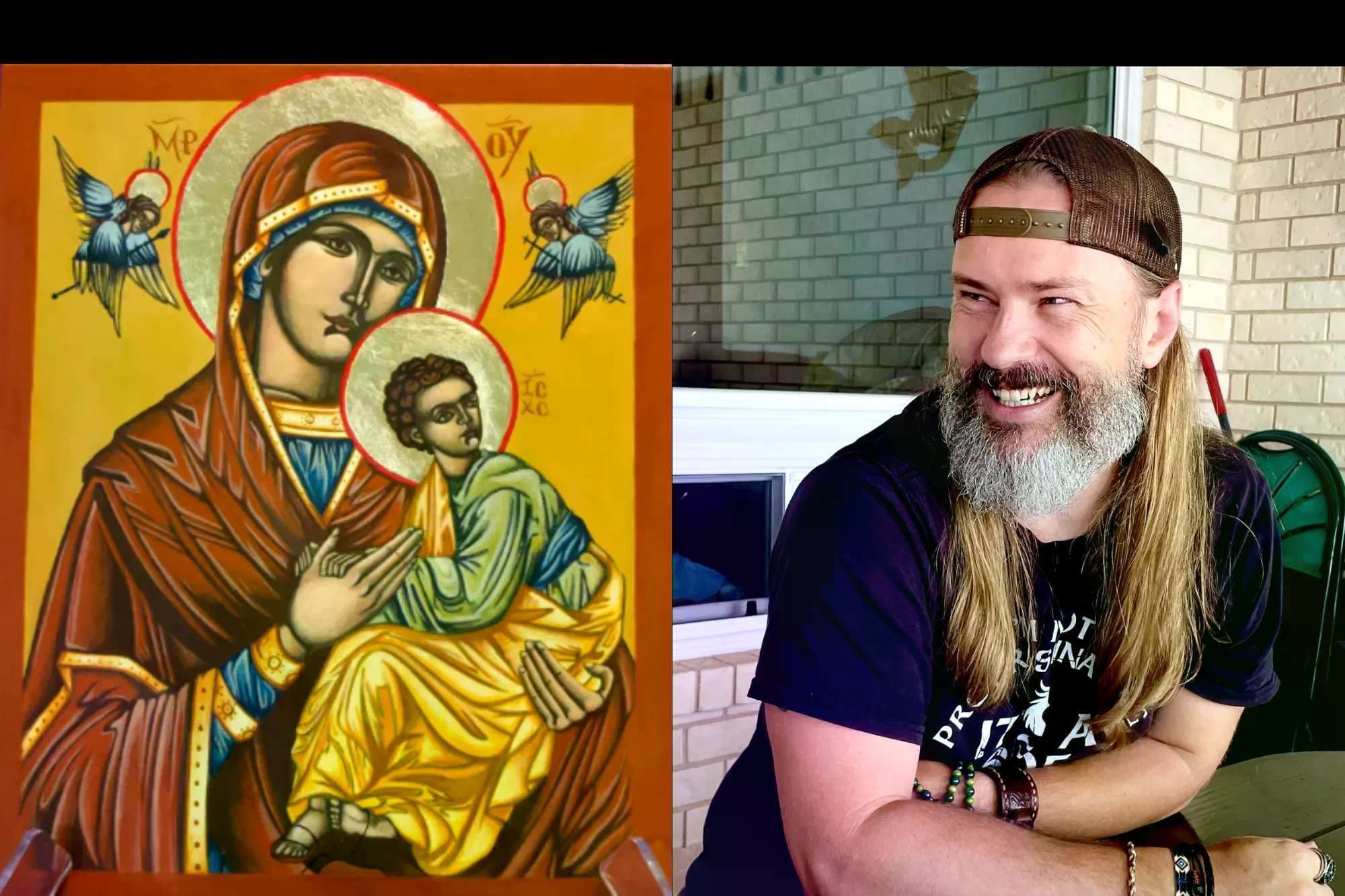
Most creative callings don’t arrive at convenient moments. For Garrett Hines, the rediscovery of his artistic calling as an iconographer came alongside the responsibilities of marriage, fatherhood, and a full-time teaching career in Texas. Hines learned to build a life that integrates his vocation as father and husband with his creative capacity. In an exclusive interview with Zeale News, he talked about how God calls each person to a unique path.
A gift rediscovered
Hines’ road to becoming a professional iconographer was long and had several detours. His artistic ability showed itself early – when he was a child, his work on a classroom project caught the attention of his teachers, who recommended he be tested for gifted programs in the arts. He stopped drawing in his teenage years, but at the end of college, when he needed to figure out his career path, he decided to go into teaching art.
“I'm not good at math. I'm not good at reading,” he said in a Feb. 5 phone call with Zeale News. “I'm not good at any of this stuff. But I can draw.” He passed the exams to become an art teacher and began teaching in 2008. That new beginning rekindled his own creative endeavors.
Later on, when Hines found out his wife was expecting, he decided to hone in on his talent as an artist so that he could better provide for his family.
“I thought, ‘I’m going to have to really up my game,’” he said.
He dove deep into watercolors and created a portfolio of children’s illustrations. When a publisher sent him some critiques, he pivoted to other subjects for his art.
Art as a path of healing
Hines and his family spent a year as evangelical missionaries in Southeast Asia from 2017 to 2018, where he continued to draw and paint. Unfortunately, the experience was very difficult for the whole family, and it was hard to find a path forward when they returned to the U.S.
“We came back physically and spiritually just …broken,” he said. “And I remember sitting at a table in this little halfway house that we were staying at as we were transitioning back. And I sat down with God and I said, ‘God, I'm done.’”
Hines prayed about his disappointment – that he was no longer a missionary, that he had to return to teaching, and that he would need to begin painting again. But thankfully, he said, his reluctance to renew his creativity didn’t last long. He taught during the day and started painting at night.
Hines created a 12-part series of Western paintings, focusing on subjects inspired by his home state of Texas.
“That saved my creativity,” he said. “That whole journey of making that work was really interesting because different symbols and things would show up in my work and then they would leave. And it really showed kind of a growth of healing.”
Art as prayer
After their experience as evangelical missionaries, Hines and his family eventually entered the Catholic Church in 2023. A priest recognized in Hines a gift for iconography, the ancient Christian tradition of sacred painting. Unlike ordinary religious art, Hines explained, icons are created intentionally for prayer.
“When an iconographer sits down to write an icon,” he said, “every line, every brushstroke, every color choice matters. Every act of the hand is designed to communicate the truth of God.”
Hines said he incorporates prayer into every stage of creating an icon and incorporates the prayer intentions of the patron who commissioned the work.
One of the important aspects of iconography, Hines said, is that the subject is always facing the viewer.
“If you look at icons, every single icon is looking in your direction,” he said. “Even if they're not looking at you, they might be looking at Christ, they might be looking at the thing behind you, but their face is turned in your direction, and that's because communion requires face-to-face. And so even the way they turn the head is trying to communicate to you something about the truth of the Gospel.”
He added that, when looking at an icon, the viewer isn’t just looking at a piece of art, but “looking through a window into the kingdom of heaven to experience the reality of the kingdom.”
Art as a calling
Now, Hines is a high school art teacher, and he works on iconography in the evenings. He feels a great sense of fulfillment from his work as an iconographer, and knows that it is a calling from God. But, he said, he wouldn’t have been ready to answer this call if he hadn’t worked in the dark for 12 years.
“There's an echo of the voice of God within each person,” he said. That voice pushes them toward God’s plan for their life. Each man or woman is responsible for responding to the echo.
“Our responsibility is to be diligent, to cultivate the skill, the talent, the creativity that He's given us,” Hines said, “so that when the moment comes that He's prepared in advance for you, you're ready.”
“And I think more than anything else, that's what I've learned,” he continued. “I've spent the last 12 years for what I think is going to be a moment that allows me to finally live out my passion aside from my nine-to-five job. But if I hadn't spent the last 12 years working – sometimes late into the night, sometimes early in the morning – and working a full-time job and raising a family, I wouldn't be ready to, and I would have missed the opportunity.”
He encouraged young men and women to trust in God’s timing for their lives. And in the meantime, to work diligently.
"It's cultivating the skill in the dark,” he said, “trusting that in time God brings it to the light."





Comments