EXCLUSIVE: Inside the Fulton Sheen beatification announcement with Msgr. Jason Gray
For Monsignor Jason Gray, the beatification of Venerable Archbishop Fulton John Sheen was never a question of if, only when.

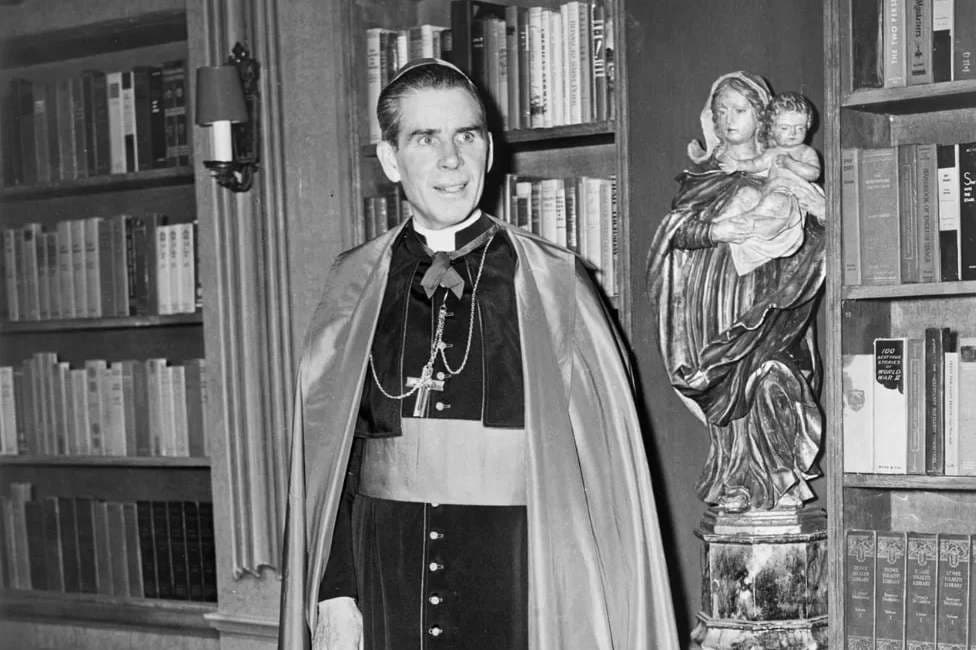
For Monsignor Jason Gray, the beatification of Venerable Archbishop Fulton John Sheen was never a question of if, only when.
Msgr. Gray, executive director of the Archbishop Fulton John Sheen Foundation, personally investigated the miracle attributed to Sheen’s intercession — the survival of a child born in 2010 without a heartbeat or respiration. Having studied both the facts of the miracle and Sheen’s life in depth, Msgr. Gray said the Church’s decision felt inevitable.
“I know the details of that miracle in and out,” he told Zeale News in a Feb. 9 interview hours after his beatification was announced. “And so, having known Sheen's life, and having known this miracle, there's really never been any doubt in my mind or in my heart, personally, that Sheen was going to be beatified.”
“I just knew it was going to happen. I just didn't know when,” he said.
A testament to humility
“Sheen was very educated and, as oftentimes happens with people who have all these sophisticated degrees, they kind of become kind of aloof,” Msgr. Gray said. “Well, Sheen was not that way.”
The unlikely unity Sheen maintained between elite scholarship and grassroots ministry is a balance Msgr. Gray called a testament to the archbishop’s humility.
That balance was struck from the earliest years of Sheen’s priesthood, when he was newly credentialed and prepared for an academic career.
“He had gotten all these degrees, and he’s ready to go teach in the university, and the bishop says, ‘Nope, come home,’” Msgr. Gray said. “And he does.”
Assigned to a working-class parish on the south side of Peoria, Sheen embraced the ordinary demands of parish life, including visiting families door to door.
“He dedicates himself to just the ordinary work of the parish priest, which he does very successfully,” Msgr. Gray said. “And it wasn’t that he had to use some intellectual trick or something like that. What he did is he used his faith.”
Msgr. Gray said Sheen’s brilliance — undeniable and widely recognized — never created distance between him and the people he served.
“Sheen’s intellect didn’t get in the way,” he said. “There was no doubt that he was brilliant. But he also really understood the common man.”
A preacher with the Bible — and the newspaper
That same attentiveness to people’s lived experience shaped Sheen’s preaching, which reached millions through radio and television but never lost its grounding in contemporary life. Msgr. Gray described Sheen as someone who instinctively bridged sacred texts and secular realities.
“Sometimes a good preacher keeps the Bible in one hand, and the local paper in another hand,” he said. “I think if Sheen didn’t actually say that, he certainly lived that way.”
Sheen’s famed television program “Life Is Worth Living” often began with reflections on philosophy, science, politics, or literature before turning toward spiritual insight. Msgr. Gray noted Sheen’s ease in quoting Russian authors, engaging modern science, and analyzing global political movements — not as abstractions, but as pathways into the Gospel.
“There’s something incarnational about the fact that, you know, Jesus came to live among us in this world,” Msgr. Gray said. “And so sometimes, by means of worldly things, Sheen could then draw people, you know, back into Jesus Christ.”
Recognized by the Church and by the faithful
Beatification marks the Church’s formal recognition of Sheen’s holiness and permits public devotion in his name.
Msgr. Gray emphasized that while beatification is a major milestone, canonization remains the ultimate goal.
“This is really a tremendous step in the process,” he said, “but ultimately, the final step is the most important, and that’s canonization.” Sheen’s canonization as a saint will require one more verified miracle.
Still, he noted that the timeline has moved relatively quickly by historical standards.
“A lot of times, causes for the servants of God can take decades or even centuries,” Msgr. Gray said. “In this case, this cause was opened in 2002, so we’re only talking about 24 years, which is actually relatively fast in terms of Church history.”
Msgr. Gray, who was present when the cause was opened in 2002 under Bishop Daniel Jenky, said it has been deeply fulfilling to be a witness to the process over the years and to see it reach beatification.
Waiting brought deepened devotion
Sheen’s cause was not without delays, but Msgr. Gray said the pauses ultimately strengthened, rather than weakened, devotion to Sheen.
“What happens when an obstacle is encountered, and what do people do? They give up,” he said. “This did not happen in Sheen’s case.”
Instead, Gray observed, popular devotion intensified during the waiting years.
“If anything, it actually caused people to be increasingly devoted to him,” he said. “The pause has only made the cause stronger.”
Following Sheen’s example
For those newly encountering Sheen in the wake of his beatification, Msgr. Gray pointed to the habits that shaped Sheen’s interior life rather than to any single devotion or program.
Msgr. Gray encouraged readers to return first to Sheen’s own voice — through his books, lectures, and broadcasts — as a way of entering the spiritual world that sustained his preaching.
More fundamentally, he said, Sheen’s life was anchored in prayer, particularly in his daily commitment to Eucharistic adoration.
“Sheen was such a man of prayer, because he was committed to the daily Eucharistic Holy Hour,” Msgr. Gray said. “Pray in front of the Blessed Sacrament. That actually is probably the most important thing that you can do.”
Looking ahead
Details surrounding the beatification — including dates and plans for public celebrations — have not been announced yet. In the meantime, official updates and information related to the cause will be made available at celebratesheen.com, the foundation’s central hub where readers can also learn what is required for his canonization.
When asked how long it might take to replace “Venerable” with “Blessed” across Sheen’s books, materials, and memorials, Msgr. Gray laughed, noting that the change will happen quickly.
Msgr. Gray added that the tomb already bears a personal detail Sheen requested during his lifetime. In his autobiography, Treasure in Clay, Sheen wrote that he hoped “JMJ,” for Jesus, Mary, and Joseph, would be inscribed on his tomb.Written in script by Sheen on the chalkboard for his television show, the initials became familiar to viewers at the time and to his many followers in the years since it aired. His wish was honored when his remains were returned to Peoria.
“We actually did so,” Msgr. Gray said. “We actually have inscribed his request, the JMJ, over, over, his title, and then we look forward to adding the word blessed.”


Comments