Bishop Barron: Christian charity offers the antidote to ‘suicidal empathy’
The popular bishop reviewed Gad Saad’s new book Suicidal Empathy: Dying to Be Kind, agreeing that empathy not governed by reason and virtue could be the end of the Christian West and encouraging virtue as the solution to the problem.
.jpg&w=3840&q=75)
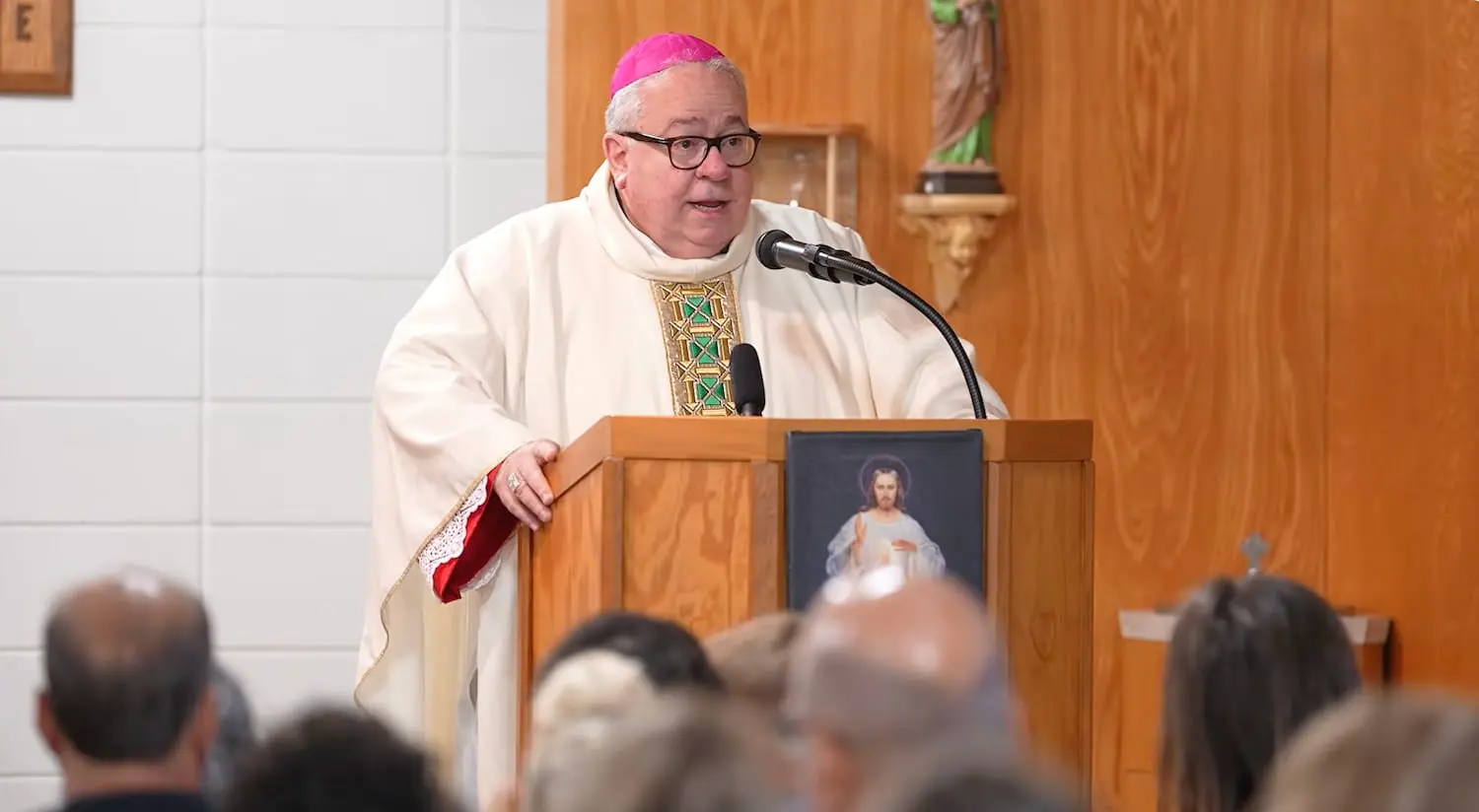
Bishop Robert Barron of the Diocese of Winona-Rochester warned in an Aug. 31 video that empathy unmoored from Christian virtue will likely undermine and even destroy the Western world.
The bishop and Word on Fire founder analyzed evolutionary psychologist Gad Saad’s latest book, Suicidal Empathy: Dying to Be Kind, agreeing with Saad that a distorted form of empathy is undermining the Western moral order. Bishop Barron argued that the Catholic answer is not less compassion but a recovery of charity as St. Thomas Aquinas defined it: willing the good of the other.
In his book, Saad argues that the West has twisted a natural and otherwise noble capacity to feel another person’s suffering into “maladaptively irrational altruism.” Society is told, for example, to prioritize criminals over victims, illegal aliens over citizens, racial identity over competence, adult sexual expression over childhood innocence, and men identifying as women over biological women. The endgame, Saad said, is civilizational self-destruction.
“Suicidal empathy is a deadly contagion of one of humanity’s most noble virtues,” He wrote.
Bishop Barron agreed, saying that if the disordered form of empathy is “not properly contained, it will destroy the West” because it dethrones the goods that actually hold a civilization together: truth, justice, and charity.
However, the bishop drew a distinction between empathy and the Christian virtue of charity or love. Empathy, he said, means to “feel into” another person’s experience and, in practice, to spare that person’s feelings, which he said is a mark of decency.
“I’d rather be empathetic than not,” Bishop Barron said.
The problem begins when empathy is treated as the supreme moral category, he warned. Love, however, is distinct from empathy.
“To love is not to have positive feelings about someone. It’s not to empathize with someone,” Bishop Barron said. “To love is to will the good of the other.”
He praised “the austerity of that language.” While empathy can accompany love, he said, love is not a feeling or mood but an act of the will. Authentic love, Bishop Barron observed, sometimes requires hurting the feelings of the beloved.
A professor who gives a student an honest “C” grade, for example, may wound the student’s pride, but he is telling the truth and urging improvement, “an act of justice and love.” A parent who reprimands a child may make the child feel bad, but it is for the sake of correcting a more damaging behavior or protecting the child. A priest who tells a murderer in confession to turn himself in to the police makes the man’s life more uncomfortable but ultimately wills his good. Refusing an unqualified trombone player a seat in the Chicago Symphony is not cruelty, Bishop Barron said. It is truthfulness.
The bishop noted that Christ did not instruct His Apostles to “have empathy for one another,” nor did St. John the Evangelist write, “God is empathy.”
“I challenge you to read the Bible and tell me that God is empathy,” Bishop Barron said. “The right formulation is God is love.”
God wills the good of His creation, “which means, man alive, there’ll be a lot of hurt feelings,” he continued.
Bishop Barron also drew a distinction between love and “niceness.” Citing Russian novelist Fyodor Dostoevsky’s line that love is “a harsh and dreadful thing,” Bishop Barron said kindness is good in its place, but “being nice is never harsh and dreadful, and real love is.” Compassion — from the Latin cum passio, meaning to suffer with — is likewise good in itself, he said, and still not the same as charity.
According to Barron, much of the confusion of terms — empathy, love, and niceness — can be traced to the universities, through postmodernism, the Frankfurt School, and the oppressor-oppressed binary promoted by critical theory. Woke ideology, he said, moralizes intensely while denying stable objective values, then installs “empathy” for those labeled marginalized as the center of the moral life. Truth, meaning, and justice are pushed to the margin “in the name of empathy.”
While Bishop Barron hypothesized that many adherents of woke ideology “mean well,” he also warned that confusing empathy with love may make woke ideology resemble “an aberrant form of Christianity,” borrowing biblical language after Christianity itself has receded as a cultural force. A church sign that reads “love thy neighbor” and then lists favored identity categories, Barron suggested, often means “be nice” rather than “will the other’s real good.”
Empathy and feelings cannot be a moral guide in life, Bishop Barron said.
He cited Plato’s analogy of the charioteer, in which the driver of a chariot represents reason, while one of the two horses represents noble desires and the other represents base appetites. Bishop Barron said that the emotional life is “fallen and energetic,” so that reason, ordered to truth, justice, and love, must drive. When feelings become normative, forbidden truths are suppressed and policy follows the path of least emotional resistance. Empathy may be a good horse, he said, but it is a disastrous charioteer.









Comments