Bishop Barron praises Ivy League college president’s op-ed on reforming university education
Dartmouth College President Sian Beilock’s Jan. 25 op-ed in The Wall Street Journal about why universities have lost the trust of the American public — and five ways to build that trust back — has earned praise from Bishop Robert Barron of Winona-Rochester, Minnesota.

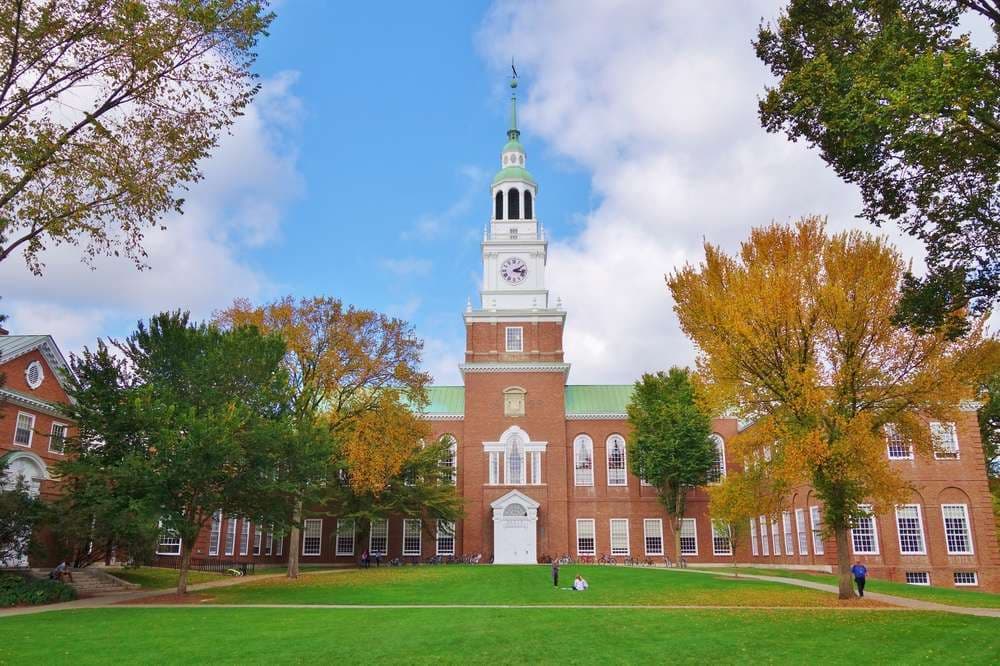
Dartmouth College President Sian Beilock’s Jan. 25 op-ed in The Wall Street Journal about why universities have lost the trust of the American public — and five ways to build that trust back — has earned praise from Bishop Robert Barron of Winona-Rochester, Minnesota.
“American higher education has a trust problem” that can’t be ignored or expected to disappear on its own, wrote Beilock, who began leading the Hanover, New Hampshire, Ivy League school in 2023.
She noted that families are increasingly wondering whether an undergraduate degree is worthwhile, as graduates struggle to get jobs in a shifting market and many campuses are restricted by ideology that doesn’t allow for students’ differing opinions or exchange of ideas.
Colleges and universities across America need to actively work to restore trust, Beilock wrote, adding that as president of Dartmouth she is committed to this effort.
Bishop Barron wrote in a Jan. 26 X post that in Beilock’s article, “She acknowledges what many of us have been saying for some time, namely, that our university system has become corrupt, and she proposes commonsense solutions.”
Beilock’s first recommendation is to make it affordable to get a degree from a university, the bishop explained.
“Tuition and costs have become just ridiculous, especially at schools that boast massive endowments,” he continued.
The second is that higher education institutions need to guarantee that the return on investment is worth it, implementing more ways to ensure that a college graduate can get a job, according to Bishop Barron.
The third – which Bishop Barron said he believes is the most important point – is to “re-center education on learning rather than political posturing,” as Beilock put it.
Beilock wrote that higher education institutions have “too often" taken part in “the culture wars.”
“The result is an environment in which students and faculty feel they must toe an ideological line rather than explore ideas that fall outside prevailing norms,” she wrote. “Our institutions must reclaim a narrower, firmer sense of our role. That means embracing institutional neutrality — or restraint, as we call it at Dartmouth — on issues that don’t directly affect our mission or core functions.”
She warned that institutions’ rushing to issue a statement on every national or global controversy signals that “there’s a ‘right’ position and that opposing views are unwelcome.”
Colleges need to allow students to exchange ideas and arguments, review evidence, and decide for themselves, Beilock wrote. Universities need to offer “clear protections for faculty, staff and students who voice unpopular views,” she later added, explaining that holistic debate “is the precondition for any serious education.”
Bishop Barron said that Beilock’s fourth point – that colleges must “emphasize equal opportunity, not equal outcomes” – was “music to my ears.”
Equal opportunity “is a basic American principle,” and equal outcomes “is dangerous Woke nonsense," he remarked.
In her piece, Beilock also noted that grade inflation is watering down the value of a transcript, as employers and students notice when a default “A” grade communicates meeting the bare minimum, not a level of excellence.
“We must be willing to reintroduce differentiation,” she wrote.
She explained a number of policy options to accomplish this, such as forced medians or more transparency about why a certain grade is given.
“At the same time, we must defend a genuine meritocracy of ideas,” she added. “Research funding, faculty hiring and academic recognition should be grounded in scholarly excellence, not ideological litmus tests.”
Bishop Barron said he was encouraged to read these points presented by the president of an Ivy League university.
“Sign of hope,” he concluded.


Comments