Bishop Barron warns against ‘explicit Marxism’ among US political leaders in op-ed
In a Feb. 22 opinion piece published by FOX News, Bishop Robert Barron of the Diocese of Winona-Rochester, Minnesota, praised Secretary of State Marco Rubio’s recent speech in Munich, Germany, while warning of the rise of “explicit Marxism” among “certain leaders on the Left in America” who criticized the address.

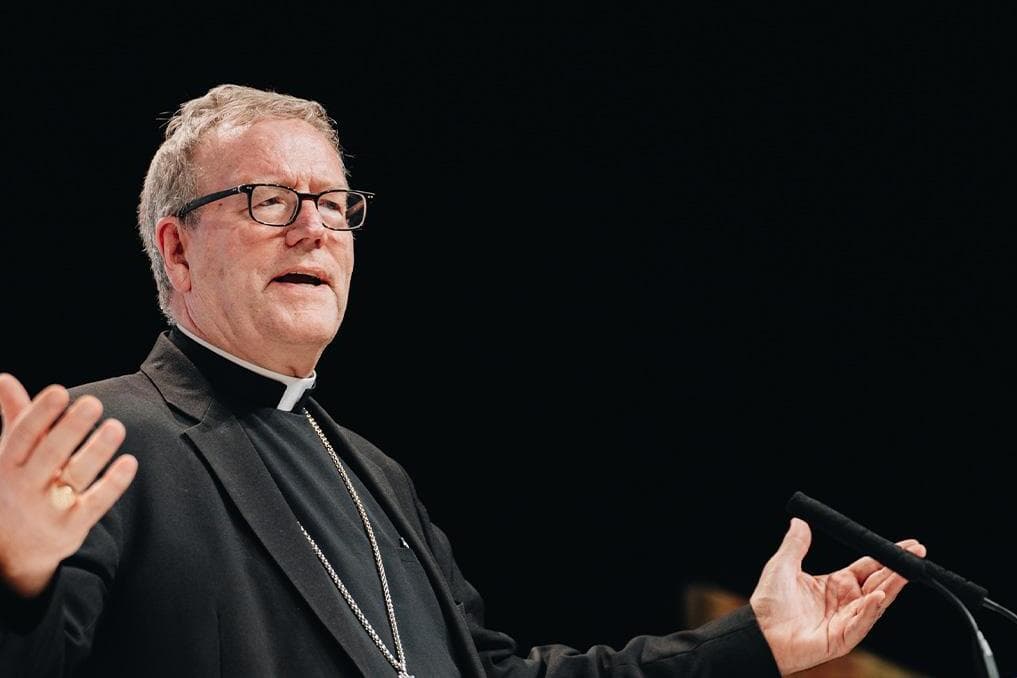
In a Feb. 22 opinion piece published by FOX News, Bishop Robert Barron of the Diocese of Winona-Rochester, Minnesota, praised Secretary of State Marco Rubio’s recent speech in Munich, Germany, while warning of the rise of “explicit Marxism” among “certain leaders on the Left in America” who criticized the address. Bishop Barron pointed specifically to Rep. Alexandria Ocasio-Cortez, D-N.Y., and New York Mayor Zohran Mamdani, a self-identified democratic socialist.
Bishop Barron had voiced similar concerns in a Feb. 16 video, as Zeale News previously reported. In the op-ed, he expanded on his argument, contrasting Rubio’s focus on the shared religious foundations of Western civilizations with Marxist ideas plaguing contemporary political rhetoric.
During his speech, Rubio “lyrically invoked Dante, the Cologne Cathedral, Shakespeare, the democratic form of government, the university system — even the Beatles and the Rolling Stones” as symbols of a common Western vision, Bishop Barron wrote.
He added that what most struck him was Rubio’s assertion that culture “is tightly linked to cult, that is to say, to religion.” This principle, Bishop Barron said, is consistent with the thought of Pope Benedict XVI and church historian Christopher Dawson.
“In a word, all the things that we value stand in relation to that which we value most highly,” Bishop Barron wrote. “And therefore, Secretary Rubio was not afraid to identify the Judeo-Christian faith as the deepest and most abiding source of what is best in Western culture.”
While noting the speech’s warm reception in some quarters, Bishop Barron pointed out that “not everyone was happy,” citing criticism from Ocasio-Cortez. Zeale News previously reported Ocasio-Cortez described Rubio’s appeal to Western culture as “thin” and argued that greater attention should be paid to material conditions and class struggles.
It is “simply breathtaking to maintain that the culture that produced the university system, affirmed the rights and prerogatives of the individual, and gave rise to democratic rule of law is ‘thin,’” Bishop Barron responded.
He argued that Ocasio-Cortez’s framework “unnervingly” reflects a Marxist understanding of religion and culture as “epiphenomenal superstructural features” designed entirely to “protect the economic substructure.”
The bishop said he is increasingly concerned about what he sees as open advocacy of Marxist ideas “in the rhetoric and practice of certain leaders on the Left in America.” He cited Mamdani’s inaugural pledge to “replace the frigidity of rugged individualism with the warmth of collectivism” and said that one of the mayor’s top aides is insisting that people “get accustomed to the idea that government can and should confiscate private property and seize the means of production.”
“Again, the Marxism is not implied or subtle; it is right out in the open, unapologetically on display,” Bishop Barron wrote. “And this should alarm every American. I might strongly encourage the followers of Mamdani and AOC [Ocasio-Cortez] to speak to those who fled the Marxist tyrannies of Russia and Eastern Europe or those today who labor under Communist oppression in North Korea, Cuba, Venezuela, or China.”
In the final section of his piece, Bishop Barron emphasized that his opposition to such ideas is rooted not only in civic concern but also in his role as a Catholic bishop.
“Marx said that the first critique is the critique of religion,” Bishop Barron wrote. “He meant that before we even get to an assessment of a capitalist political economy, and certainly before we engage in revolutionary praxis, we must throw off religion, which functions, as he famously put it, as ‘opium for the masses.’”
Marxist regimes have historically targeted religious institutions early in their rule, Bishop Barron wrote, citing leaders like Vladimir Lenin, Joseph Stalin, Mao Tse-Tung, Fidel Castro, and Pol Pot.
“Some might find the Marxism touted by certain radical politicians today trendy and refreshing, something to be bandied about at Upper East Side cocktail parties,” Bishop Barron concluded. “Given the historical record, I find it chilling.”



Comments